With daily losses of $170 million and the UAE cutting off supplies, how long can Iran's oil exports sustain themselves?
2026-08-21 09:31:00
On Friday (August 21) during Asian trading hours, Brent crude futures fluctuated higher, currently trading around $93.50 per barrel, slightly below the three-week high of $94.68 per barrel reached overnight. Geopolitical risk premiums continue to accumulate, with Trump's latest sanctions threats injecting new upward momentum into oil prices. On Wednesday (August 19), US President Trump announced the "toughest economic action in history" against Iran, vowing to subject Iran to "unprecedented economic warfare and isolation," and threatening "huge economic consequences" for any country providing "any lifeline" to Iran. Tehran's official response was dismissive—Revolutionary Guard media refuted Trump's threats as "delusional." However, Trump's basic argument is essentially correct: what truly destroys the Iranian economy is not the sanctions list, but the actual blockade of Iranian ports by the US Navy and Iran's loss of the ability to convert oil into currency at all costs. More importantly, the US Navy is slowly but decisively gaining strategic advantage in the Strait of Hormuz, ignoring Iranian military obstruction. 
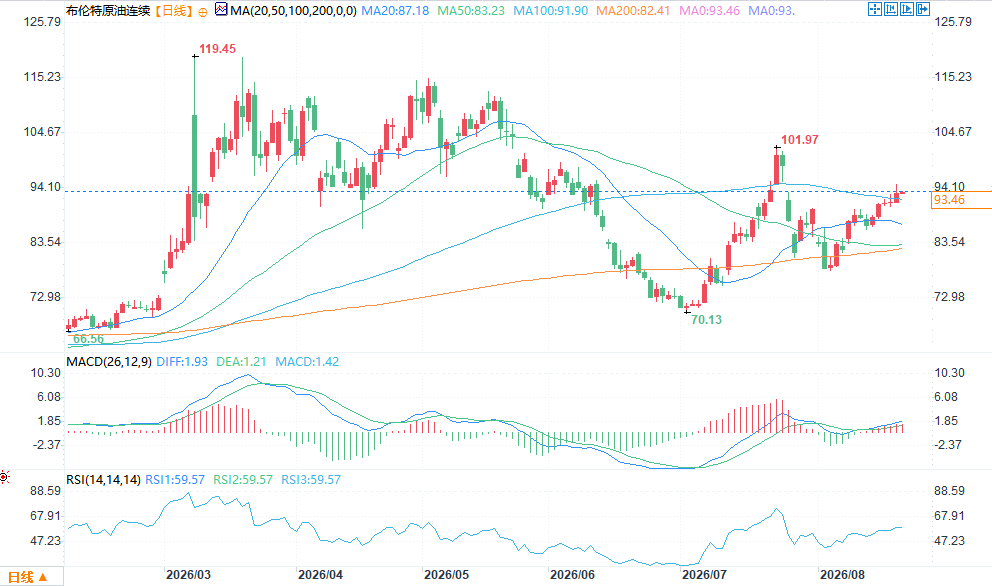 (Brent crude oil futures daily chart, source: EasyTrade) At 9:28 AM Beijing time on August 21, Brent crude oil futures were trading at $93.69 per barrel.
The effects of the lockdown: $170 million in losses per day
Before the war, Iran exported approximately 1.7 to 1.8 million barrels of crude oil daily, primarily to small, independent refineries in major Asian countries, at prices typically 10% to 15% lower than international benchmarks. This crucial export route was essentially severed after the US Navy imposed a naval blockade on April 13th. Based on current oil prices, this translates to a direct loss of approximately $170 million in oil revenue for Iran daily. The months-long blockade has created a deficit of billions of dollars, severely restricting government funding for importing basic goods, subsidizing the public, and maintaining fiscal operations. An even heavier blow came from the United Arab Emirates. On August 19th, the UAE announced the suspension of all trade and financial ties with Iran. Previously, the UAE supplied over 30% of Iran's imports, with an annual trade volume of approximately $21 billion; it also absorbed nearly 13% of Iran's exports, equivalent to about $7 billion. This disruption directly cut off Iran's vital access to food, machinery, and electronic products, and also blocked some transshipment routes for oil and petrochemical products. Iran was already facing a foreign exchange shortage due to sanctions and blockades. The UAE's supply disruption further pushed up domestic prices, exacerbating inflationary pressures and the risk of supply chain disruptions. In summary, the sharp decline in oil revenues and the suspension of trade with major partners have created a double shock, putting significant contractionary pressure on the Iranian economy in the short term. Foreign exchange reserves are being depleted rapidly, and both people's livelihoods and industrial operations are facing greater challenges.Control of Hormuz is being transferred.
For the past six months, it was widely believed that Iran controlled the Strait of Hormuz. However, the reality is that the US Navy has developed a sophisticated method—transporting large oil tankers in batches and guiding them under US protection through the Strait of Hormuz at night, bypassing the Iranian coastline and approaching the Omani coast. According to a report released on August 18 by a global data analytics company, in the past two weeks, over 80% of ships transiting the Persian Gulf used the Oman route—a UN-authorized southern shipping lane that Iran opposes and is unable to regulate—rather than the Iranian territorial waters. The head of the company's analysis team stated, "Iran has at least partially lost control of the strait." Arab monarchies in the Gulf region are also continuously improving their methods of bypassing the Strait of Hormuz. Saudi Aramco has resumed exporting oil via ship-to-ship transshipment near the UAE coast, and the UAE is accelerating the expansion of the Fujairah pipeline.Current situation: Iran has been weakened, but the United States is still far from victory.
The generally accepted figure among energy analysts is that 8 to 10 million barrels of oil are now passing through the Strait of Hormuz every night, roughly half the normal flow. This is insufficient to alleviate the long-term oil shortage, but it may be enough to prevent further sharp increases in oil prices. Moreover, every barrel of oil leaving the Gulf permanently diminishes the value of Iran's claim to control the waterway. However, the fact remains that global oil prices are still at least 20% higher than at the beginning of the war. Trump reinstated economic sanctions because he had no other choice—diplomatic negotiations had broken down, neither side had bothered to renegotiate the ceasefire agreement, US arms reserves were depleted, there had been no military strikes against Iranian territory since August 1, and the issue of funding to sustain the war remained controversial in Congress. Financial austerity measures against Iran will continue to intensify, but the Iranians are betting that the US will not remain in the region for the next few years—they believe that once the US Navy withdraws, Iran will regain control of the Strait of Hormuz. (Brent crude oil futures daily chart, source: EasyTrade) At 9:28 AM Beijing time on August 21, Brent crude oil futures were trading at $93.69 per barrel.- Risk Warning and Disclaimer
- The market involves risk, and trading may not be suitable for all investors. This article is for reference only and does not constitute personal investment advice, nor does it take into account certain users’ specific investment objectives, financial situation, or other needs. Any investment decisions made based on this information are at your own risk.