Gold retreats from three-month high: US Treasury buyback program and Iranian risks dominate market trading.
2026-08-25 21:49:01
On Tuesday (August 25), spot gold prices weakened slightly during the early US trading session, while spot silver saw a more significant decline. Influenced by a stronger dollar, gold briefly approached the $4,700 per ounce mark overnight, before some investors opted to take profits. Spot gold traded at $4,619.74 per ounce, down 0.68%; spot silver was at $67.737, down 1.74% on the day.  The current market is characterized by a complex interplay of bullish and bearish forces: on the one hand, economic growth data is weakening, while on the other hand, the Federal Reserve has yet to overcome inflation. July's non-farm payrolls decreased by 23,000; the US CPI fell to 3.4% year-on-year, and core CPI dropped to 2.5%. However, the minutes of the July Federal Open Market Committee (FOMC) meeting showed that three policymakers supported a 25 basis point rate hike, and several participating officials stated that further rate hikes could not be ruled out if inflation fails to cool. Market expectations for the Fed to begin an easing cycle have cooled, and traders are now focusing on Wednesday's PCE inflation data and Kevin Warsh's speech at the Jackson Hole Economic Symposium on Friday to confirm whether the current 3.50%-3.75% interest rate target range has sufficient tightening effect. The US Treasury's repurchase program for US Treasury bonds remains a core event affecting various assets. The Treasury plans to at least double the size of its liquidity support repurchase operations of 10-20 year and 20-30 year US Treasury bonds from September 9th to November 4th, increasing the size of each operation from $2 billion to at least $4 billion. The earlier decline in long-term US Treasury yields has subsided, with the 10-year yield hovering around 4.7% and the 30-year yield still above 5.2%. This situation is disrupting the global bond market, marginally supporting the US dollar while increasing the attractiveness of gold, which has become a tool for hedging against sovereign debt pressure, fiscal credibility risks, and potential currency devaluation risks. Ipek Ozkardashka, senior analyst at Banco Santander, said this morning, "Gold is still attracting buying interest against the backdrop of persistently high US long-term Treasury yields, a phenomenon that is very noteworthy." She believes that the influx of funds into gold is to hedge against uncertainty surrounding US fiscal planning, inflation risks, and volatility in risky assets due to high valuations and AI financing. She also mentioned that the global trend of institutions reducing their holdings of US Treasuries and allocating to gold is providing long-term support for gold, but also warns that gold is already overbought and there is still a risk of a correction. The impact of the Strait of Hormuz is currently only reflected in a risk premium and has not yet evolved into a substantial supply shock. Oil prices fell to a one-week low as traders judged that the latest US sanctions threats against Iran were unlikely to cause an impact similar to a military conflict in the short term. Brent crude was trading at $91.82 per barrel, and West Texas Intermediate (WTI) crude at $84.60 per barrel. However, risks have not disappeared: an oil tanker was rendered unable to navigate after being attacked by an unidentified flying object in northeastern Oman; only two commodity carriers passed through the Strait of Hormuz on Monday, and Iran has blacklisted 45 oil tankers, accusing them of violating navigation rules. Gold maintained safe-haven demand due to these geopolitical risks; while the decline in oil prices alleviated some of the short-term inflationary pressures on yields. US traders are focused on: the S&P Case-Shiller Home Price Index to be released at 9:00 AM ET; new home sales data, the Conference Board Consumer Confidence Index, and the Richmond Fed Manufacturing Index to be released at 10:00 AM ET. July PCE inflation, durable goods orders data, and the second-quarter GDP revision will be released on Wednesday. The core question in the precious metals market is whether weakening economic demand data can adequately offset inflation and fiscal risks, thereby suppressing yield increases. External market overview: WTI crude oil on the New York Mercantile Exchange fell to $82.22 per barrel; Brent crude oil was around $89.20 per barrel; the US dollar index maintained a slightly stronger trend. The benchmark 10-year US Treasury yield traded around 4.66%. Technical Analysis
 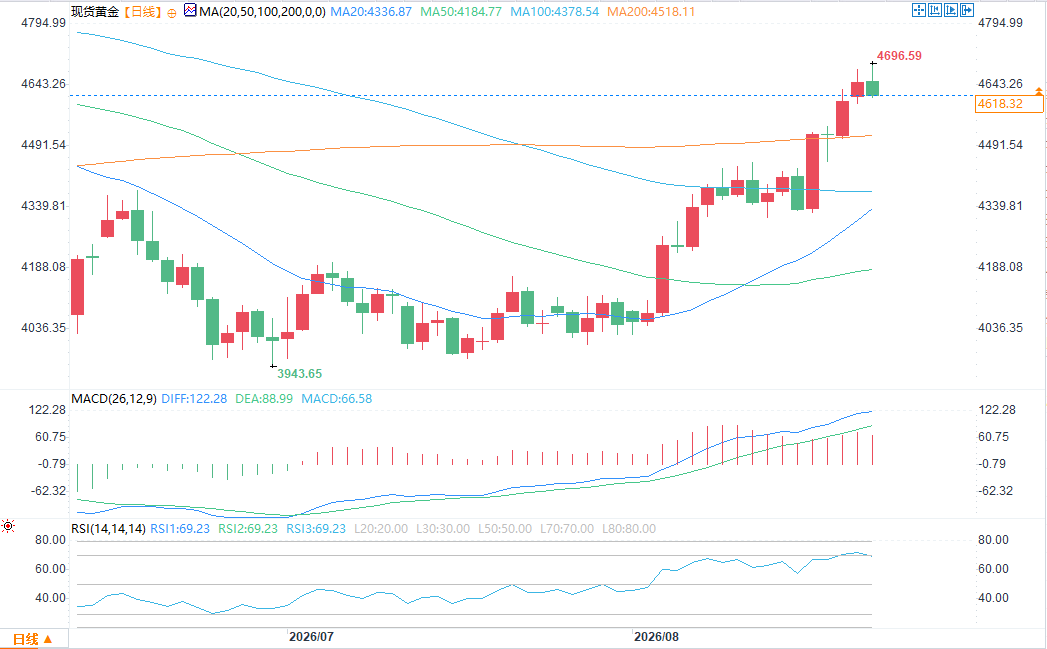 (Spot Gold Daily Chart Source: FX678) Spot gold bulls' next upside target: to push the price above the $4654-$4689 resistance zone; a successful breakout would target $4780, followed by a challenge of the April high near $4891. Bears' short-term downside target: a break below $4509; further downside targets are $4500, then $4410. Initial resistance levels: $4654, $4689; initial support levels: $4509, $4500. Spot silver bulls' next upside target: for the price to regain the $70.08-$72.00 range, a break above which would target $90.00. Bears' downside target: a break below $67.45; a deeper downside target is $66.48, then $60.00. The first resistance levels are $70.08 and $72.00; the first support levels are $67.45 and $66.48.
The current market is characterized by a complex interplay of bullish and bearish forces: on the one hand, economic growth data is weakening, while on the other hand, the Federal Reserve has yet to overcome inflation. July's non-farm payrolls decreased by 23,000; the US CPI fell to 3.4% year-on-year, and core CPI dropped to 2.5%. However, the minutes of the July Federal Open Market Committee (FOMC) meeting showed that three policymakers supported a 25 basis point rate hike, and several participating officials stated that further rate hikes could not be ruled out if inflation fails to cool. Market expectations for the Fed to begin an easing cycle have cooled, and traders are now focusing on Wednesday's PCE inflation data and Kevin Warsh's speech at the Jackson Hole Economic Symposium on Friday to confirm whether the current 3.50%-3.75% interest rate target range has sufficient tightening effect. The US Treasury's repurchase program for US Treasury bonds remains a core event affecting various assets. The Treasury plans to at least double the size of its liquidity support repurchase operations of 10-20 year and 20-30 year US Treasury bonds from September 9th to November 4th, increasing the size of each operation from $2 billion to at least $4 billion. The earlier decline in long-term US Treasury yields has subsided, with the 10-year yield hovering around 4.7% and the 30-year yield still above 5.2%. This situation is disrupting the global bond market, marginally supporting the US dollar while increasing the attractiveness of gold, which has become a tool for hedging against sovereign debt pressure, fiscal credibility risks, and potential currency devaluation risks. Ipek Ozkardashka, senior analyst at Banco Santander, said this morning, "Gold is still attracting buying interest against the backdrop of persistently high US long-term Treasury yields, a phenomenon that is very noteworthy." She believes that the influx of funds into gold is to hedge against uncertainty surrounding US fiscal planning, inflation risks, and volatility in risky assets due to high valuations and AI financing. She also mentioned that the global trend of institutions reducing their holdings of US Treasuries and allocating to gold is providing long-term support for gold, but also warns that gold is already overbought and there is still a risk of a correction. The impact of the Strait of Hormuz is currently only reflected in a risk premium and has not yet evolved into a substantial supply shock. Oil prices fell to a one-week low as traders judged that the latest US sanctions threats against Iran were unlikely to cause an impact similar to a military conflict in the short term. Brent crude was trading at $91.82 per barrel, and West Texas Intermediate (WTI) crude at $84.60 per barrel. However, risks have not disappeared: an oil tanker was rendered unable to navigate after being attacked by an unidentified flying object in northeastern Oman; only two commodity carriers passed through the Strait of Hormuz on Monday, and Iran has blacklisted 45 oil tankers, accusing them of violating navigation rules. Gold maintained safe-haven demand due to these geopolitical risks; while the decline in oil prices alleviated some of the short-term inflationary pressures on yields. US traders are focused on: the S&P Case-Shiller Home Price Index to be released at 9:00 AM ET; new home sales data, the Conference Board Consumer Confidence Index, and the Richmond Fed Manufacturing Index to be released at 10:00 AM ET. July PCE inflation, durable goods orders data, and the second-quarter GDP revision will be released on Wednesday. The core question in the precious metals market is whether weakening economic demand data can adequately offset inflation and fiscal risks, thereby suppressing yield increases. External market overview: WTI crude oil on the New York Mercantile Exchange fell to $82.22 per barrel; Brent crude oil was around $89.20 per barrel; the US dollar index maintained a slightly stronger trend. The benchmark 10-year US Treasury yield traded around 4.66%. Technical Analysis (Spot Gold Daily Chart Source: FX678) Spot gold bulls' next upside target: to push the price above the $4654-$4689 resistance zone; a successful breakout would target $4780, followed by a challenge of the April high near $4891. Bears' short-term downside target: a break below $4509; further downside targets are $4500, then $4410. Initial resistance levels: $4654, $4689; initial support levels: $4509, $4500. Spot silver bulls' next upside target: for the price to regain the $70.08-$72.00 range, a break above which would target $90.00. Bears' downside target: a break below $67.45; a deeper downside target is $66.48, then $60.00. The first resistance levels are $70.08 and $72.00; the first support levels are $67.45 and $66.48.
- Risk Warning and Disclaimer
- The market involves risk, and trading may not be suitable for all investors. This article is for reference only and does not constitute personal investment advice, nor does it take into account certain users’ specific investment objectives, financial situation, or other needs. Any investment decisions made based on this information are at your own risk.