A chart: The Baltic Dry Index rose to a two-week high, boosted by gains in shipping stocks.
2026-08-25 23:03:01
Latest data shows that the Baltic Dry Index (BDI) reached 2926 points on August 25, 2026, a new high since August 12, 2026, up 1.53% month-on-month, the largest increase since August 21, 2026, and the fourth consecutive day of increase (including zero growth). Looking at the short-term charts, the recent 11 BDI data points show: 6 positive increases, 5 negative increases, and 0 zero increases. Specifically, the Panamax Freight Index (BPI) reached 2166 points, up 1.64% from the previous value; the Capesize Freight Index (BCI) reached 4735 points, up 1.98%; and the Supramax Freight Index (BSI) reached 1643 points, up 0.12%. For detailed 720-day and 10-year trend charts of the Baltic Dry Index and its three sub-indices, please refer to the charts specially prepared by FX678. 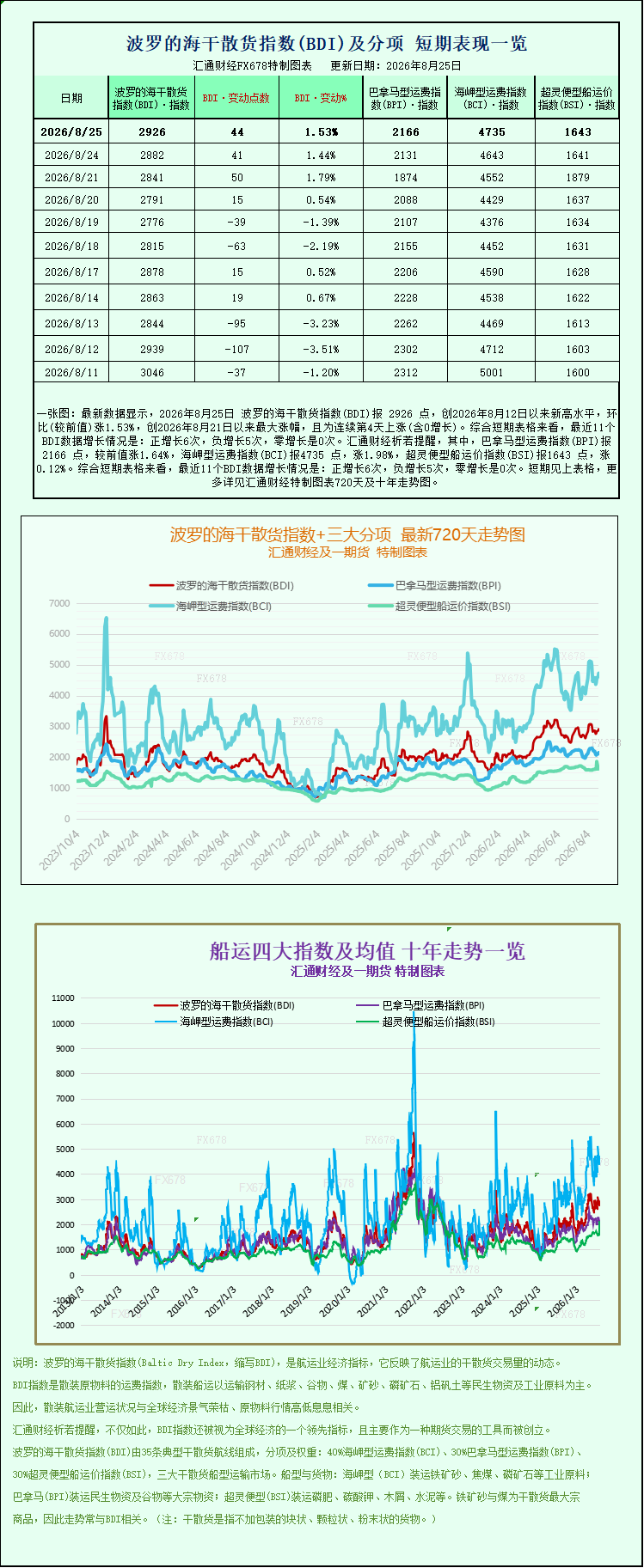 On Tuesday, the international shipping market saw a broad-based price increase, with the Baltic Dry Index (BDI) continuing its upward trend and climbing to its highest level in nearly two weeks. This index rise was comprehensive, with freight rates for the three major vessel types—Capesize, Panamax, and Supramax—all increasing simultaneously. Coupled with a boost in global shipping stocks, this reflects a continued recovery in the dry bulk shipping industry and sends a positive signal of a rebound in global commodity seaborne trade. Data shows that the Baltic Dry Index, which tracks freight rates for all types of dry bulk vessels, rose 44 points, or 1.5%, to close at 2926 points, a new high since August 12th. As a core indicator of the global dry bulk shipping market, this index comprehensively reflects the ocean shipping costs of bulk commodities such as iron ore, coal, and grain. Its continued rebound not only reflects a marginal improvement in the supply-demand relationship in the shipping market but also resonates positively with the strong rise in the shipping sector in the A-share and Hong Kong stock markets, indicating a continued rise in capital market expectations for the shipping industry's recovery. Looking at specific vessel types, Capesize vessels, with the largest tonnage and the highest proportion of long-haul transportation, have become the core driver of this index increase. The index representing Capesize freight rates rose sharply by 92 points, a 2% increase, closing at 4735 points, a new high since August 11. In terms of profitability, Capesize vessels mainly engaged in the transportation of 150,000-ton bulk raw materials, primarily carrying industrially essential raw materials such as iron ore, thermal coal, and metallurgical coal, saw their average daily revenue increase by $840 to $39,442, with per-vessel profitability continuing to rise. Market analysis indicates that the strong rebound in Capesize freight rates is mainly due to the concentrated release of short-term ocean freight and regional capacity mismatch. Recently, major iron ore exporting countries such as Brazil and Australia have accelerated their shipment pace, coupled with increased restocking demand from the Asia-Pacific steel industry, resulting in a significant increase in cargo volume on trans-Pacific and trans-Atlantic long-haul routes. At the same time, fluctuations in loading and unloading efficiency at some key ports and longer vessel turnaround times have led to a tight supply of effective shipping capacity, further pushing up the premium for large bulk carriers. It is worth noting that iron ore futures prices fell slightly on the day, diverging from ocean freight rates. The core reason is that the continued rise in coking coal prices has triggered market concerns about compressed steel company profits, offsetting the positive expectations of steel mills stockpiling before the Chinese National Day holiday, putting pressure on iron ore futures, but not affecting the recovery trend of physical ocean shipping demand. The medium-sized vessel market also continued its steady upward trend, with Panamax freight rates achieving three consecutive increases. Data shows that the Panamax index rose 35 points, or 2%, to 2166 points, marking its third consecutive day of gains and showing a steady upward trend. This vessel type primarily transports 60,000 to 70,000 tons of commodities such as thermal coal, grain, and fertilizer, suitable for inter-regional and mid-range ocean routes. Its average daily revenue increased by $318 to $19,496. This round of price increases is mainly supported by the peak season for global grain trade, with the harvesting and export of grain in the Gulf of America and the Black Sea region entering its peak period. This, coupled with stable demand for energy imports from Southeast Asia and the Middle East, continues to drive demand for medium-sized bulk carriers. The small vessel market maintained steady growth with relatively mild fluctuations. The Supramax index rose slightly by 2 points, or 0.1%, to 1643 points. Compared to the significant increases in large and medium-sized vessels, the price increases for small vessels were limited, mainly due to their shorter routes, faster turnaround times, relatively ample market capacity, and lower price elasticity. The overall trend was one of steady recovery, complementing the overall market pattern of widespread price increases across all vessel types. Looking at recent industry trends, the dry bulk shipping market has shown an overall recovery since 2026. The average BDI index in the first half of the year more than doubled compared to the same period in 2025, indicating a continued rebound in industry activity. Entering August, the market continued its off-season recovery, with freight rates fluctuating upwards, supported by strong sentiment in the shipping sector's capital markets. The current widespread increase in freight rates across all ship types confirms the steady recovery in global demand for industrial raw materials and agricultural products. Simultaneously, the slowdown in the pace of new global shipping capacity deployment has further optimized the supply and demand structure of the shipping market. Industry analysts indicate that in the short term, with the approach of China's National Day holiday, domestic steel mills and traders are expected to accelerate their stockpiling, coupled with the continued peak season for global grain exports, ensuring that dry bulk shipping demand remains rigid, and freight rates are likely to maintain a high level of fluctuation. However, key variables such as commodity price fluctuations, the strength of the global manufacturing recovery, and port capacity turnover efficiency still need to be monitored, as these factors may affect the sustainability of this shipping rally. Overall, the fundamentals of the shipping market continue to improve, with both the shipbuilding sector and the shipping index showing positive growth, and the path to profit recovery for the industry has gradually opened.
On Tuesday, the international shipping market saw a broad-based price increase, with the Baltic Dry Index (BDI) continuing its upward trend and climbing to its highest level in nearly two weeks. This index rise was comprehensive, with freight rates for the three major vessel types—Capesize, Panamax, and Supramax—all increasing simultaneously. Coupled with a boost in global shipping stocks, this reflects a continued recovery in the dry bulk shipping industry and sends a positive signal of a rebound in global commodity seaborne trade. Data shows that the Baltic Dry Index, which tracks freight rates for all types of dry bulk vessels, rose 44 points, or 1.5%, to close at 2926 points, a new high since August 12th. As a core indicator of the global dry bulk shipping market, this index comprehensively reflects the ocean shipping costs of bulk commodities such as iron ore, coal, and grain. Its continued rebound not only reflects a marginal improvement in the supply-demand relationship in the shipping market but also resonates positively with the strong rise in the shipping sector in the A-share and Hong Kong stock markets, indicating a continued rise in capital market expectations for the shipping industry's recovery. Looking at specific vessel types, Capesize vessels, with the largest tonnage and the highest proportion of long-haul transportation, have become the core driver of this index increase. The index representing Capesize freight rates rose sharply by 92 points, a 2% increase, closing at 4735 points, a new high since August 11. In terms of profitability, Capesize vessels mainly engaged in the transportation of 150,000-ton bulk raw materials, primarily carrying industrially essential raw materials such as iron ore, thermal coal, and metallurgical coal, saw their average daily revenue increase by $840 to $39,442, with per-vessel profitability continuing to rise. Market analysis indicates that the strong rebound in Capesize freight rates is mainly due to the concentrated release of short-term ocean freight and regional capacity mismatch. Recently, major iron ore exporting countries such as Brazil and Australia have accelerated their shipment pace, coupled with increased restocking demand from the Asia-Pacific steel industry, resulting in a significant increase in cargo volume on trans-Pacific and trans-Atlantic long-haul routes. At the same time, fluctuations in loading and unloading efficiency at some key ports and longer vessel turnaround times have led to a tight supply of effective shipping capacity, further pushing up the premium for large bulk carriers. It is worth noting that iron ore futures prices fell slightly on the day, diverging from ocean freight rates. The core reason is that the continued rise in coking coal prices has triggered market concerns about compressed steel company profits, offsetting the positive expectations of steel mills stockpiling before the Chinese National Day holiday, putting pressure on iron ore futures, but not affecting the recovery trend of physical ocean shipping demand. The medium-sized vessel market also continued its steady upward trend, with Panamax freight rates achieving three consecutive increases. Data shows that the Panamax index rose 35 points, or 2%, to 2166 points, marking its third consecutive day of gains and showing a steady upward trend. This vessel type primarily transports 60,000 to 70,000 tons of commodities such as thermal coal, grain, and fertilizer, suitable for inter-regional and mid-range ocean routes. Its average daily revenue increased by $318 to $19,496. This round of price increases is mainly supported by the peak season for global grain trade, with the harvesting and export of grain in the Gulf of America and the Black Sea region entering its peak period. This, coupled with stable demand for energy imports from Southeast Asia and the Middle East, continues to drive demand for medium-sized bulk carriers. The small vessel market maintained steady growth with relatively mild fluctuations. The Supramax index rose slightly by 2 points, or 0.1%, to 1643 points. Compared to the significant increases in large and medium-sized vessels, the price increases for small vessels were limited, mainly due to their shorter routes, faster turnaround times, relatively ample market capacity, and lower price elasticity. The overall trend was one of steady recovery, complementing the overall market pattern of widespread price increases across all vessel types. Looking at recent industry trends, the dry bulk shipping market has shown an overall recovery since 2026. The average BDI index in the first half of the year more than doubled compared to the same period in 2025, indicating a continued rebound in industry activity. Entering August, the market continued its off-season recovery, with freight rates fluctuating upwards, supported by strong sentiment in the shipping sector's capital markets. The current widespread increase in freight rates across all ship types confirms the steady recovery in global demand for industrial raw materials and agricultural products. Simultaneously, the slowdown in the pace of new global shipping capacity deployment has further optimized the supply and demand structure of the shipping market. Industry analysts indicate that in the short term, with the approach of China's National Day holiday, domestic steel mills and traders are expected to accelerate their stockpiling, coupled with the continued peak season for global grain exports, ensuring that dry bulk shipping demand remains rigid, and freight rates are likely to maintain a high level of fluctuation. However, key variables such as commodity price fluctuations, the strength of the global manufacturing recovery, and port capacity turnover efficiency still need to be monitored, as these factors may affect the sustainability of this shipping rally. Overall, the fundamentals of the shipping market continue to improve, with both the shipbuilding sector and the shipping index showing positive growth, and the path to profit recovery for the industry has gradually opened.
- Risk Warning and Disclaimer
- The market involves risk, and trading may not be suitable for all investors. This article is for reference only and does not constitute personal investment advice, nor does it take into account certain users’ specific investment objectives, financial situation, or other needs. Any investment decisions made based on this information are at your own risk.