Gold Trading Alert: Gold Prices Approaching the $4700 Mark! PCE Inflation Data + Jackson Hole Speech: Will the Price Continue to Rise or Has It Topped Out?
2026-08-26 07:47:00
On Tuesday (August 25), spot gold fluctuated at high levels, briefly touching $4,696.55 per ounce, a three-month high since May 14, before retreating to around the $4,600 mark. It ultimately closed at $4,658.67, a slight increase of 0.13%. However, behind this daily candlestick pattern of rising and falling, three deep forces are surging, enough to reshape the logic of global asset pricing. Bart Melek, Global Head of Commodity Strategy at TD Securities, pointed out: "This is merely a pause in the rally." A pause, not an end—this judgment accurately summarizes the delicate position gold is currently in. Gold prices encountered technical selling pressure as they approached the strong resistance level of $4,700, but the macroeconomic drivers that have propelled gold prices higher over the past few weeks have not diminished; on the contrary, they continue to ferment in multiple dimensions. On Wednesday (August 26) in early Asian trading, spot gold fluctuated narrowly, currently trading at $4,657.28 per ounce. 
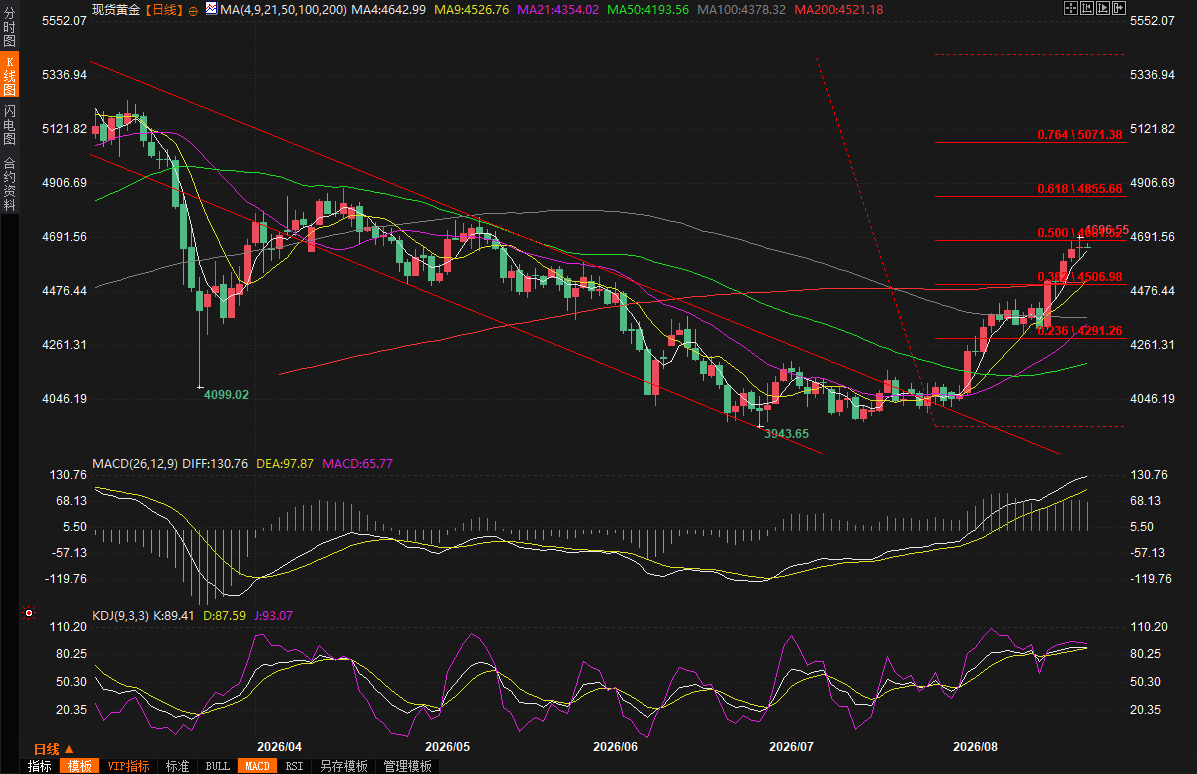 (Spot gold daily chart, source: EasyTrade) At 07:44 Beijing time, spot gold is currently trading at $4656.79 per ounce.
Technical analysis of the $4,700 level: a healthy pullback or the end of a trend?
From a technical perspective, $4700 has become a crucial bastion that bulls must overcome. Gold prices reached a high of $4696.18 in the early morning before quickly retreating, falling to a low of around $4605, a daily range of nearly $100. This movement clearly indicates that as prices approached a key resistance level, short-term profit-taking and trapped positions created a combined selling pressure. Technical analysts point out that if gold prices can find effective support around $4600, the next target could be $4755 or even $4850. However, if the $4600 level is breached, prices could further decline to around $4519, where the 200-day moving average is located. Gold prices are currently at a critical crossroads—a breakout would open up upward potential, while a pullback could lead to a period of consolidation. However, more important than a simple technical correction is whether the underlying logic driving gold price increases has fundamentally changed. Based on the current situation, the answer is clearly no.Geopolitical Powder Keg: Iran Vows Retaliation, Hormuz Casts a Shadow
Gold, as the ultimate safe-haven asset, has always had its price movements inextricably linked to geopolitical factors. The current situation in the Middle East is providing a sustained risk premium for gold prices. On Monday, the US Treasury announced expanded sanctions against Iran, imposing new sanctions on 60 individuals, entities, and vessels. Iran quickly responded strongly, condemning the new US sanctions as "blatant violations" and vowing retaliation. More disturbingly, Iranian state television broadcast a video over the weekend discussing the assassination of Barron Trump, the 20-year-old son of US President Donald Trump, claiming he was being monitored and offering a $10 million reward. This unprecedented provocation has undoubtedly pushed the US-Iran confrontation to a new level. Meanwhile, tensions remain high in the Strait of Hormuz. The UK's Office for Maritime Trade Operations reported that an oil tanker was struck and lost power by an unidentified projectile approximately 9 nautical miles northeast of Ashhisha, Oman. Iran and Oman have stated that they are discussing plans to jointly monitor navigation safety in the Strait of Hormuz. Although oil prices fell for the second consecutive day due to limited market reaction to the sanctions, traders remain highly vigilant about Iran's continued ability to disrupt shipping. Interestingly, the US is beginning to send personnel back to some Middle Eastern diplomatic missions that had previously withdrawn or scaled back due to tensions with Iran. This move suggests that Washington believes the risk of further escalation of the recent conflict has decreased, but Iran's vows of retaliation mean that geopolitical uncertainty is far from over. For gold, as long as the Middle East powder keg continues to smolder, safe-haven demand will not easily subside.Cracks in the Dollar's Credit: When the Treasury Begins "Intervention" in the Bond Market
If geopolitics is the "fuel" for gold prices, then the profound changes in the dollar system are the "engine" driving this round of gold price increases. Last week, US Treasury Secretary Bessenter announced a major decision—to at least double the scale of quarterly repurchases of longer-term Treasury bonds. The direct purpose of this move is to alleviate upward pressure on long-term US Treasury yields, but the market has more keenly picked up on the underlying signal: the US government is using direct intervention in the bond market to lower borrowing costs. Billionaire investor Stanley Druckenmiller issued a stern warning, saying that this move is eroding the credibility of the bond market and missing a good opportunity for substantive debt reform. Economists worry that the cost of lowering yields through repurchasing long-term bonds may be a continued weakening of the dollar. In fact, the dollar index fell sharply after the announcement, once dropping to near its lowest level since mid-May. Citigroup has lowered its three-month dollar index forecast from 102.12 to 98.34, clearly turning bearish on the short-term dollar trend. The market generally believes that this move by the US Treasury sends a policy signal to push the dollar weaker. The weakening dollar is precisely one of the most direct catalysts for the rise in gold prices. A deeper issue lies in the fact that this move by the US Treasury has raised questions about whether the "strong dollar policy" is faltering. The World Gold Council points out: "Uncontrolled US debt and uncertainty surrounding US policy are eroding the credibility of the dollar system. The global monetary system is gradually moving away from the traditional dollar-dominated order." In an era where the dollar's credibility is being eroded, gold's attractiveness as a non-sovereign currency asset is systematically increasing.Inflation Fog and Monetary Policy Uncertainty: The Dual Test of PCE and Jackson Hole
The market's primary focus is undoubtedly on Wednesday's release of the US July Personal Consumption Expenditures (PCE) inflation report, and Federal Reserve Chairman Warsh's speech at the Jackson Hole symposium on Friday. The PCE data is crucial because it's the Fed's official measure of inflation. The market widely expects a 3.6% year-on-year increase in overall PCE for July, with core PCE remaining at 3.3%. Even a slight decline in core inflation would weaken the basis for further Fed rate hikes. It's worth noting that the weak producer price index and consumer price index released this month have significantly reduced the likelihood of a near-term US rate hike. The CME FedWatch tool shows traders are currently pricing in only a 38% probability of a September rate hike. A month ago, this probability was around 55%—the continued cooling of rate hike expectations is fundamentally eroding the dollar's yield advantage. Warsh's speech at Jackson Hole could bring even greater policy uncertainty. Warsh has consistently advocated for a more limited role for the Fed in the market, including reducing forward guidance. The market will closely watch whether he releases any clues about interest rate direction and whether he comments on the Treasury's debt repurchase program. If Warsh's remarks further dampen expectations of interest rate hikes, the dollar will face new downward pressure, while gold is expected to gain new upward momentum. Goldman Sachs believes that its previous forecast of $4,900/ounce for gold by the end of 2026 carries significant upside risk. This assessment appears increasingly credible in the current macroeconomic environment.Structural support for demand in the East
While Western investors focus on Federal Reserve policy, physical demand from the East is providing solid fundamental support for gold prices. Latest data shows that China's net gold imports via Hong Kong increased by approximately 11% month-on-month in July. Meanwhile, the People's Bank of China increased its gold holdings by 19.9 tons in July, marking the largest monthly increase since October 2023. Chinese gold prices have maintained a slight premium relative to the London market for six consecutive weeks, indicating strong purchasing power in the domestic market. As the world's largest gold consumer and importer, China's demand dynamics have a significant impact on the global gold market. Demand for gold from Chinese investors and official institutions is expected to remain strong, providing structural support for gold prices from the East.The US-Canada trade war: an overlooked bullish variable for gold.
While the main focus remains on the Middle East and the Federal Reserve, another power struggle unfolding in North America is also worth noting for gold investors. On Tuesday, Canada announced retaliatory tariffs on approximately $20 billion worth of U.S. imports, covering about 700 products with rates of 15%, 25%, and 50%. This comes after the U.S. imposed a new 50% tariff on $20 billion worth of Canadian imports. Trump also threatened to rename Lake Ontario, which straddles the border between the two countries, to "Lake America" and announced that tariffs on all Canadian cars, trucks, auto parts, and steel would be raised to 50% starting in 2027. This tit-for-tat trade war marks a new low in the relationship between these two long-time allies. More notably, the Trump administration is discussing imposing additional trade penalties on Canada. The continued escalation of global trade frictions will further exacerbate global economic uncertainty, thereby boosting safe-haven demand for gold.In conclusion: The multiple narratives surrounding gold have only just begun.
From a geopolitical perspective, the escalating confrontation between the US and Iran threatens shipping safety in the Strait of Hormuz, providing a floor for gold prices due to safe-haven demand. From a monetary perspective, the US Treasury's intervention in the bond market is eroding the dollar's credibility, and the weakening dollar provides upward momentum for gold prices. From a monetary policy perspective, weak inflation data is diminishing expectations of interest rate hikes, and the potential for lower real interest rates opens up a channel for valuation increases for gold, a non-interest-bearing asset. From a physical demand perspective, Eastern powers, represented by China, are continuously increasing their gold holdings, providing solid fundamental support for the market. $4700 may be a short-term resistance level, but with the combined effect of the aforementioned multiple forces, breaking through this level may only be a matter of time. As TD Securities stated, the current pullback is more of a technical momentum waning than a trend reversal. When the dollar's credibility cracks, geopolitical risk premiums persist, and global central banks compete to increase their gold holdings, the narrative of gold's rise may have only just begun. For investors, instead of worrying about whether $4,700 can be broken in one go, it's more important to consider a more fundamental question: In the current macroeconomic environment, has gold's safe-haven and asset allocation value been fully priced in by the market? The answer is likely no. This week's PCE data and Warsh's speech will provide key clues to determine whether this trend can continue. Regardless of how the data unfolds, gold is already above $4,660, resetting itself to a higher price benchmark. (Spot gold daily chart, source: EasyTrade) At 07:44 Beijing time, spot gold is currently trading at $4656.79 per ounce.
- Risk Warning and Disclaimer
- The market involves risk, and trading may not be suitable for all investors. This article is for reference only and does not constitute personal investment advice, nor does it take into account certain users’ specific investment objectives, financial situation, or other needs. Any investment decisions made based on this information are at your own risk.