Australian CPI exceeded expectations across the board! The Australian dollar jumped to its highest level since June. Will the Reserve Bank of Australia intervene in September?
2026-08-26 11:01:01
The Australian dollar rose briefly against the US dollar during Asian trading hours on Wednesday (August 26), currently trading around 0.7180. Strong inflation data completely altered market expectations regarding the Reserve Bank of Australia's (RBA) policy path, with the Australian dollar rising as much as 0.3% to a high of 0.7184, its highest level since June. Wednesday's Australian July CPI data exceeded expectations across the board—the monthly CPI rose 1.0% month-on-month, far exceeding the expected 0.8%; the annual rate fell from 3.8% to 3.5%, but remained above the market consensus range of 3.2%-3.3%. The more closely watched core inflation indicator—the revised mean CPI—rose 0.5% month-on-month, far exceeding the expected 0.3%, while the annual rate remained stable at 3.6%, above the consensus of 3.5%. Data details showed that inflationary pressures had a broad basis: market goods and services excluding volatile items rose 1% month-on-month, and discretionary spending excluding tobacco rose 1.5% month-on-month. The Australian dollar jumped after the data release, with the market quickly repricing the possibility of a further RBA rate hike in September. 
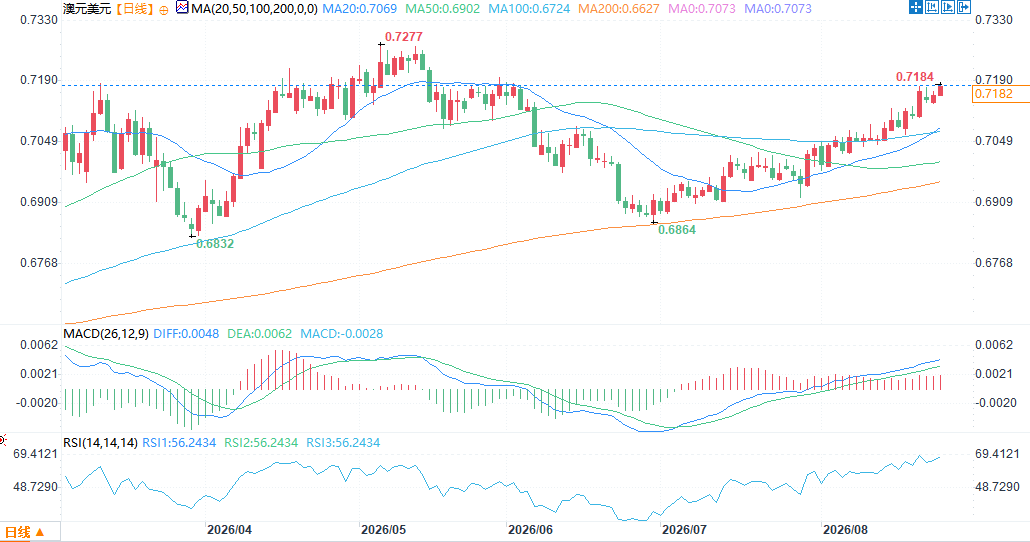 (Australian dollar/US dollar daily chart, source: EasyForex) At 10:59 Beijing time on August 26, the Australian dollar was trading at 0.7178/79 against the US dollar.
Inflation data exceeded expectations across the board, with the revised average jumping 0.5% month-on-month.
Australia's CPI rose 1.0% month-on-month in July, far exceeding the expected 0.8% and reversing the 0.1% decline in the previous month. The annual rate fell to 3.5% from 3.8%, but remained above the market consensus range of 3.2%-3.3% and the median forecast of 3.3%. The improvement in the annual rate partly reflects the fading of the unusually high base effect in July last year, rather than a genuine slowdown in current price momentum. The Reserve Bank of Australia's preferred revised mean CPI rose 0.5% month-on-month, far exceeding the expected 0.3%, while the annual rate remained stable at 3.6%, above the consensus of 3.5%. The weighted median CPI annual rate fell to 3.6% from 3.7%, but rose 0.4% month-on-month from 0.3%.Inflationary pressures are widespread, not just a "short-lived spike in gasoline prices."
The data details reveal a broad-based inflation. Market goods and services, excluding volatile items, rose 1% month-on-month, while discretionary spending excluding tobacco rose 1.5%. This breadth is more concerning to the Reserve Bank of Australia (RBA) than the petrol-driven component – it points to underlying demand pressures across a wider range of goods and services, rather than a single cost-driven distortion. The data, which exceeded expectations across the board, marks a significant shift in the market narrative surrounding a decline in inflation – major banks had generally expected a revised average decline to around 3.5%. RBA staff had previously warned of upside risks to inflation forecasts, and today's data may indicate that these risks are now materializing.The Reserve Bank of Australia is repricing expectations for a September rate hike.
The Australian dollar jumped after the data release, with the market quickly repricing the possibility of a further rate hike by the Reserve Bank of Australia (RBA) in September. Previously, the money market had priced in a roughly 50% probability of a December rate hike; today's data has put the September meeting in a more dynamic state. The RBA has already raised rates three times this year, striving to bring core inflation back to its 2%-3% target range. Today's data provides strong evidence that the tightening cycle is not yet over. More data will be released before the September meeting, but today's data has significantly changed the direction of policy dialogue—from "whether to hold rates steady" to "whether to raise rates again."Summarize
Australia's July CPI rose 1.0% month-on-month, far exceeding expectations; the annual rate of 3.5% was higher than the consensus. The revised average CPI rose 0.5% month-on-month, also far exceeding expectations, while the annual rate remained stable at 3.6%. Data details showed broad-based inflationary pressures – market goods and services rose 1% month-on-month, and discretionary spending rose 1.5%. This data, which exceeded expectations across the board, marks a significant shift in the narrative of declining inflation. The Australian dollar jumped, and the market quickly repriced in the possibility of a September rate hike. The Reserve Bank of Australia has already raised interest rates three times, and today's data provides strong evidence that the tightening cycle is not yet over. (Australian dollar/US dollar daily chart, source: EasyForex) At 10:59 Beijing time on August 26, the Australian dollar was trading at 0.7178/79 against the US dollar.
- Risk Warning and Disclaimer
- The market involves risk, and trading may not be suitable for all investors. This article is for reference only and does not constitute personal investment advice, nor does it take into account certain users’ specific investment objectives, financial situation, or other needs. Any investment decisions made based on this information are at your own risk.