The US Treasury expanded its bond buyback program, causing the dollar index's rebound to stall near the 99 level, awaiting the release of PCE data.
2026-08-26 14:31:00
The US dollar index rebounded to around 99.00 in early European trading on Wednesday, showing some technical recovery after recent consecutive weakening. However, the dollar remains in a relatively fragile market environment, with US fiscal policy, Federal Reserve interest rate expectations, and upcoming inflation data all determining its next direction.  The U.S. Treasury recently expanded its long-term Treasury bond repurchase program, raising the maximum size of a single repurchase from $2 billion to at least $4 billion. The primary aim is to improve liquidity in the long-term Treasury bond market and alleviate rising long-term financing costs. The market believes this measure will help stabilize long-term yields in the short term, but it has also raised further concerns among investors about the U.S. fiscal situation. Given that the U.S. government debt exceeds $40 trillion, bond repurchases are more about improving the supply and demand structure of the bond market than addressing the fiscal deficit and debt growth. The market has also recently focused on whether the Treasury might use cash reserves in its fiscal accounts to fund long-term Treasury bond repurchases. If this operation is further expanded, it could reduce supply pressure in the long-term Treasury bond market and exert some downward pressure on long-term yields. For the dollar, declining U.S. Treasury yields will weaken the interest rate attractiveness of dollar assets; therefore, while the Treasury's repurchase program aims to stabilize the bond market, it may have the side effect of suppressing the dollar in the short term. Meanwhile, the Federal Reserve's interest rate expectations have also changed significantly. Previously, the market had heavily bet on a further rate hike in September. However, with signs of cooling in US inflation data and a reassessment of the economic outlook by financial markets, the current pricing probability of a 25 basis point rate hike in September has fallen to about 38.4%, significantly lower than the approximately 67% level at the beginning of the month. This rapid cooling of rate hike expectations is a key reason why the US dollar index has struggled to sustain a recent rebound. The upcoming release of the US July PCE price index has therefore become the focus of market attention. The PCE is an important indicator for the Federal Reserve to assess inflation trends. If core inflation continues to slow, the market may further reduce its expectations for rising US interest rates, putting new downward pressure on the dollar index. Conversely, if the data is significantly higher than expected, it could push up US Treasury yields again, providing temporary support for the dollar. The market is also awaiting policy signals from the Jackson Hole symposium. Fed Chairman Kevin Warsh's speech could be a significant catalyst for the short-term movement of the dollar. If the policy statement emphasizes inflation risks and the duration of high interest rates, US Treasury yields may rebound, and the dollar index could retest the 100 level. If the policy signal leans towards easing, the recent weakness of the dollar may continue. From a policy communication perspective, the market currently needs not only interest rate assessments but also a clearer direction for US fiscal policy. Market analysts believe that if the US Treasury Department cannot provide a clearer fiscal consolidation plan, and the Federal Reserve's policy framework lacks clear guidance, the previous rebound in the US dollar may be unsustainable. Geopolitical risks provide some safe-haven support for the dollar. Recent economic sanctions surrounding Iran have further expanded; if regional tensions escalate, funds may flow back into traditional safe-haven assets such as the dollar. However, this support for the dollar depends more on changes in risk sentiment than on improvements in the dollar's own fundamentals, so its sustainability remains to be seen. From a global foreign exchange market perspective, the pressure on the dollar is currently widespread. Declining expectations for long-term US interest rates will weaken the dollar's yield advantage, while changes in policy expectations in major economies such as Europe and Japan may further influence the reallocation of funds between different currencies. If the dollar index continues to trade below 100, the market may gradually form a consensus of a medium-term weakness in the dollar. From a daily chart perspective, the dollar index remains bearish in the short term, with prices continuing to trade below the 100-day moving average and the Bollinger Band's middle line, indicating that the bears still hold some initiative in the medium term. Although the index has rebounded from its lows, it remains under pressure near the 99 level. The first resistance level to watch is the Bollinger Band middle line around 99.55, followed by the 100-day moving average around 99.70. A decisive break above 99.70 would target the upper Bollinger Band around 100.40. Only a retest of the 100 level would significantly improve the medium-term weakness of the US dollar index. On the downside, the lower Bollinger Band around 98.65 is the most important short-term support. If the index breaks below this area and confirms it, the dollar could move further towards 98.20 or even 97.80. The RSI is currently around 34.60, nearing oversold territory, indicating continued bearish pressure, but short-term downside may be limited by technical corrections. Therefore, if the PCE data is weak, the dollar index may first break below 98.65 before entering a new bottom-finding phase; if the data is strong, the oversold condition could help the dollar rebound more quickly. From a 4-hour chart perspective, the US dollar index is currently in a crucial confirmation phase after a low-level rebound. The area around 99.00 is a short-term dividing line between bullish and bearish sentiment. If the price can break through 99.55 and hold above it, the rebound momentum is expected to strengthen further, potentially testing 99.70 and 100.00. Conversely, if the rebound is resisted near 99.55 and falls back below 98.65, it means the bears have regained control, and the downward trend may continue. The current technical structure remains bearish, and the 99.55-99.70 area is the core resistance zone for determining whether this rebound can strengthen.
 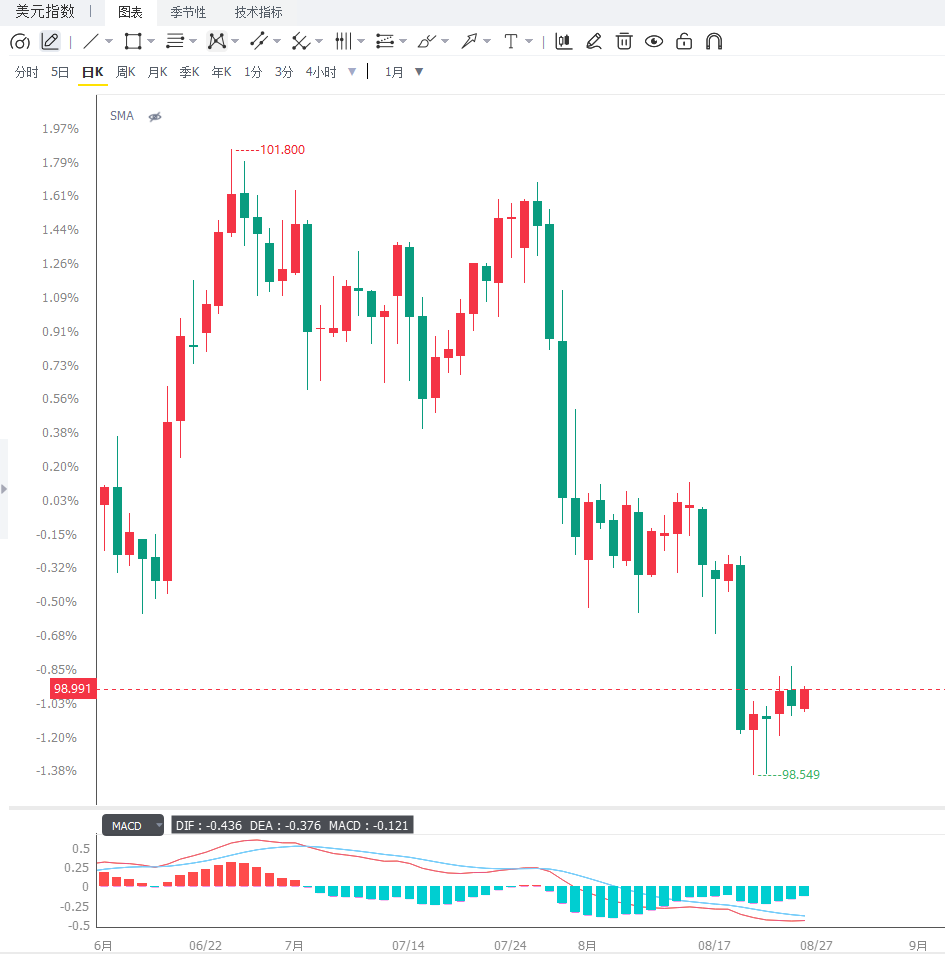 Editor's Summary: The current rebound in the US dollar index is more of a technical correction within a weak market structure than a clear trend reversal. While the US Treasury's expansion of long-term Treasury bond repurchases helps alleviate pressure on long-term yields, it cannot fundamentally solve the US debt and fiscal deficit problems. Instead, it may weaken the dollar's interest rate support by suppressing long-term yields. In the short term, the US July PCE data and policy signals from the Jackson Hole meeting will determine the dollar's next direction. If inflation continues to cool and the Fed releases dovish signals, the risk of the dollar index falling below 98.65 will increase; if the PCE shows renewed inflation stickiness, and the Fed releases a more hawkish interest rate signal, the dollar is expected to retest the 99.70 or even 100 level. Overall, as long as the dollar index cannot regain a foothold above 100, the market should still view the current rebound as a correction within a medium-term weakness. Going forward, it is crucial to observe the interplay between US inflation, long-term US Treasury yields, fiscal policy, and the Fed's policy communication, as this will determine whether the dollar can escape its current weak structure.
The U.S. Treasury recently expanded its long-term Treasury bond repurchase program, raising the maximum size of a single repurchase from $2 billion to at least $4 billion. The primary aim is to improve liquidity in the long-term Treasury bond market and alleviate rising long-term financing costs. The market believes this measure will help stabilize long-term yields in the short term, but it has also raised further concerns among investors about the U.S. fiscal situation. Given that the U.S. government debt exceeds $40 trillion, bond repurchases are more about improving the supply and demand structure of the bond market than addressing the fiscal deficit and debt growth. The market has also recently focused on whether the Treasury might use cash reserves in its fiscal accounts to fund long-term Treasury bond repurchases. If this operation is further expanded, it could reduce supply pressure in the long-term Treasury bond market and exert some downward pressure on long-term yields. For the dollar, declining U.S. Treasury yields will weaken the interest rate attractiveness of dollar assets; therefore, while the Treasury's repurchase program aims to stabilize the bond market, it may have the side effect of suppressing the dollar in the short term. Meanwhile, the Federal Reserve's interest rate expectations have also changed significantly. Previously, the market had heavily bet on a further rate hike in September. However, with signs of cooling in US inflation data and a reassessment of the economic outlook by financial markets, the current pricing probability of a 25 basis point rate hike in September has fallen to about 38.4%, significantly lower than the approximately 67% level at the beginning of the month. This rapid cooling of rate hike expectations is a key reason why the US dollar index has struggled to sustain a recent rebound. The upcoming release of the US July PCE price index has therefore become the focus of market attention. The PCE is an important indicator for the Federal Reserve to assess inflation trends. If core inflation continues to slow, the market may further reduce its expectations for rising US interest rates, putting new downward pressure on the dollar index. Conversely, if the data is significantly higher than expected, it could push up US Treasury yields again, providing temporary support for the dollar. The market is also awaiting policy signals from the Jackson Hole symposium. Fed Chairman Kevin Warsh's speech could be a significant catalyst for the short-term movement of the dollar. If the policy statement emphasizes inflation risks and the duration of high interest rates, US Treasury yields may rebound, and the dollar index could retest the 100 level. If the policy signal leans towards easing, the recent weakness of the dollar may continue. From a policy communication perspective, the market currently needs not only interest rate assessments but also a clearer direction for US fiscal policy. Market analysts believe that if the US Treasury Department cannot provide a clearer fiscal consolidation plan, and the Federal Reserve's policy framework lacks clear guidance, the previous rebound in the US dollar may be unsustainable. Geopolitical risks provide some safe-haven support for the dollar. Recent economic sanctions surrounding Iran have further expanded; if regional tensions escalate, funds may flow back into traditional safe-haven assets such as the dollar. However, this support for the dollar depends more on changes in risk sentiment than on improvements in the dollar's own fundamentals, so its sustainability remains to be seen. From a global foreign exchange market perspective, the pressure on the dollar is currently widespread. Declining expectations for long-term US interest rates will weaken the dollar's yield advantage, while changes in policy expectations in major economies such as Europe and Japan may further influence the reallocation of funds between different currencies. If the dollar index continues to trade below 100, the market may gradually form a consensus of a medium-term weakness in the dollar. From a daily chart perspective, the dollar index remains bearish in the short term, with prices continuing to trade below the 100-day moving average and the Bollinger Band's middle line, indicating that the bears still hold some initiative in the medium term. Although the index has rebounded from its lows, it remains under pressure near the 99 level. The first resistance level to watch is the Bollinger Band middle line around 99.55, followed by the 100-day moving average around 99.70. A decisive break above 99.70 would target the upper Bollinger Band around 100.40. Only a retest of the 100 level would significantly improve the medium-term weakness of the US dollar index. On the downside, the lower Bollinger Band around 98.65 is the most important short-term support. If the index breaks below this area and confirms it, the dollar could move further towards 98.20 or even 97.80. The RSI is currently around 34.60, nearing oversold territory, indicating continued bearish pressure, but short-term downside may be limited by technical corrections. Therefore, if the PCE data is weak, the dollar index may first break below 98.65 before entering a new bottom-finding phase; if the data is strong, the oversold condition could help the dollar rebound more quickly. From a 4-hour chart perspective, the US dollar index is currently in a crucial confirmation phase after a low-level rebound. The area around 99.00 is a short-term dividing line between bullish and bearish sentiment. If the price can break through 99.55 and hold above it, the rebound momentum is expected to strengthen further, potentially testing 99.70 and 100.00. Conversely, if the rebound is resisted near 99.55 and falls back below 98.65, it means the bears have regained control, and the downward trend may continue. The current technical structure remains bearish, and the 99.55-99.70 area is the core resistance zone for determining whether this rebound can strengthen. Editor's Summary: The current rebound in the US dollar index is more of a technical correction within a weak market structure than a clear trend reversal. While the US Treasury's expansion of long-term Treasury bond repurchases helps alleviate pressure on long-term yields, it cannot fundamentally solve the US debt and fiscal deficit problems. Instead, it may weaken the dollar's interest rate support by suppressing long-term yields. In the short term, the US July PCE data and policy signals from the Jackson Hole meeting will determine the dollar's next direction. If inflation continues to cool and the Fed releases dovish signals, the risk of the dollar index falling below 98.65 will increase; if the PCE shows renewed inflation stickiness, and the Fed releases a more hawkish interest rate signal, the dollar is expected to retest the 99.70 or even 100 level. Overall, as long as the dollar index cannot regain a foothold above 100, the market should still view the current rebound as a correction within a medium-term weakness. Going forward, it is crucial to observe the interplay between US inflation, long-term US Treasury yields, fiscal policy, and the Fed's policy communication, as this will determine whether the dollar can escape its current weak structure.
- Risk Warning and Disclaimer
- The market involves risk, and trading may not be suitable for all investors. This article is for reference only and does not constitute personal investment advice, nor does it take into account certain users’ specific investment objectives, financial situation, or other needs. Any investment decisions made based on this information are at your own risk.