A breakthrough in the Hormuz negotiations sent Brent crude oil prices below $90, but institutions say normalization is still a long way off.
2026-08-26 15:19:01
International oil prices are under renewed downward pressure. ING commodities strategists Warren Patterson and Ewa Manthey point out that ICE Brent crude has fallen below $90 a barrel as negotiations between Iran, Oman, and Pakistan regarding the Strait of Hormuz and the Middle East conflict progress. However, the two analysts also caution that there is still a considerable distance between the positive signals from the negotiations and the normalization of oil flows, and that official US flow data may overestimate the actual capacity of the strait.
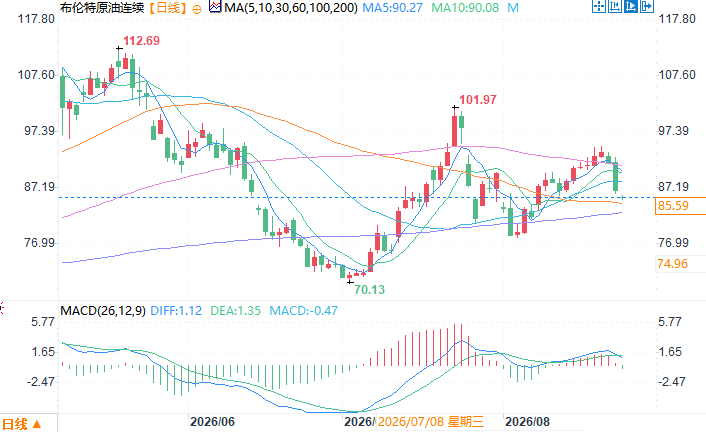 Brent crude oil daily chart source: EasyTrade. At 15:16 Beijing time on August 26, Brent crude oil was trading at $85.42 per barrel.
Positive signs emerged in the Persian Gulf negotiations, causing oil prices to fall accordingly.
Oil prices continued to decline, with Brent crude closing down 5.64% yesterday, falling below $90 a barrel. This downward pressure persisted in Asian trading this morning. ING analysts wrote that the catalyst appeared to be positive signals from the Persian Gulf negotiations. However, they immediately emphasized that the complexity of the situation should not be underestimated, stating, "However, any agreement reached between the two sides does not mean that the flow of oil through this key choke point will normalize. Before we see any signs of normalization, it will likely require the US to lift its blockade of Iranian ports and ease sanctions on Iran."US traffic data questioned: Daily traffic volume in Hormuz far lower than official figures.
ING analysts also questioned the US data on the flow of oil through the Strait of Hormuz. They pointed out, "The US claims that approximately 8 to 9 million barrels of oil pass through the Strait of Hormuz daily, which may be achievable in the short term, but this figure seems overly aggressive over a longer timeframe. Estimates from multiple shipping tracking agencies are much lower, ranging from around 2 to 6 million barrels per day." If these more conservative estimates are true, then the actual throughput capacity of the Strait of Hormuz may be far lower than previously perceived by the market, meaning that even if negotiations progress, the recovery of global oil supply may not be as rapid as expected.Inventory data diverge: Crude oil inventories accumulate, while refined oil inventories are tighter.
US inventory data reveals a divergence in market signals. ING analysts pointed out: "Overnight, the American Petroleum Institute (API) inventory data showed that US crude oil inventories increased by 4.2 million barrels last week. However, the refined product market tightened further, with gasoline and distillate inventories falling by 3.2 million barrels and 500,000 barrels, respectively." This combination of "increased crude oil and decreased refined product inventories" reflects a structural imbalance at the refinery processing or operating rate level. Even with some easing on the crude oil supply side, the tightness in the downstream refined product market continues, which is precisely one of the key factors that previously pushed up crack spreads and exacerbated inflation concerns.Conclusion
Brent crude oil prices fell below $90, largely thanks to positive signals from the Persian Gulf negotiations. However, ING's reminder is significant: an agreement does not equate to normalized oil flows; the US blockade and sanctions against Iran remain the biggest variable; the US official figure of 8 to 9 million barrels per day in transit is far from the shipping tracking data; and behind the accumulation of crude oil inventories, the continued decline in refined product inventories continues to sound alarm bells about supply shortages. For the oil market, the "dawn of negotiations" may still be a long way from a "springtime of supply." Brent crude oil daily chart source: EasyTrade. At 15:16 Beijing time on August 26, Brent crude oil was trading at $85.42 per barrel.
- Risk Warning and Disclaimer
- The market involves risk, and trading may not be suitable for all investors. This article is for reference only and does not constitute personal investment advice, nor does it take into account certain users’ specific investment objectives, financial situation, or other needs. Any investment decisions made based on this information are at your own risk.