PCE inflation stickiness supports the dollar; can Jackson Hole provide another boost?
2026-08-27 14:10:10
On Thursday (August 27) during Asian trading hours, the US dollar index traded in a narrow range, currently hovering around 99.10. Overnight, it rose as much as 0.3% to 99.22, a new high in nearly five trading days. July's PCE data released on Wednesday showed that inflation remained sticky—the overall PCE annual rate held steady at 3.7% (expected to fall to 3.6%), and the core PCE annual rate held steady at 3.3%, both in line with expectations. Market expectations for a Fed rate hike in September have remained largely unchanged. Investors are now turning their attention to Fed Chairman Warsh's speech at Friday's Jackson Hole symposium. 
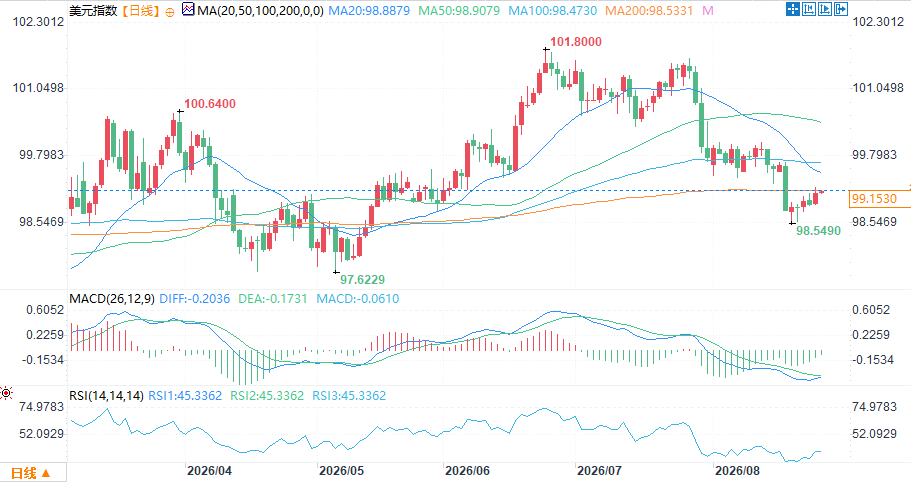 (US Dollar Index Daily Chart, Source: FX678) At 14:09 Beijing time on August 27, the US Dollar Index was at 99.15.
PCE data reinforces inflation stickiness.
July's PCE data released on Wednesday showed an overall annualized rate of 3.7% (market expectation 3.6%) and a core annualized rate of 3.3%, both in line with or slightly above expectations, further confirming that inflation remains sticky and has not shown signs of a rapid decline. This result provided some support for the US dollar, as sticky inflation reduced market expectations for a rapid shift to easing by the Federal Reserve. Meanwhile, the CME FedWatch tool showed that the probability of keeping rates unchanged in September remained stable at around 64%, with little change in expectations of a rate hike. Although the data itself was hawkish, the market remained cautious ahead of the Jackson Hole global central bank symposium, with bulls unwilling to chase the market higher before important speeches, thus limiting further upside potential for the dollar index. Overall, the PCE data reinforced the short-term support logic for the dollar, but also made traders more reliant on subsequent statements from high-level officials to find catalysts for a directional breakout.Jackson Hall becomes the focus, Walsh's speech attracts much attention.
Investors are focusing all their attention on Federal Reserve Chairman Warsh's speech at Friday's Jackson Hole symposium. As one of the world's most important central bank communication platforms, this speech is seen as a key indicator ahead of the September policy meeting. DBS economists point out that Warsh faces a difficult balancing act: on the one hand, he needs to firmly defend the Fed's independence and price stability mandate, avoiding any interpretation that policy is influenced by political pressure; on the other hand, he must provide sufficient policy transparency to the market without abandoning his preference for "less talk, more action," preventing excessive volatility in expectations. This inherent tension is particularly crucial for dollar observers, as the upcoming release of US economic data and Fed events are highly concentrated, and any subtle changes in wording can be quickly reflected in exchange rate and interest rate pricing. The market generally believes that Warsh's remarks will directly affect the short-term dollar trend and global risk appetite; his communication strategy itself has become an important variable in pricing.Market Expectations and Potential Impact
Market expectations for Warsh's speech are clearly divided, and the potential impact path is correspondingly clear. If Warsh releases clear signals in his speech, such as emphasizing that upside risks to inflation still exist, or explicitly retaining the option of further rate hikes, the dollar may gain short-term rebound momentum, pushing the index to extend its reach above 99. Conversely, if he adheres to his consistent "talk less" strategy, with neutral or even dovish wording, emphasizing data dependence or economic uncertainty, the dollar may face renewed downward pressure, and the support previously gained from the PCE data may be quickly digested. Since Warsh has deliberately reduced the frequency of his forward guidance since taking office, the market is exceptionally sensitive to his communication strategy—any statement deviating from the "silence" pattern will be amplified and interpreted. Therefore, this speech is not only related to short-term exchange rate fluctuations, but will also largely determine the market's pricing direction for the Fed's subsequent policy path, becoming the most crucial catalyst for the foreign exchange and interest rate markets this week.Summarize
The US dollar index is currently trading around 99.10. July's PCE data showed sticky inflation—the overall annual rate of 3.7% was higher than expected, while the core annual rate of 3.3% was in line with expectations. The probability of the Federal Reserve keeping rates unchanged in September remains stable at 64%. The market is focused on Warsh's speech at Jackson Hole on Friday. DBS Bank points out that Warsh faces the challenge of balancing the Fed's independence with policy transparency. Warsh's remarks will be a key catalyst for the short-term direction of the US dollar. (US Dollar Index Daily Chart, Source: FX678) At 14:09 Beijing time on August 27, the US Dollar Index was at 99.15.
- Risk Warning and Disclaimer
- The market involves risk, and trading may not be suitable for all investors. This article is for reference only and does not constitute personal investment advice, nor does it take into account certain users’ specific investment objectives, financial situation, or other needs. Any investment decisions made based on this information are at your own risk.