Short-term improvement in Hormuz transport capacity has become the core of the US-Iran rivalry, which is now anchored to oil prices.
2026-08-27 16:29:01
On Thursday (August 27), during the Asian and European sessions, international oil prices continued to decline, erasing most of the rebound recorded on Wednesday. WTI crude oil futures are currently trading around 81.05. The current US-Iran standoff continues according to the previous logic: as long as oil prices don't rise significantly, the US won't initiate hostilities. The US has even mentioned that Khamenei has begun to speak favorably of Iran. International oil prices have declined for three consecutive days, and market panic regarding supply disruptions in the Middle East has significantly subsided. Overall, whoever controls oil prices currently benefits. A decline in oil prices means the US has the upper hand in this phase of the standoff, while a decline in oil prices reduces Iran's bargaining power. Therefore, both sides currently see oil prices as crucial to success or failure. In other words , while oil prices are originally a result of the US-Iran conflict, due to the US debt crisis and Iran's limited bargaining power, oil prices are now the most direct indicator of the strength and progress of the confrontation between the two sides. 
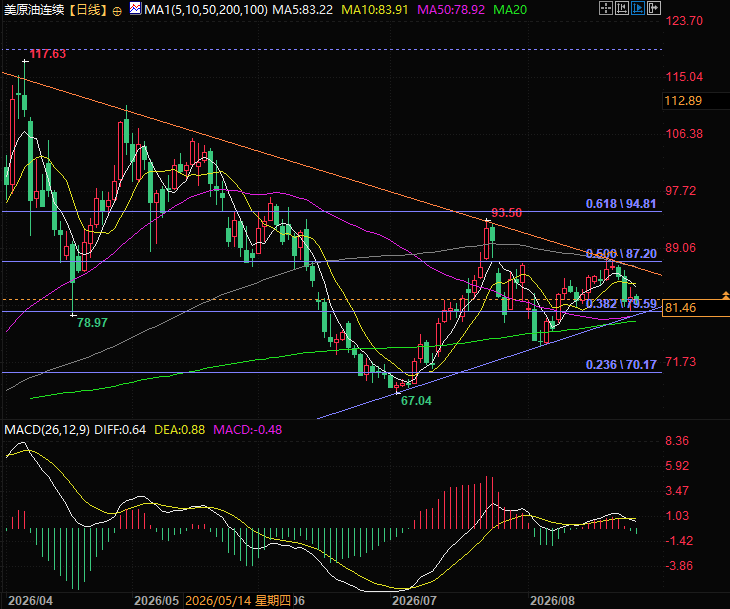 (WTI crude oil futures daily chart, source: EasyTrade) At 16:24 Beijing time, WTI crude oil futures were trading at $81.53 per barrel.
Diplomatic mediation continues: US-Iran negotiations have a window to restart, but core differences remain.
Breakthrough progress on the diplomatic front is the core driver of this round of oil price correction. To break the months-long diplomatic deadlock between the US and Iran, the Qatari Prime Minister and Foreign Minister will visit Iran on Thursday to restart long-stalled mediation efforts in US-Iran negotiations. Qatar previously successfully facilitated a ceasefire and is currently the most crucial neutral mediator. However, the market needs to view negotiation expectations rationally. US President Trump has clearly stated that he is "in no hurry to reach an agreement," while Iran continues to insist on its hardline demands, requiring the US to lift the blockade, cancel all sanctions, and provide relevant compensation. The core differences between the two sides have not yet been resolved.Strait of Hormuz negotiations: uncertainties loom as they approach landing; US-Iran rivalry hinders navigation and restoration efforts.
The much-anticipated shipping negotiations between Iran and Oman over the Strait of Hormuz are currently in a delicate phase, "on the verge of implementation but not yet finalized." Previously, the Iranian Revolutionary Guard had released positive signals, stating that both sides had reached a consensus on the division of control of the strait and the distribution of shipping revenue, achieving phased progress in the negotiations. However, senior Iranian officials later clarified that the details of the agreement are still under discussion and no final conclusion has been reached. Iran has clearly drawn its bottom line: the Strait of Hormuz will not be fully reopened until the United States meets its core demands. At the same time, the Revolutionary Guard publicly accused the United States of continuously obstructing Iran-Aman negotiations and disrupting regional navigation order. Coupled with Trump's previous warning to Oman against deep cooperation with Iran, this further increases the uncertainty surrounding the agreement's implementation. However, the Omani Foreign Minister still released optimistic signals, hoping to announce a temporary safe passage through the Strait of Hormuz in the near future. Both sides are also simultaneously advancing mine clearance work in the strait and exploring the establishment of a permanent shipping passage mechanism, leaving room for future possibilities regarding the restoration of the waterway.Shipping capacity has recovered significantly: multiple countries have entered the shuttle shipping market, and the supply capacity of the strait has rebounded markedly.
Boosted by expectations of diplomatic easing, the oil transport capacity of the Strait of Hormuz has been substantially restored, completely recovering from its previous near-paralysis. At the height of the conflict, oil transport volume through the strait was only a quarter of pre-war levels, severely impacting global energy supply. Currently, Gulf oil-producing countries are making every effort to ensure supply. The UAE pioneered a shuttle transport model, utilizing segmented transport via ship-to-ship transshipment in the Gulf of Oman to circumvent the high-risk navigation risks of the strait. Saudi Arabia followed suit. Recently, Kuwait and Qatar officially joined this transport system, and their combined oil exports have recovered to 70% of the pre-war level of 2 million barrels per day. Currently, the daily oil throughput through the strait is stable at 7-8 million barrels, more than double the low of 4 million barrels in mid-July, recovering to three-quarters of pre-war levels. Data from the third-party agency Vortexa suggests an even higher figure of 10 million barrels per day, exceeding market expectations for supply recovery. Shipping data also confirms the recovery, with the number of bulk commodity vessels passing through the Strait of Hormuz increasing to 10 on Wednesday, a slight increase from the previous day. Oil tankers and LNG carriers are passing through in an orderly manner, while only the volume of traffic in the Bab el-Mandeb Strait has slowed down slightly, and the overall regional logistics resilience continues to strengthen.The United States' multi-dimensional strategic layout: proactively stabilizing geopolitics and locking in oil price fluctuation ranges.
To maintain control over the Middle East situation and stabilize global oil prices, the United States has recently implemented a series of strategic initiatives, with the core objective of suppressing extreme geopolitical risks and anchoring stable expectations in the crude oil market. On one hand, the US military plans to hold meetings with several European countries to jointly develop a security plan for the Strait of Hormuz, unify regional escort operation standards, reduce the risk of sudden shipping attacks, and safeguard the normalization of navigation in the Strait. On the other hand, the US dispatched CIA Director Ratcliffe on a surprise visit to Moscow, becoming the first senior CIA official to visit Russia during Trump's term, mirroring the risk management logic of Burns' visit to Russia in 2021 during Biden's presidency. The core objectives of this secret visit were twofold: first, to warn Russia against attacking NATO's Baltic member states and avoid direct conflict between major powers; and second, to pressure Russia to reduce its military, intelligence, and technological support to Iran, weakening Iran's regional bargaining power and fundamentally reducing the probability of escalation of US-Iran conflict and disruption of shipping in the Strait. Although the US has not officially acknowledged the details of the talks, this in-depth communication at the intelligence level between major powers is essentially a key operation by the US to proactively stabilize oil prices and control geopolitical risks in the Middle East.Current market pricing logic: Geopolitical panic subsides, supply and demand recovery dominates market trends.
Overall, the current crude oil market has shifted from "geopolitical panic pricing" to a "supply and demand recovery + wait-and-see" pricing model. The geopolitical risk premium continues to shrink, supporting a temporary decline in oil prices. Key short-term positive factors for oil prices are concentrated: the continued recovery of shipping capacity across the Taiwan Strait, the increasingly完善的shuttle transport system, the continued progress of multilateral diplomatic mediation, and the US's proactive efforts to stabilize risks, significantly limiting the upside potential for oil prices. As previously mentioned, as long as oil prices don't rise, the US will be relatively more restrained, but Iran may become restless and seek opportunities to pressure the US on oil prices. This also indicates that the overall trend has shifted to the US actively paving the way for higher oil prices. The main axis of the US-Iran confrontation has shifted from regime change to nuclear weapons and then to the opening of the Taiwan Strait; now, the US has conceded that as long as oil prices remain stable, it is acceptable to the US. Therefore, the US will try to maintain this bottom line. Technical Analysis: Oil prices retreated after being pressured by the double-top candlestick pattern on the 2nd, and then found support at the upward trend line and the 0.382 Fibonacci retracement level. Subsequently, a triangle consolidation pattern was formed. We will observe whether there will be a breakout from the triangle pattern. (WTI crude oil futures daily chart, source: EasyTrade) At 16:24 Beijing time, WTI crude oil futures were trading at $81.53 per barrel.- Risk Warning and Disclaimer
- The market involves risk, and trading may not be suitable for all investors. This article is for reference only and does not constitute personal investment advice, nor does it take into account certain users’ specific investment objectives, financial situation, or other needs. Any investment decisions made based on this information are at your own risk.