Iran holds the trump card, the US controls the pace: textbook-perfect range-bound trading in crude oil.
2026-08-28 16:26:01
On Friday (August 28), international oil prices saw a slight pullback during the Asian and European sessions. On Thursday evening, oil prices had risen from -2% to 2% intraday. Currently, WTI crude oil futures are trading around 83.02, down 0.59%. On Thursday evening, the Trump administration publicly released a tough diplomatic signal, explicitly refusing to engage in any direct negotiations with Iran and completely rejecting a return to the framework of the memorandum of understanding reached between the US and Iran in June. The US stance has continued to harden, not only abandoning the path of diplomatic détente but also intensifying its "Operation Orphan," continuously strengthening its financial and trade blockade against Iran and comprehensively squeezing Iran's economic survival space. The market interpreted this as a complete failure of expectations for US-Iran reconciliation and a renewed escalation of geopolitical conflict risks, leading to a rapid influx of safe-haven funds into the oil market, directly driving a short-term surge in international oil prices. Later on Friday morning, Iranian officials confirmed a deep consensus with Oman, finalizing a temporary shipping corridor in the Strait of Hormuz under joint management. The channel covers the territorial waters of both Iran and Oman, while simultaneously advancing detailed implementation rules such as mine clearance and safe passage procedures for merchant ships. This news directly alleviated market panic regarding energy supply disruptions. Coupled with expectations of marginal improvement in navigation conditions across the strait, the safe-haven premium for crude oil quickly declined. 
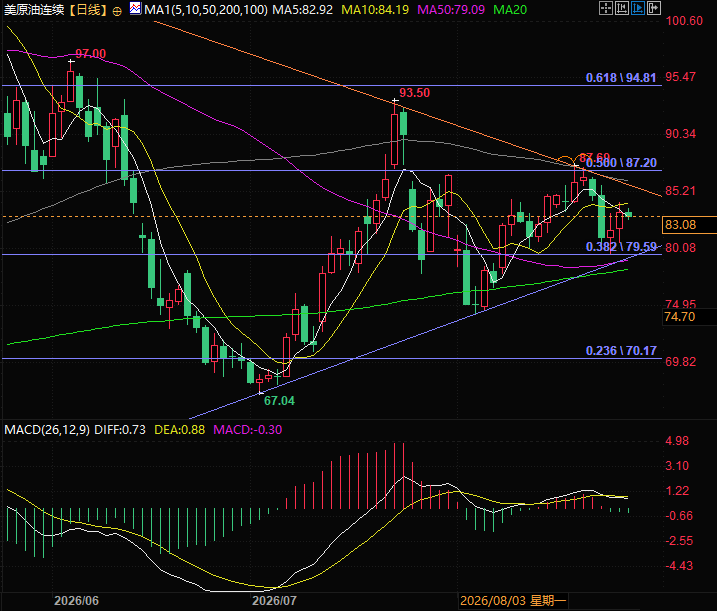 (WTI crude oil futures daily chart, source: EasyForex) At 16:23 Beijing time, WTI crude oil futures were trading at $82.99 per barrel.
Current status of cross-strait navigation: low traffic volume and lingering risks provide solid support for oil prices.
Real-time navigation data further confirms the cautious sentiment in the oil market regarding shipping conditions in the Strait of Hormuz. Amidst the escalating tensions between the US and Iran, the number of cargo ships passing through the strait on Thursday dropped to seven, a significant decrease from the 17 ships passed the previous day, and also significantly below the ten-day average of 15 ships, indicating that logistics operations in the strait remain at a low level. Even if Iran and Afghanistan reach a consensus on navigation, the safety risks in the waterway have not been completely eliminated. Previous cases of oil tankers being attacked by unidentified projectiles suggest that current navigation is only controlled and limited, far from restoring pre-war normal shipping levels. This provides a floor for oil prices, limiting the potential for a pullback.The core logic of the game: Iran understands the pain points of oil prices and seizes the initiative in countering the situation.
The core underlying logic of this round of oil price fluctuations lies in the unequal bargaining power and pricing strategies of the US and Iran. Currently, with oil price increases slowing and cross-strait traffic showing a slight recovery, the US is determined to intensify its economic blockade against Iran and refuse diplomatic negotiations, attempting to force Iran to compromise through maximum pressure. However, Iran has accurately grasped the core pain points of the oil market and holds absolute initiative in countering the situation: Iran clearly understands that once geopolitical risks subside and oil prices continue to fall sharply, US inflation and energy pressures will ease rapidly, and the US's willingness to compromise in negotiations with Iran will decrease accordingly; conversely, as long as oil prices stabilize and rise, the US will face increased inflation and market pressures, and will proactively release conciliatory signals and make concessions in negotiations.Iran responds strongly: publicly mocks US credibility and resists unilateral sanctions.
Based on this game theory logic, Iran has recently released several strong signals, directly countering US pressure. The Iranian parliament speaker publicly mocked US Treasury Secretary Bessenter, citing foreign media reports and directly addressing the US debt market's credibility crisis, stating that the US has excessively interfered in the Middle East situation and that its own economic credibility is already precarious, strongly refuting US unilateral sanctions and diplomatic pressure. More importantly, Iran holds multiple trump cards, forming a comprehensive risk hedging system and firmly controlling the initiative. Besides the Strait of Hormuz navigation dispute, Iran has begun to plan alternative countermeasures. According to Iraqi official sources, Iran is planning to support Iraqi militias to attack newly built oil export routes that bypass the Strait of Hormuz. The core objective of this move is to cut off Iraq's alternative energy export routes, forcing Middle Eastern crude oil exports to rely on the Strait of Hormuz again, continuously consolidating its core voice in regional energy transportation, and potentially stimulating an oil price rebound by creating supply disruptions.Market Overview Summary: A balance between bulls and bears maintains, solidifying the logic behind oil price volatility.
Amidst a complex interplay of factors, international crude oil prices have officially established a short-term pattern of wide fluctuations with defined boundaries for both upward and downward movements. On the upside, the US's hardline stance of refusing negotiations and continuing sanctions, coupled with Iran's readily available geopolitical leverage—including potential risks such as shipping lane disruptions and attacks on Iraqi oil pipelines—will continue to elevate market risk premiums, limiting the downside potential for oil prices. On the downside, ongoing mediation by Qatar, Oman, and Pakistan, the steady progress of the Iran-Aman air traffic control mechanism, and a temporary recovery in air traffic in the Strait of Hormuz, coupled with the US's reluctance to see continuously rising oil prices impact its domestic economy, will prompt it to release conciliatory signals in a timely manner, alleviating market panic and suppressing further price increases.Summary and Technical Analysis: Geopolitical factors dominate market movements; one-sided trends are unlikely to form.
Overall, the current oil market lacks the foundation for a one-sided bull or bear market. It completely follows the rhythm of the US-Iran rivalry. This isn't just empty talk; excessive declines will likely trigger Iranian intervention, while excessive rises will likely lead to US intervention. In the short term, oil prices will continue to fluctuate around the progress of navigation in the Strait of Hormuz, US-Iran diplomatic statements, and potential Iranian actions: signals of geopolitical easing will lead to price corrections, while Iranian countermeasures and escalating tensions will result in price rebounds. A volatile, sideways market will be the dominant trend in the near term. Technically, oil prices continue to consolidate within a triangle pattern, maintaining a wide range of fluctuations. Resistance and support levels are seen at the triangle's resistance line and the upward trend line, respectively. (WTI crude oil futures daily chart, source: EasyForex) At 16:23 Beijing time, WTI crude oil futures were trading at $82.99 per barrel.- Risk Warning and Disclaimer
- The market involves risk, and trading may not be suitable for all investors. This article is for reference only and does not constitute personal investment advice, nor does it take into account certain users’ specific investment objectives, financial situation, or other needs. Any investment decisions made based on this information are at your own risk.