Gold Trading Alert: Warsh's Jackson Hole debut was hawkish, causing gold to plummet and fall below $4,500; the non-farm payrolls report will be a key test this week.
2026-08-31 07:51:02
Last Friday (August 28), the global gold market experienced a dramatic reversal. Spot gold briefly fell to $4445.50 per ounce, its lowest level since August 20, before closing at $4454.23 per ounce, a single-day drop of over 3%. On Monday (August 31) in early Asian trading, gold prices opened lower and briefly touched a one-and-a-half-week low of $4431.52 per ounce, but quickly rebounded to around $4466 per ounce thanks to bargain hunting. However, gold prices have since fallen back below $4450 per ounce. This sudden plunge was almost entirely triggered by Federal Reserve Chairman Warsh's remarks at Jackson Hole. Market bets on a September rate hike by the Fed instantly jumped from "low probability" to "50/50" or even higher, fully exposing the vulnerability of gold as a non-interest-bearing asset. At the same time, a stronger dollar, cooling physical demand in India, and the lingering effects of geopolitical tensions combined to create a complex picture in the gold market. 
 Analysts' opinions are clearly divided. Some believe Warsh has already hinted at a September rate hike, and pricing needs to rise further to a higher level before it truly materializes; others point out that momentum indicators are reversing, and gold prices may further decline to $4400 or even lower, especially as the dollar may continue to strengthen before the release of US employment data. Another side emphasizes that after a healthy correction, the long-term path remains upward, as the speech did not mention a genuine commitment to tightening or the US government reducing borrowing, suggesting Warsh may not ultimately turn hawkish. Looking ahead to this week, market focus will be heavily on the US August employment report, the ISM Purchasing Managers Index, JOLTS job openings data, and ADP employment data . The Reserve Bank of New Zealand is expected to raise rates, while the Bank of Canada is expected to hold rates steady. The G20 finance ministers and central bank governors meeting will also provide macroeconomic clues. The Federal Reserve will release its Beige Book, and several officials will speak. With only one key inflation report remaining before the September 15-16 policy meeting, this week's data will directly test Warsh's statement of "waiting for more data." If the labor market remains stable or strengthens, while inflationary pressures persist, market pricing in interest rate hikes may be revised upwards further; conversely, this could provide breathing room for gold prices. Overall, the core driver of this round of gold price adjustments is the repricing of expectations regarding Fed policy, rather than a fundamental deterioration in the economic fundamentals. Warsh's remarks did increase the likelihood of a rate hike, but the market remains skeptical about his final actions, and this "50/50" game inherently implies high volatility. Gold is indeed under pressure in a high-interest-rate environment, but inflation stickiness, geopolitical uncertainty, and the long-term trend of central bank gold purchases still provide support for prices in the medium to long term. In the short term, whether gold prices can hold the key support level around $4400 and find new direction after the release of employment data will determine whether this adjustment is a healthy correction or the beginning of a trend reversal. Investors need to closely monitor upcoming economic data and subsequent statements from Fed officials, seeking a new balance in the tug-of-war between interest rate expectations and safe-haven demand.
 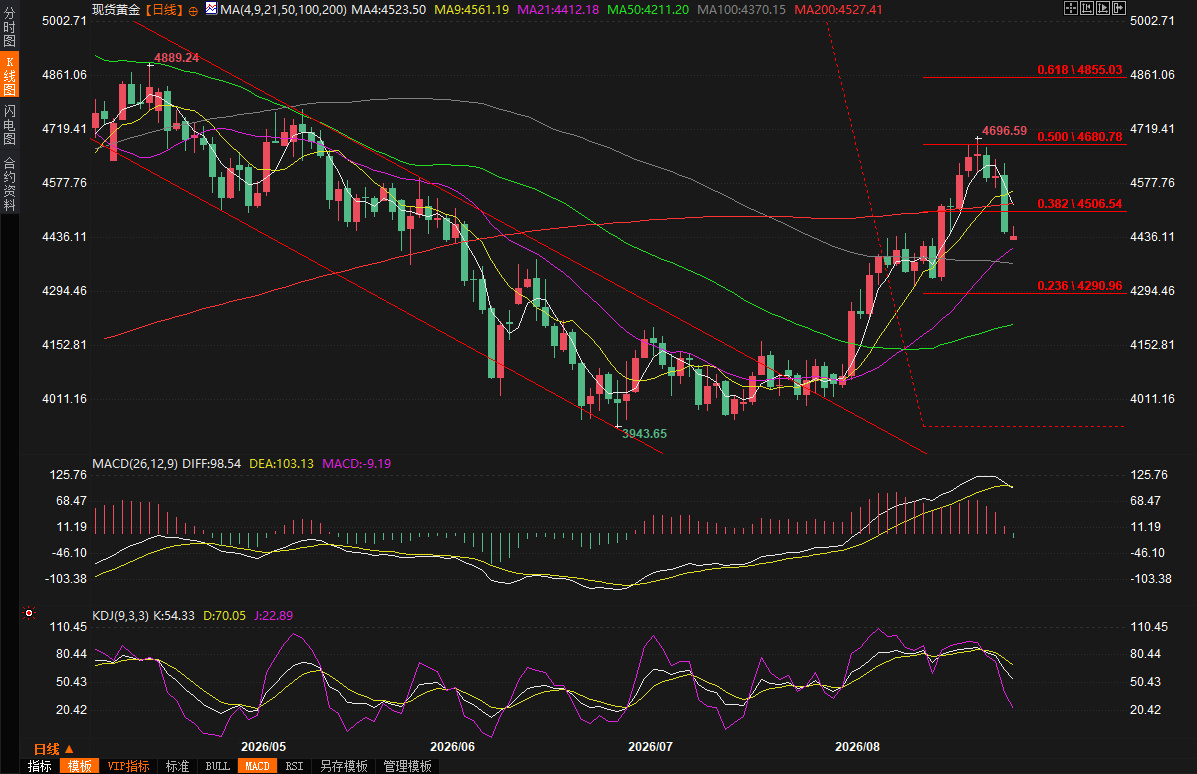 (Spot gold daily chart, source: EasyTrade) At 07:48 Beijing time, spot gold is currently trading at $4441.11 per ounce.
Warsh's speech: From vague to explicitly hawkish, the market reprices the path of interest rate hikes.
Warsh's keynote speech at the Jackson Hole Economic Symposium in Wyoming became the direct trigger for the recent gold price decline. He explicitly stated that if policymakers cannot be confident that core inflation is returning to the 2% target with clear and sufficiently rapid progress, then the Federal Reserve "still has work to do." This was his closest statement to date to acknowledging the possibility of needing to raise interest rates to alleviate price pressures. He emphasized that with the labor market remaining stable, inflation still too high, and financial conditions showing little indication that policy rates are having a restraining effect, the Fed's primary focus should be on prices. This statement contrasts sharply with his previous relatively cautious and even vague style. Warsh pointed out that inflation progress over the past two years has been quite limited; as of July, the Fed's preferred personal consumption expenditures price index rose 3.7% year-on-year. Recent data has not shown a significant improvement in the underlying trend, with about half of the items in the PCE goods and services basket still showing annual increases exceeding 3%. He further emphasized that inflation expectations must be closely monitored, and ensuring they do not lose their anchor is the Fed's responsibility. Short-term interest rates remain the primary tool for achieving the dual mandate, and currently, there are almost no signs of policy constraints in the credit and lending markets. Independent analyst Tai Wong pointed out that Warsh's statement confirmed that inflation had not slowed significantly, and that the Fed "has work to do," severely impacting gold prices. Although the market still suspects this might be all bark and no bite, the September meeting's decision is now viewed as a 50/50 chance. The CME FedWatch tool shows that traders believe the probability of a US rate hike in September jumped from about 36% before Warsh's speech to around 58%, with a December rate hike probability as high as 89%. This sharp change in expectations directly pushed up real interest rate expectations, and gold, as a non-interest-bearing asset, naturally loses its appeal in a high-interest-rate environment.The dollar and bond markets are moving in tandem: rising funding costs further strengthen the logic that gold is under pressure.
Warsh's hawkish signals quickly spread to the foreign exchange and bond markets. The dollar index surged 0.55% on Friday, its biggest one-day gain in two and a half months, and rose nearly 0.9% for the week, its biggest weekly gain in 10 weeks. The dollar's rise to a more than one-week high made dollar-denominated gold more expensive for holders using other currencies, further suppressing buying interest. Meanwhile, US Treasury yields rose significantly. The yield on the interest rate-sensitive two-year Treasury note rose nearly 12 basis points, hitting a more than one-month high; the yield on the ten-year Treasury note also rose to a one-week high. The yield curve flattened further. Analysts such as TD Securities believe that the market has already priced in more rate hike expectations. Bank of America analysts noted that Warsh clarified that the 2% inflation target is measured by the PCE, contrasting with his ambiguous statements at his July press conference, enhancing market clarity regarding the Fed's policy framework. These interconnected reactions form the core logic chain behind the decline in gold prices: hawkish rhetoric increases the probability of interest rate hikes → real interest rate expectations rise → the dollar strengthens → the opportunity cost of holding gold increases → funds flow out of the precious metals market. Although Warsh explicitly stated that his speech should not be regarded as "forward guidance" or even a clear reaction function, the market still quickly adjusted its pricing.Real Demand and Geopolitical Disturbances: India's Discounts Deepen, Middle East Conflicts Offer Potential Buffer
Beyond the financial-driven adjustments, the physical market is also showing signs of cooling. The discount on gold in India deepened significantly this week, with demand plummeting, leading to market speculation that the government may consider rescinding its recent decision to raise import tariffs. As a major global gold consumer, fluctuations in Indian demand often have a marginal impact on short-term prices. The current widening discount reflects the wait-and-see attitude of local buyers amid high prices and policy uncertainty. Geopolitically, the latest developments in the US-Iran conflict are also suppressing gold prices. The US military attacked missile silos on Iran's Larak Island on Sunday, the first military strike against Iranian targets since late July; Iran subsequently launched ballistic missiles at US bases in Jordan. Although most were intercepted, tensions escalated again, with US crude oil prices rising nearly 3% at the open on Monday. This is more supportive of inflation concerns and expectations of a Fed rate hike, and more likely to suppress gold prices. Since the conflict began on February 28, it has lasted for more than six months, and the shadow of the previous blockade of the Strait of Hormuz remains. While such events typically boost gold's safe-haven premium, in this round of market activity, their supporting effect has been overshadowed by the impact of expectations surrounding Federal Reserve policy, demonstrating that the current gold market is far more sensitive to interest rate paths than to geopolitical risk premiums.Sentiment Divergence and Data Window: Wall Street is half bullish, retail investor enthusiasm wanes, and the jobs report becomes a key variable.
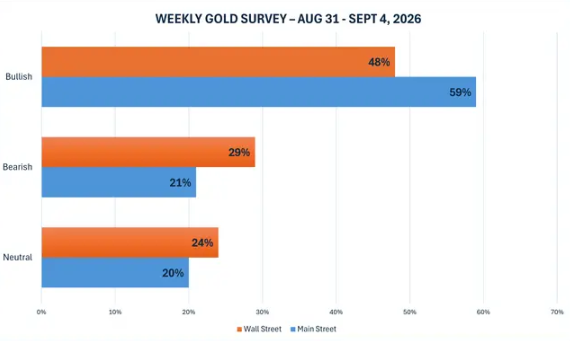
The latest Kitco News Weekly Gold Price Survey shows that despite a sharp drop in gold prices last Friday, about half of Wall Street analysts remain bullish. Of the 21 experts surveyed, 48% expect gold prices to rise in the coming week, 29% are bearish, and 24% believe prices will consolidate. Among retail investors, 59% of traders in the online poll remain bullish, but this percentage has fallen from last week's high, reflecting a cooling of sentiment after the weekend's correction. Analysts' opinions are clearly divided. Some believe Warsh has already hinted at a September rate hike, and pricing needs to rise further to a higher level before it truly materializes; others point out that momentum indicators are reversing, and gold prices may further decline to $4400 or even lower, especially as the dollar may continue to strengthen before the release of US employment data. Another side emphasizes that after a healthy correction, the long-term path remains upward, as the speech did not mention a genuine commitment to tightening or the US government reducing borrowing, suggesting Warsh may not ultimately turn hawkish. Looking ahead to this week, market focus will be heavily on the US August employment report, the ISM Purchasing Managers Index, JOLTS job openings data, and ADP employment data . The Reserve Bank of New Zealand is expected to raise rates, while the Bank of Canada is expected to hold rates steady. The G20 finance ministers and central bank governors meeting will also provide macroeconomic clues. The Federal Reserve will release its Beige Book, and several officials will speak. With only one key inflation report remaining before the September 15-16 policy meeting, this week's data will directly test Warsh's statement of "waiting for more data." If the labor market remains stable or strengthens, while inflationary pressures persist, market pricing in interest rate hikes may be revised upwards further; conversely, this could provide breathing room for gold prices. Overall, the core driver of this round of gold price adjustments is the repricing of expectations regarding Fed policy, rather than a fundamental deterioration in the economic fundamentals. Warsh's remarks did increase the likelihood of a rate hike, but the market remains skeptical about his final actions, and this "50/50" game inherently implies high volatility. Gold is indeed under pressure in a high-interest-rate environment, but inflation stickiness, geopolitical uncertainty, and the long-term trend of central bank gold purchases still provide support for prices in the medium to long term. In the short term, whether gold prices can hold the key support level around $4400 and find new direction after the release of employment data will determine whether this adjustment is a healthy correction or the beginning of a trend reversal. Investors need to closely monitor upcoming economic data and subsequent statements from Fed officials, seeking a new balance in the tug-of-war between interest rate expectations and safe-haven demand. (Spot gold daily chart, source: EasyTrade) At 07:48 Beijing time, spot gold is currently trading at $4441.11 per ounce.
- Risk Warning and Disclaimer
- The market involves risk, and trading may not be suitable for all investors. This article is for reference only and does not constitute personal investment advice, nor does it take into account certain users’ specific investment objectives, financial situation, or other needs. Any investment decisions made based on this information are at your own risk.