US and Iran attacked military targets, causing oil prices to jump at the open. How high can the geopolitical premium go?
2026-08-31 08:09:03
On Sunday (August 30), the U.S. military launched an airstrike on a Revolutionary Guard missile launch facility on Iran's Larak Island, marking the first U.S. military strike against targets inside Iran since July 29. The Iranian Revolutionary Guard responded by launching ballistic missiles at U.S. bases in Jordan and warned that "no aggression can weaken Iran's control over the Strait of Hormuz." 
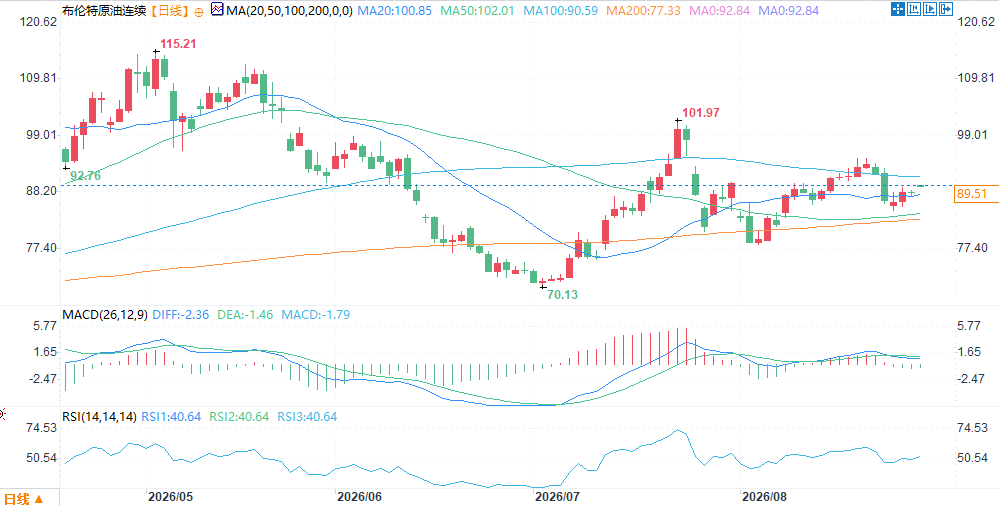 (Brent crude oil futures daily chart, source: FX678) At 8:04 AM Beijing time on August 31, Brent crude oil futures were trading at $89.58 per barrel.
US airstrikes on Larak Island shatter weeks of military calm
The U.S. military launched an airstrike on Sunday against two Revolutionary Guard missile launch sites on Iran's Larak Island, marking the first U.S. military strike against targets inside Iran since July 29. U.S. Central Command stated that it observed Revolutionary Guard personnel preparing to use these launchers to lay mines in the international shipping lanes of the Strait of Hormuz, prompting the attack. The U.S. military had just announced last week the completion of mine-clearing operations in the international shipping lanes of the Strait of Hormuz. U.S. President Trump had previously announced that all mines in the strait's international waters had been cleared. Iranian semi-official media reported explosions near Larak Island, and the Revolutionary Guard stated that the attack caused casualties among militants and civilians.Iranian missiles retaliate against US military bases in Jordan
Iran's Revolutionary Guard responded swiftly, announcing that it had launched ballistic missiles at the U.S. Hussein and Azraq air bases in Jordan. The Revolutionary Guard statement asserted that no enemy aggression could weaken Iran's control of the Strait of Hormuz and warned that "every launch will be met with an even stronger response." U.S. sources confirmed that Iran launched ballistic missiles at U.S. forces in Jordan, and almost all incoming missiles were successfully intercepted without causing significant damage or casualties. This was Iran's direct response to the U.S. airstrike on Larak Island, marking a new escalation of direct military confrontation between the U.S. and Iran after weeks of relative calm.Background of Conflict Escalation: From Military Confrontation to Economic Pressure
The conflict has lasted for over six months since the US and Israel launched their war against Iran on February 28. In the preceding weeks, the military confrontation between the US and Iran was relatively subdued, with Washington shifting towards economic pressure. However, Sunday's airstrikes demonstrate that military options remain in the US toolbox. As the conflict continues, Iran has suffered direct and indirect losses amounting to $270 billion. Traffic in the Strait of Hormuz remains far below pre-war levels—a stark contrast to Trump's claim of "unimpeded passage." The British military stated that an oil tanker was attacked by an unidentified flying object in the strait near Oman on Saturday. The Iranian Revolutionary Guard warned that any aggression would not weaken Iran's control over the strait, and the risk of escalation has significantly increased.Geopolitical risks escalated suddenly, and supply premiums quickly returned to normal.
Sunday's US airstrike on Iran's Larak Island and Iran's subsequent ballistic missile attack on US bases in Jordan marked a sudden escalation of the US-Iran military confrontation after weeks of relative calm. This event had an immediate short-term impact on Brent crude futures prices—geopolitical risk premiums are rapidly being re-incorporated into prices. On Monday (August 31), Brent crude opened about 1.5% higher in Asian trading and is currently trading near the $90/barrel mark, as market concerns about the safety of passage through the Strait of Hormuz have intensified again. The supply risks in the Strait of Hormuz have never truly subsided. Although the US military announced last week that it had completed mine-clearing operations, the daily oil flow through the strait remains far below pre-war levels—Trump's claim of "24 ships passing through" contrasts sharply with the normal flow of about 130 ships per day before the war. The Iranian Revolutionary Guard has explicitly warned that "no aggression can weaken control over the Strait of Hormuz," meaning that if the conflict escalates, about one-fifth of the world's oil supply (about 20 million barrels per day) faces a substantial risk of disruption. If the military confrontation between the US and Iran escalates further, Brent crude oil could quickly push towards the $100/barrel mark. Even if the conflict is kept under control at its current level, the uncertainty surrounding passage through the Strait of Hormuz is enough to support oil prices in the high $90/barrel range. In the short term, oil price movements will be highly sensitive to the next developments in the US-Iran military confrontation.Bessant escalates financial sanctions against Iran
U.S. Treasury Secretary Bessenter announced on Sunday that the Treasury Department plans to impose more secondary sanctions on Iran each week, starting with banks, and warned that "the next time it could be a direct sanctions on a bank." This comes after the U.S. imposed restrictions on an Egyptian bank's branch in the UAE. Bessenter emphasized that holding Iranian funds or aiding the Iranian regime is "unacceptable." This move marks a significant escalation in financial pressure on Iran. Direct sanctions on banks will sever their ties to the dollar clearing system, forcing global financial institutions to choose between Iranian operations and U.S. financial access. Iran has long circumvented sanctions and received payments for oil through regional banking networks, including those in the UAE. Banking sanctions are seen as a key step in cutting off Iran's remaining financial lifeline. For the oil market, expanded financial sanctions could further compress settlement channels for Iranian oil exports. Even if the physical blockade at Hormuz does not escalate, Iran's ability to sell oil through shadow banking will be weakened, keeping geopolitical risk premiums for oil prices high. Bessenter's statement suggests that financial pressure will continue unless Iran returns to negotiations.Institutional Views
Morgan Stanley significantly raised its Brent crude oil price forecast at the end of August, primarily due to a slower-than-expected recovery in Middle Eastern supply and a continued tightening of the global oil market. The firm noted that floating storage inventories have decreased sharply by approximately 168 million barrels since mid-July, with onshore inventories declining in tandem, rapidly depleting the supply buffer. Middle Eastern exports have fallen back to March and April levels. Analysts predict that a full recovery in Middle Eastern supply will continue until 2027, with the market remaining in deficit in the fourth quarter of 2026 and the first quarter of 2027. Specifically, the forecast is for an average price of approximately $90 per barrel in the third quarter of 2026, rising to nearly $100 per barrel in the fourth quarter, falling back to $95 per barrel in the first quarter of 2027, and remaining at $90 per barrel in the second quarter. Goldman Sachs believes that the physical market continues to tighten, with global visible inventories declining at a rate of approximately 6.3 million barrels per day recently, mainly due to reduced flows in the Gulf and Red Seas, decreased Russian exports, and increased Asian imports; the seven-day moving average of Gulf exports has fallen to approximately 36% of pre-war levels. Goldman Sachs stated that under the upside risk scenario, if disruptions persist, the price could exceed $120 in the fourth quarter, with an average price of around $100 by 2027; on the downside, it could fall to a low of $60. (Brent crude oil futures daily chart, source: FX678) At 8:04 AM Beijing time on August 31, Brent crude oil futures were trading at $89.58 per barrel.
- Risk Warning and Disclaimer
- The market involves risk, and trading may not be suitable for all investors. This article is for reference only and does not constitute personal investment advice, nor does it take into account certain users’ specific investment objectives, financial situation, or other needs. Any investment decisions made based on this information are at your own risk.