With the US refusing to introduce new interventions or force interest rate hikes, who will be the next destination for the yen?
2026-08-31 08:40:03
U.S. Treasury Secretary Bessant said on Sunday (August 30) that the yen's recent movements were "quite controlled," denying that it was in a disorderly state and suggesting that Washington currently does not see the need for a new round of coordinated intervention. Bessant declined to comment on whether the Bank of Japan should raise interest rates continuously, saying he would not "tell the central bank what to do," and expressed confidence that Bank of Japan Governor Kazuo Ueda would "do the right thing." 
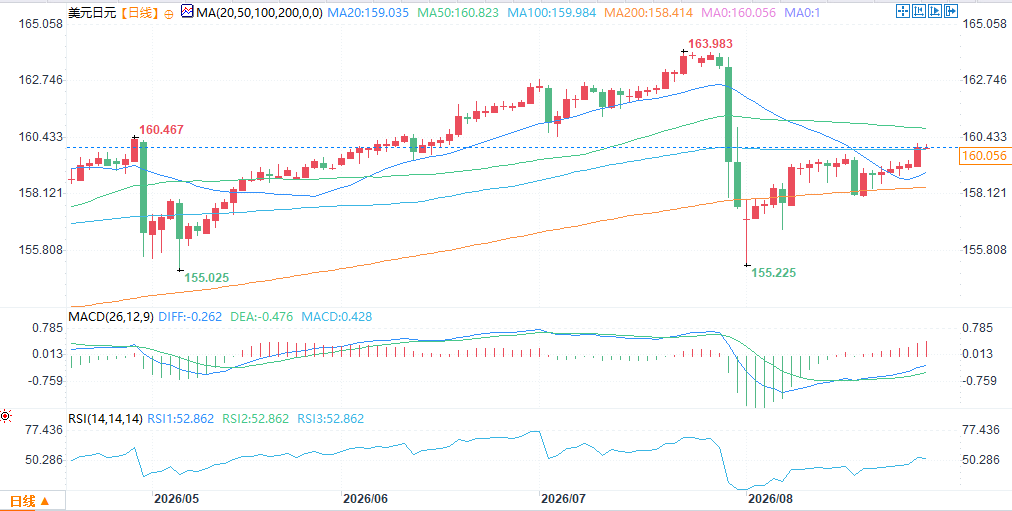 (USD/JPY daily chart, source: EasyForex) At 8:27 Beijing time, USD/JPY was trading at 160.04/05.
Bessant: The yen's movement is "quite controlled," and he does not believe new intervention is needed.
U.S. Treasury Secretary Scott Bessant stated in a media interview on Sunday that recent yen exchange rate fluctuations are "quite controlled" and not disorderly. This statement contrasts sharply with the official wording used by the U.S. and Japan during their joint intervention last month. At that time, the yen fell to its lowest level against the dollar since 1986, hitting a range of approximately 163-164. For the first time since 1998, the two countries jointly bought yen to curb excessive volatility and prevent it from spreading to global markets. Japanese officials emphasized that the intervention was aimed at "excessive volatility," while Bessant had previously warned that disorderly yen movements could trigger forced liquidation of positions, thereby pushing up U.S. borrowing costs. While the yen has now fallen below the 160 level again, sparking speculation about further intervention, Bessant believes the trend has significantly eased, and Washington does not see the need to repeat last month's actions. His remarks send a clear signal: the U.S. has increased its tolerance for the current exchange rate level, and the threshold for intervention has not been lowered to the point of immediate action. This stance helps stabilize market expectations, reduces excessive bets on joint intervention in the short term, and shows that the U.S. and Japan prefer to observe fundamental changes rather than frequently use administrative measures in their exchange rate coordination. The USD/JPY exchange rate may be more influenced by Japanese economic data and policy signals in the short term.Trusting Ueda, he refused to comment on the possibility of continuous interest rate hikes.
In an interview, Bessant declined to comment specifically on whether the Bank of Japan should raise interest rates continuously to address the yen's depreciation, emphasizing, "I won't tell them what to do," and explicitly expressing his trust in Bank of Japan Governor Kazuo Ueda to "do the right thing." He noted that Ueda, with the support of Prime Minister Sanae Takaichi, is capable of handling monetary policy effectively. Bessant plans to meet with Ueda this week during the G20 finance ministers' meeting in Asheville, North Carolina, and highly praised him as an "underrated, astute market operator." The two have known each other for 15 years, and Bessant has great confidence in Ueda's economic expertise and market acumen. Previously, Bessant had repeatedly called on the Bank of Japan to raise interest rates to address inflation and the yen's weakness, leading the market to almost fully price in a September rate hike. His deliberate restraint in avoiding direct pressure demonstrates respect for the Bank of Japan's independence and also conveys the US's satisfaction with the current policy path. The meeting coincides with the G20 meeting, and the two sides are likely to exchange in-depth views on exchange rate stability, monetary policy normalization, and global economic coordination. Bessant's statement helped alleviate market concerns about strong US intervention in Japan's monetary policy, allowing the focus to return to domestic Japanese data and inflation trends.Abenomics has reached its end; Japan should allow its achievements to continue to flourish.
Bessant further pointed out that Japan may have reached the end of Abenomics. This reflation plan, centered on large-scale monetary stimulus, fiscal expansion, and structural reforms, was launched in 2013 by the late Prime Minister Shinzo Abe to escape long-term deflation. He stated that under the leadership of the Sanae Takaichi government, government intervention has decreased, and Japan should allow the achievements accumulated by Abenomics to take effect naturally, entering a new phase of "Takaichi Economics." Bessant believes that Japan has successfully "conquered" deflation and can now enjoy the economic vitality brought about by past policies. These remarks indicate that Washington is satisfied with Tokyo's gradual normalization of policies, rather than rushing to push for faster and stronger yen support measures. The US values Japan's sustainable growth through endogenous reforms and monetary policy adjustments more than reliance on external intervention. Bessant's assessment provides a policy tone for the market: the USD/JPY exchange rate will be more sensitive in the short term to the release of Japanese economic data, central bank statements, and official communications during the G20 summit, rather than new US pressure or expectations of joint action. Overall, the US stance has shifted from active intervention to observation and trust, which is conducive to the gradual stabilization of the yen driven by fundamentals.Bessant stated that he would lower expectations for intervention, and that the policy path would return to data-driven approaches.
Bessant's statement that "the yen's movement is quite under control" has reduced market expectations for another coordinated intervention in the short term. Previously, when the yen broke below the 160 level, the market speculated that the US and Japan might coordinate another intervention. Bessant's comments essentially confirm that the 160 level is not an "automatic trigger line," easing the intervention pressure on USD/JPY around 160. Bessant's refusal to comment on the Bank of Japan's continued interest rate hikes, emphasizing "trusting Ueda to do the right thing," means that the US will no longer exert additional political pressure on the Bank of Japan, allowing the Bank of Japan's policy path to return to data-driven—domestic indicators such as Tokyo inflation, service sector prices, and wage growth will once again become the core variables for the yen's movement. Bessant's judgment that Abenomics has reached its end confirms the long-term direction of Japan's policy normalization, and the medium-term trend of USD/JPY will depend more on the natural evolution of the US-Japan interest rate differential. If the meeting between Bessant and Ueda during the G20 meeting releases signals of coordination, it may provide short-term support for the yen. Overall, USD/JPY is expected to fluctuate in the 158-161 range in the short term, awaiting new data and policy signals to break the deadlock. (USD/JPY daily chart, source: EasyForex) At 8:27 Beijing time, USD/JPY was trading at 160.04/05.
- Risk Warning and Disclaimer
- The market involves risk, and trading may not be suitable for all investors. This article is for reference only and does not constitute personal investment advice, nor does it take into account certain users’ specific investment objectives, financial situation, or other needs. Any investment decisions made based on this information are at your own risk.