The pound/dollar pair rose and then fell back as expectations of a Fed rate hike intensified and the safe-haven dollar strengthened.
2026-08-31 14:43:03
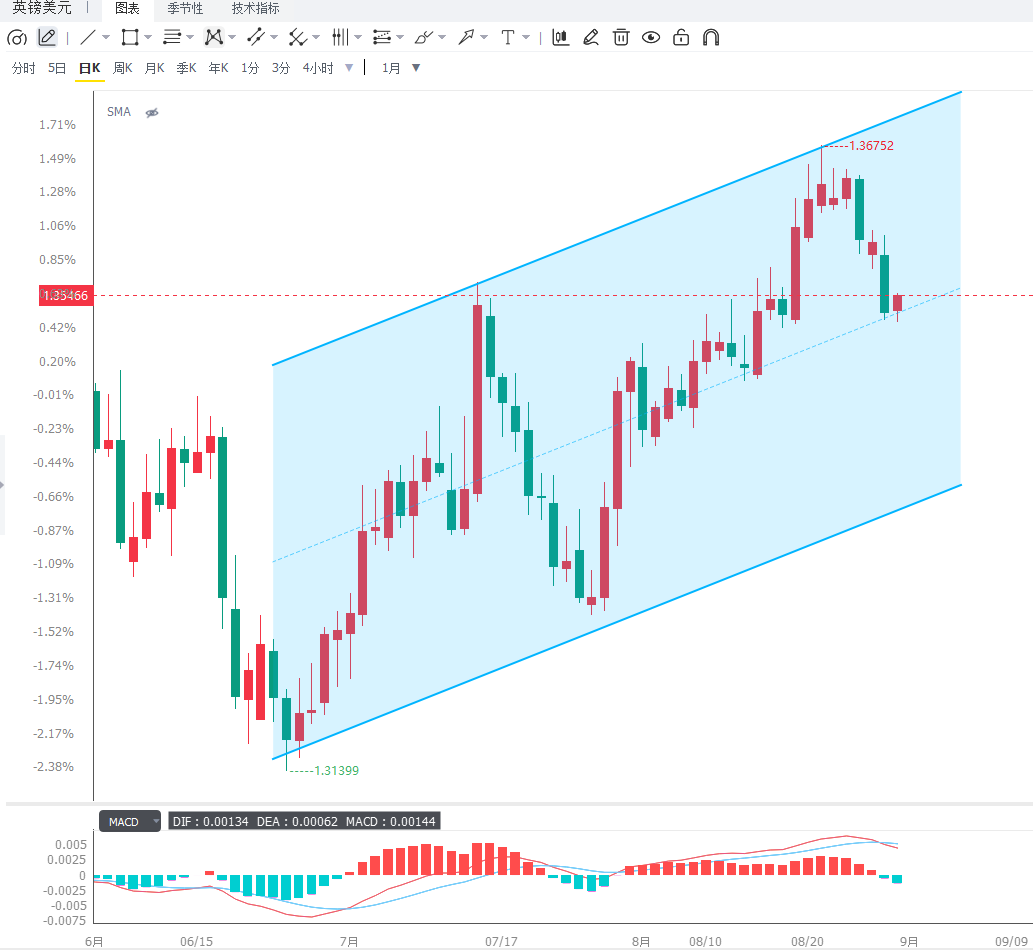
The pound/dollar pair saw a modest rebound in Asian trading on Monday, partially recovering its significant losses from last Friday, and is currently trading below 1.3550. Previously, the pound/dollar had been pulling back from its highest level since February reached this month, falling to a more than one-week low last Friday. While month-end rebalancing has temporarily slowed the dollar's short-term rally, providing some breathing room for the pound, the bulls currently lack sufficiently strong momentum, and the market should remain wary that the previous correction may not yet be over.  The US dollar entered a consolidation phase after a significant strengthening on Friday. Federal Reserve Chairman Kevin Warsh delivered a hawkish signal at the Jackson Hole symposium, emphasizing that while recent US inflation data has improved, it is insufficient to prove a substantial change in underlying price trends. He stated that if inflation fails to return to the 2% target at a sufficiently clear pace, the Fed will still need to further tighten policy. This statement significantly altered some of the market's previous expectations of a gradual shift towards easing US monetary policy. Currently, market bets on further Fed tightening in September have increased significantly. For GBP/USD, this means the dollar has regained support from interest rate expectations, increasing relative valuation pressure on the pound. If subsequent US employment and inflation data continue to show strong economic resilience, the market may further increase the probability of a Fed rate hike, and the dollar's upward trend may continue. Meanwhile, UK domestic fiscal policy has become a key factor supporting the pound. Chancellor of the Exchequer John Healy emphasized that the government needs to prioritize fiscal discipline before the upcoming autumn budget. Market attention to the UK's fiscal situation has increased recently; therefore, if the government can continue to signal its commitment to controlling the fiscal deficit and stabilizing public finances, it will help alleviate market concerns about UK fiscal risks and provide some fundamental support for the pound. However, the Bank of England's policy expectations have not shifted hawkish in tandem. The market has now further postponed its expectation for the next Bank of England rate hike from the end of 2026 to 2027. This means the interest rate expectation gap between the UK and the US may continue to tilt towards the US dollar. If UK economic data fails to improve significantly, or inflationary pressures continue to ease, the Bank of England lacks the incentive to further tighten policy in the short term, which will limit the pound's upside potential. The divergence in monetary policy expectations between the US and the UK is one of the core factors preventing the pound/dollar from forming a sustained upward trend. In the US, the market is re-discussing the possibility of rate hikes; in the UK, the market is further postponing rate hike expectations. Even if the UK's fiscal policy remains relatively sound, it will not be enough to completely offset the impact of changes in the interest rate differential. Geopolitical risks further enhance the dollar's defensive attributes. Recent renewed tensions between the US and Iran, with Iran responding militarily after the US strikes Iranian military targets, have again drawn market attention to the security of the Strait of Hormuz and global energy transport risks. Escalating geopolitical tensions typically drive capital flows to highly liquid safe-haven assets such as the US dollar, thus putting additional pressure on the pound/dollar. Rising energy prices may also affect the exchange rate market through inflation. If crude oil prices continue to rise, global inflationary pressures may increase again, limiting the path of interest rate cuts by major central banks. However, for the UK, high energy costs could further increase spending pressure on businesses and households, negatively impacting economic growth. Therefore, rising oil prices are not simply a boon for the pound; the market needs to distinguish between the different impacts of energy export revenue and imported inflation. This week, market focus will gradually shift to a new round of US macroeconomic data, with the non-farm payroll report being particularly important. If the US job market continues to perform strongly, it will provide more room for the Federal Reserve to further tighten policy, and the dollar may continue its recent upward trend. If employment cools significantly, market bets on a September rate hike may decline, weakening the dollar's upward momentum, and the pound/dollar pair may regain room for a rebound. In addition, the UK also needs to pay attention to employment, wage, and economic growth data. If the UK labor market remains resilient and wage growth remains high, the possibility of the Bank of England tightening policy again in the future will not completely disappear, helping to alleviate the pound's interest rate disadvantage. Conversely, if UK economic data continues to be weak, the market will further postpone expectations of a Bank of England rate hike, and the pound may continue to be under pressure. From a market sentiment perspective, the GBP/USD pair is currently in a fairly typical pattern of "dominant dollar policy advantage and partial support for the pound." Month-end fund adjustments may cause short-term volatility in the dollar, but if new US data continues to validate hawkish policy expectations, the dollar's fundamental advantage may regain dominance. Therefore, caution is advised when chasing rallies before GBP/USD has firmly established itself above key technical resistance levels. Looking at the daily chart, GBP/USD has been undergoing a sustained pullback from its February highs, and the short-term trend has shifted from a strong uptrend to a correction. If the exchange rate fails to recover the 1.3550-1.3580 area, the rebound is more likely to be seen as a technical correction rather than the start of a new uptrend. The 100-period moving average near 1.3559 provides direct resistance, while the 23.6% Fibonacci retracement level near 1.3579 further strengthens the pressure. If the price breaks through 1.3579, the next resistance levels to watch are 1.3620 and 1.3680. Conversely, if the rebound is again met with resistance and the price breaks below the 38.2% Fibonacci support around 1.3521, it may further adjust towards the 50% retracement level of 1.3474. If the 50% level is also breached, 1.3427 will become the next important support level. Overall, the daily chart still needs more signals to confirm whether the pullback has ended. Looking at the 4-hour chart, GBP/USD is currently oscillating between multiple Fibonacci levels, showing a neutral to slightly bearish short-term pattern. The 100-period moving average around 1.3559 and the 23.6% retracement level around 1.3579 form a relatively dense resistance zone above. Only a decisive break and hold above this area will allow the bulls to regain control in the short term. The first support level to watch is 1.3521. If this level is broken on the 4-hour chart, the correction could extend further to 1.3474 and 1.3427. If 1.3427 is also breached, the 78.6% Fibonacci retracement level around 1.3360 will become a deeper support level. Conversely, if the price breaks above 1.3579 and holds above it, a short-term rebound could extend towards 1.3620 or even 1.3680. Currently, 1.3521 and 1.3579 are key support and resistance levels for both bulls and bears in the short term.
  Editor's Summary: The GBP/USD pair remains pressured by divergent monetary policy expectations between the US and UK. Hawkish signals from the Federal Reserve are fueling expectations of a US rate hike, while the Bank of England's next rate hike is expected to be pushed further back to 2027. This interest rate differential gives the US dollar a fundamental advantage. The future direction of GBP/USD will ultimately depend on US employment and inflation data. Strong US non-farm payrolls could push the dollar higher, potentially towards 1.3474 or even 1.3427. Conversely, a significant cooling in US employment data and a decline in rate hike expectations could see GBP/USD break above 1.3580 and recover to higher levels. At this stage, it's more appropriate to focus on trend confirmation after a breakout from key technical levels rather than blindly chasing the market in the middle of the range.
The US dollar entered a consolidation phase after a significant strengthening on Friday. Federal Reserve Chairman Kevin Warsh delivered a hawkish signal at the Jackson Hole symposium, emphasizing that while recent US inflation data has improved, it is insufficient to prove a substantial change in underlying price trends. He stated that if inflation fails to return to the 2% target at a sufficiently clear pace, the Fed will still need to further tighten policy. This statement significantly altered some of the market's previous expectations of a gradual shift towards easing US monetary policy. Currently, market bets on further Fed tightening in September have increased significantly. For GBP/USD, this means the dollar has regained support from interest rate expectations, increasing relative valuation pressure on the pound. If subsequent US employment and inflation data continue to show strong economic resilience, the market may further increase the probability of a Fed rate hike, and the dollar's upward trend may continue. Meanwhile, UK domestic fiscal policy has become a key factor supporting the pound. Chancellor of the Exchequer John Healy emphasized that the government needs to prioritize fiscal discipline before the upcoming autumn budget. Market attention to the UK's fiscal situation has increased recently; therefore, if the government can continue to signal its commitment to controlling the fiscal deficit and stabilizing public finances, it will help alleviate market concerns about UK fiscal risks and provide some fundamental support for the pound. However, the Bank of England's policy expectations have not shifted hawkish in tandem. The market has now further postponed its expectation for the next Bank of England rate hike from the end of 2026 to 2027. This means the interest rate expectation gap between the UK and the US may continue to tilt towards the US dollar. If UK economic data fails to improve significantly, or inflationary pressures continue to ease, the Bank of England lacks the incentive to further tighten policy in the short term, which will limit the pound's upside potential. The divergence in monetary policy expectations between the US and the UK is one of the core factors preventing the pound/dollar from forming a sustained upward trend. In the US, the market is re-discussing the possibility of rate hikes; in the UK, the market is further postponing rate hike expectations. Even if the UK's fiscal policy remains relatively sound, it will not be enough to completely offset the impact of changes in the interest rate differential. Geopolitical risks further enhance the dollar's defensive attributes. Recent renewed tensions between the US and Iran, with Iran responding militarily after the US strikes Iranian military targets, have again drawn market attention to the security of the Strait of Hormuz and global energy transport risks. Escalating geopolitical tensions typically drive capital flows to highly liquid safe-haven assets such as the US dollar, thus putting additional pressure on the pound/dollar. Rising energy prices may also affect the exchange rate market through inflation. If crude oil prices continue to rise, global inflationary pressures may increase again, limiting the path of interest rate cuts by major central banks. However, for the UK, high energy costs could further increase spending pressure on businesses and households, negatively impacting economic growth. Therefore, rising oil prices are not simply a boon for the pound; the market needs to distinguish between the different impacts of energy export revenue and imported inflation. This week, market focus will gradually shift to a new round of US macroeconomic data, with the non-farm payroll report being particularly important. If the US job market continues to perform strongly, it will provide more room for the Federal Reserve to further tighten policy, and the dollar may continue its recent upward trend. If employment cools significantly, market bets on a September rate hike may decline, weakening the dollar's upward momentum, and the pound/dollar pair may regain room for a rebound. In addition, the UK also needs to pay attention to employment, wage, and economic growth data. If the UK labor market remains resilient and wage growth remains high, the possibility of the Bank of England tightening policy again in the future will not completely disappear, helping to alleviate the pound's interest rate disadvantage. Conversely, if UK economic data continues to be weak, the market will further postpone expectations of a Bank of England rate hike, and the pound may continue to be under pressure. From a market sentiment perspective, the GBP/USD pair is currently in a fairly typical pattern of "dominant dollar policy advantage and partial support for the pound." Month-end fund adjustments may cause short-term volatility in the dollar, but if new US data continues to validate hawkish policy expectations, the dollar's fundamental advantage may regain dominance. Therefore, caution is advised when chasing rallies before GBP/USD has firmly established itself above key technical resistance levels. Looking at the daily chart, GBP/USD has been undergoing a sustained pullback from its February highs, and the short-term trend has shifted from a strong uptrend to a correction. If the exchange rate fails to recover the 1.3550-1.3580 area, the rebound is more likely to be seen as a technical correction rather than the start of a new uptrend. The 100-period moving average near 1.3559 provides direct resistance, while the 23.6% Fibonacci retracement level near 1.3579 further strengthens the pressure. If the price breaks through 1.3579, the next resistance levels to watch are 1.3620 and 1.3680. Conversely, if the rebound is again met with resistance and the price breaks below the 38.2% Fibonacci support around 1.3521, it may further adjust towards the 50% retracement level of 1.3474. If the 50% level is also breached, 1.3427 will become the next important support level. Overall, the daily chart still needs more signals to confirm whether the pullback has ended. Looking at the 4-hour chart, GBP/USD is currently oscillating between multiple Fibonacci levels, showing a neutral to slightly bearish short-term pattern. The 100-period moving average around 1.3559 and the 23.6% retracement level around 1.3579 form a relatively dense resistance zone above. Only a decisive break and hold above this area will allow the bulls to regain control in the short term. The first support level to watch is 1.3521. If this level is broken on the 4-hour chart, the correction could extend further to 1.3474 and 1.3427. If 1.3427 is also breached, the 78.6% Fibonacci retracement level around 1.3360 will become a deeper support level. Conversely, if the price breaks above 1.3579 and holds above it, a short-term rebound could extend towards 1.3620 or even 1.3680. Currently, 1.3521 and 1.3579 are key support and resistance levels for both bulls and bears in the short term. Editor's Summary: The GBP/USD pair remains pressured by divergent monetary policy expectations between the US and UK. Hawkish signals from the Federal Reserve are fueling expectations of a US rate hike, while the Bank of England's next rate hike is expected to be pushed further back to 2027. This interest rate differential gives the US dollar a fundamental advantage. The future direction of GBP/USD will ultimately depend on US employment and inflation data. Strong US non-farm payrolls could push the dollar higher, potentially towards 1.3474 or even 1.3427. Conversely, a significant cooling in US employment data and a decline in rate hike expectations could see GBP/USD break above 1.3580 and recover to higher levels. At this stage, it's more appropriate to focus on trend confirmation after a breakout from key technical levels rather than blindly chasing the market in the middle of the range.
- Risk Warning and Disclaimer
- The market involves risk, and trading may not be suitable for all investors. This article is for reference only and does not constitute personal investment advice, nor does it take into account certain users’ specific investment objectives, financial situation, or other needs. Any investment decisions made based on this information are at your own risk.