With the escalating US-Iran conflict and the near standstill in the Taiwan Strait, why are oil prices only experiencing wide fluctuations?
2026-08-31 15:58:02
On Monday (August 31), oil prices opened 2% higher during the Asian and European sessions, then fluctuated at high levels. Currently, WTI crude oil futures are trading around 85.22, up 2.18%. Over the weekend, the US military bombed two missile silos suspected of being mines on Iran's Larak Island. Iran subsequently reacted swiftly by launching ballistic missiles at US military bases in Jordan. This aligns with the predictions made in last week's articles that Iran would likely seize the opportunity presented by falling oil prices and reduced international attention to Iran to initiate this suspected mine-laying incident, ultimately leading to a US-Iran standoff and a rise in oil prices. Recently, the US military's resumption of military strikes against Iran, the near paralysis of shipping in the Strait of Hormuz, the deadlock in US-Iran negotiations, and the US's extreme economic sanctions have all contributed to the continued disruption of the global oil supply chain, causing international oil prices to once again experience a rise in geopolitical risk premiums. 
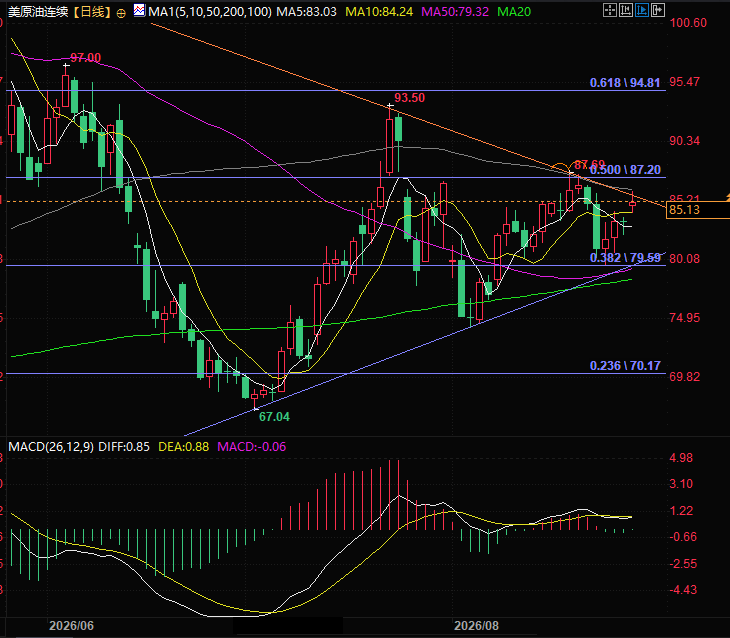 (WTI crude oil futures daily chart, source: EasyTrade) At 15:55 Beijing time, WTI crude oil futures were trading at $85.13 per barrel.
Military friction between the US and Iran has resumed, and regional conflicts have escalated again.
On Sunday, the U.S. military conducted a precision strike on a rocket launcher on Iran's Larak Island in the Strait of Hormuz. This marked the first U.S. military action against Iran in a month since the large-scale airstrikes on July 29, breaking weeks of battlefield silence between the two sides. The U.S. Central Command explicitly stated that the operation was a preventative defensive strike, based on intelligence monitoring indicating that the Iranian Revolutionary Guard was preparing to lay rockets and mines in the international shipping lanes of the strait. The U.S. military had just completed minesweeping operations in the main shipping lanes of the strait last week. The strike was intended to protect the safety of global merchant shipping and maintain international trade order, not a proactive military provocation. This strike directly triggered a strong Iranian retaliation. Iranian officials confirmed that they had launched ballistic missiles at U.S. bases in Jordan in retaliation. The Jordanian military monitored and successfully intercepted eight incoming missiles, causing no casualties or damage to facilities. Iran clearly considers the Strait of Hormuz a non-negotiable strategic red line and is finalizing a joint management agreement with Oman. Iran insists that it will not fully open the strait to navigation until the U.S. completely ends the war, lifts the blockade and sanctions, and completes war reparations, while reserving the right to strike unauthorized vessels. The US has completely abandoned its short-term military victory strategy, shifting to a dual strategy of extreme economic sanctions as the primary approach, supplemented by military deterrence. US Treasury Secretary Bessenter publicly stated that the new round of comprehensive sanctions will block all of Iran's revenue sources, while also introducing secondary sanctions to force major trading partners such as China, Turkey, and the UAE to sever trade ties with Iran. The UAE has already announced a complete suspension of trade with Iran, further tightening Iran's external economic circulation. The Iranian Revolutionary Guard has issued a strong statement condemning the US action as a fatal mistake in the context of economic warfare, threatening comprehensive retaliation on both military and economic fronts, escalating regional conflict once again. The core reason for the US strategic shift is the apparent shortage of its own military equipment. The ongoing Middle East conflict has depleted a large amount of advanced air defense interception munitions, and the Patriot missile stockpile of the US military and NATO in Europe continues to decline. Long-term high-intensity military investment is unsustainable, and the cost and risk of forcibly opening up the straits by force are too high. At the same time, the battlefield stalemate continues to reshape the geopolitical landscape of the Middle East, and the Gulf countries' trust in the US security umbrella has declined significantly. Saudi Arabia and other countries have begun to seek to build new defense cooperation systems with Pakistan and Turkey, and the US's dominance in the Middle East continues to weaken.Shipping through the Strait of Hormuz has nearly ground to a halt, and crude oil transport routes have shrunk dramatically.
Shipping data shows that by the end of August, the number of monitored commodity vessels passing through the Strait of Hormuz on weekends had plummeted to an average of only five vessels per day, all of which were small vessels, including only two liquefied petroleum gas (LPG) carriers; large crude oil tankers were almost nonexistent. Before the war, the Strait saw an average of around 130 vessels passing through daily; the current volume is less than 4% of the normal level. To avoid attacks, many merchant ships have chosen to disable their Automatic Identification Systems (AIS) and navigate covertly. The actual number of vessels passing through is slightly higher than the monitored data, but the overall stagnation of shipping remains unchanged. The shipping security environment in the Strait continues to deteriorate, with frequent attacks. Last week alone, the UK's Office for Maritime Trade Operations recorded three attacks on vessels in the Strait. The latest incident occurred on Saturday, when an oil tanker was attacked by an unidentified projectile in the waters north of Hasab, Oman. Fortunately, there were no casualties or marine pollution. Shipping companies have generally adopted extremely conservative strategies, actively reducing, detouring, or even canceling strait routes, resulting in a significant decrease in the efficiency of global crude oil maritime transport. As of Sunday, the US military's maritime blockade had forced 83 merchant ships to divert and seized 3 ships in Iranian ports, further exacerbating waterway congestion and supply shortages.Iran's economy is mired in recession, and despite the pressure of sanctions, it remains committed to its strategic bottom line.
The combination of long-term sanctions and six months of war has plunged Iran's economy into a deep recession. The Iranian rial has fallen to a record low of 2.02 million rials to the US dollar. Since the war began, rice prices have risen by 60% and beef prices have soared by 150%, leading to significant inflation in essential goods. The IMF predicts that Iran's GDP will shrink by more than 5% this year, with unemployment continuing to rise and many people facing hardship. However, economic pressure has not translated into political compromise. Leveraging its years of experience in combating sanctions, Iran has circumvented restrictions through domestic production, cross-border grey trade, and a shadow tanker fleet, demonstrating resilience far exceeding US expectations. More importantly, the strategic leverage of its control of the Strait of Hormuz allows Iran to continue to constrain the US, forcing the US to withstand public and economic pressure regarding rising energy prices before the midterm elections.Summary and Technical Analysis:
The US-Iran conflict shows no signs of easing, and the sluggish shipping situation in the Strait of Hormuz is expected to continue for a long time. Iran hopes for a compromise from the US, and has reached a near-agreement with Oman, but dares not rashly open the Strait. Oil prices and the Strait are Iran's most important bargaining chips. As long as oil prices do not rise out of control, the US will choose to impose economic sanctions to weaken Iran, forcing Iran to increase domestic pressure and take the initiative to negotiate with the US. The global crude oil supply chain will continue to face structural disruptions. Shipping disruptions and increased geopolitical risks will continue to support high oil prices. If the conflict escalates further, the possibility of another sharp rise in oil prices cannot be ruled out, and global energy inflation and economic recovery pressures will continue to intensify. However, the overall strategy remains that rising oil prices will be subject to potential negative news from the US, while falling oil prices will be subject to positive news from Iran. Overall, oil prices are in a wide-ranging fluctuation environment. At the same time, due to domestic inflationary pressures and national debt pressures in the US, coupled with some oil tankers secretly passing through the Strait of Hormuz, we believe that oil prices are still under control. From a technical perspective, WTI oil prices have currently encountered resistance at the trendline of a triangle pattern and retreated. Support is around 83, while resistance is near the orange resistance line of the triangle formation. (WTI crude oil futures daily chart, source: EasyTrade) At 15:55 Beijing time, WTI crude oil futures were trading at $85.13 per barrel.
- Risk Warning and Disclaimer
- The market involves risk, and trading may not be suitable for all investors. This article is for reference only and does not constitute personal investment advice, nor does it take into account certain users’ specific investment objectives, financial situation, or other needs. Any investment decisions made based on this information are at your own risk.