Rising oil prices and increasing expectations of a Federal Reserve rate hike kept the USD/CAD exchange rate in a narrow range.
2026-08-31 14:46:02
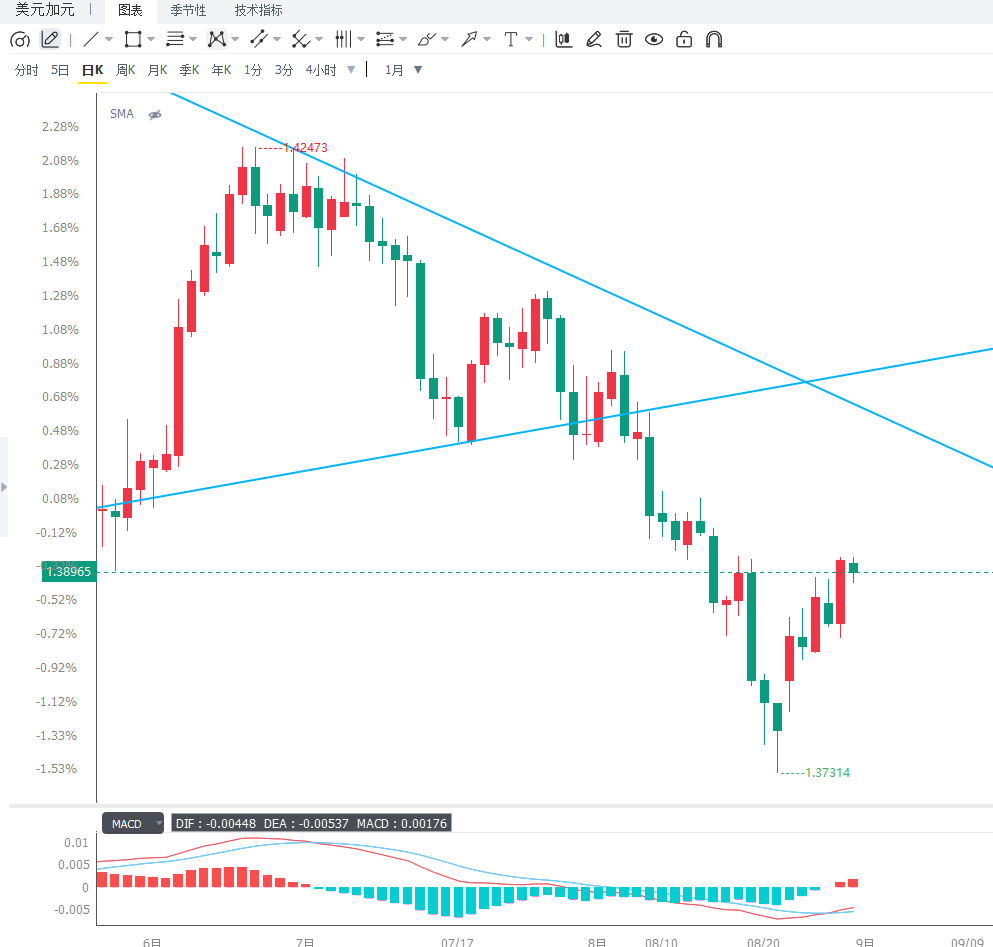
The USD/CAD pair weakened slightly in Asian trading on Monday, last trading around 1.3890. The pair has gradually retreated after encountering significant resistance near the 1.40 level, while rising oil prices have further strengthened the Canadian dollar's relative advantage. Currently, the market is influenced by both developments in the Middle East and a reassessment of the Federal Reserve's future policy path, resulting in a period of consolidation for the USD/CAD pair amidst a mix of bullish and bearish fundamental factors.  Renewed tensions between the US and Iran have significantly boosted international crude oil prices. The US stated that it recently struck military targets near Iran's Larak Island, marking the first direct military action since the end of July. Iran subsequently responded militarily, refocusing market attention on shipping safety in the Strait of Hormuz and global energy supply risks. For Canada, rising oil prices typically support the Canadian dollar through trade and export revenue. As a major global producer and exporter of crude oil, Canada's energy export revenue and related corporate cash flow usually improve when international crude oil prices rise, potentially increasing demand for the Canadian dollar. Therefore, oil prices regaining their position near $84 is a significant external driver of the current short-term pullback in the USD/CAD exchange rate. However, the support for the Canadian dollar from rising oil prices remains constrained by other macroeconomic variables. If the rise in crude oil prices is primarily driven by short-term geopolitical risk premiums, without a sustained disruption to actual supply, then any subsequent decline in oil prices could quickly weaken the additional support for the Canadian dollar. Furthermore, high energy prices could reignite global inflation expectations and lead major central banks to maintain tighter monetary policies for an extended period, which would provide some support for the US dollar through the interest rate channel. In the US, Federal Reserve Chairman Kevin Warsh delivered a clearly hawkish signal at the Jackson Hole symposium. He emphasized that while recent US summer inflation data showed some improvement, it was insufficient to prove a substantial change in underlying price pressures. If inflation does not move towards the 2% target at a sufficiently rapid pace, the Fed will need to take further action. This statement has boosted market expectations for continued high US interest rates, or even further tightening. For USD/CAD, this means that the support for the Canadian dollar from oil prices directly offsets expectations of a hawkish Fed policy. If US interest rate expectations continue to rise, even if oil prices remain high, the downside for USD/CAD may be limited. Canadian economic data has been relatively robust recently. Several recently released Canadian economic indicators have consistently exceeded market expectations, indicating a degree of resilience in domestic economic activity. Scotiabank believes that the market has already priced in the Canadian dollar to some extent the consistent outperformance of Canadian data. Therefore, while continued improvement in future data may provide moderate support, it may not be enough to drive a significant one-sided appreciation of the Canadian dollar. This means that the importance of the Canadian employment data to be released this week is further enhanced. If the job market continues to be resilient, with both wages and employment growth performing well, the market may reassess the Bank of Canada's future policy path, providing further support for the Canadian dollar. Conversely, if Canadian employment cools significantly, the positive impact of rising oil prices on the Canadian dollar may be partially offset, increasing the risk of a renewed rebound in USD/CAD. US employment data is also a key focus for the market this week. A strong non-farm payroll report will reinforce expectations of a hawkish Fed policy, pushing the dollar higher; if the employment data is significantly weaker than expected, the market may reduce its bets on further interest rate hikes, putting pressure on the dollar and creating more room for USD/CAD to decline. From a market sentiment perspective, USD/CAD has not yet formed a clear one-sided trend. Rising oil prices have given the Canadian dollar a short-term advantage, but US interest rate expectations continue to support the dollar. Investors therefore need to pay attention to whether oil prices and the US dollar index move in the same direction. If oil prices continue to rise while the dollar weakens, USD/CAD may accelerate its decline; if the rise in oil prices weakens while US economic data is strong, the exchange rate may retest the resistance near 1.40. Currently, the core variables affecting USD/CAD can be summarized as follows: oil prices determine the short-term strength of the Canadian dollar, the Federal Reserve determines the medium-term direction of the US dollar, and employment data from Canada and the US determine changes in interest rate differential expectations. Before the release of key data this week, the exchange rate is more likely to remain range-bound, and investors should be wary of a rapid increase in volatility after the data release. From a daily chart perspective, USD/CAD currently maintains a mildly bearish short-term pattern, with the price trading below the 20-day Bollinger Band middle line near 1.3900 and the 100-day simple moving average near 1.3915, indicating some technical resistance above. The RSI is currently around 45.6, having broken below the 50 midline, indicating that the previous upward momentum is weakening, but it has not yet entered a clearly oversold zone. The first resistance level to watch is 1.3900, followed by 1.3915. If these two levels can be broken again, the exchange rate may rebound towards the 1.4000 psychological level and the upper Bollinger Band near 1.4045. On the downside, watch for psychological support around 1.3800, with further significant support at the lower Bollinger Band around 1.3750. A decisive break below 1.3750 could open up deeper downside for USD/CAD. Looking at the 4-hour chart, USD/CAD has gradually retreated after its previous surge, and the short-term rebound structure is weakening. The first resistance level is currently around 1.3900; if the price fails to hold above this area, bears may continue testing support around 1.3850 and 1.3800. If oil prices remain strong and the US dollar index falls in tandem, a further downtrend may form on the 4-hour chart, with the price potentially moving towards 1.3750. Conversely, if the US dollar regains support from interest rate expectations and pushes the pair above 1.3915, short-term bearish pressure will significantly ease, with further upside targets at 1.4000 and 1.4045. Overall, 1.3750-1.4045 constitutes the current main fluctuation range, while 1.3900-1.3915 is the most critical area for the recent shift between bullish and bearish sentiment.
  Editor's Summary: The core contradiction in the USD/CAD pair is the interplay between the support for the Canadian dollar from rising oil prices and expectations of a hawkish Federal Reserve policy. The Middle East situation is driving up oil prices, which benefits the resource-based Canadian dollar; however, US inflation remains resilient, and Warsh's hawkish remarks have again raised US interest rate expectations, providing support for the US dollar. This week's US and Canadian employment data will be the main catalysts for market movements. If US employment data is strong while Canadian data is weak, USD/CAD may rise again; if US employment cools, the Canadian economy remains resilient, and oil prices continue to rise, the probability of further declines in the exchange rate will increase significantly. Until key data is released, range trading remains the preferred strategy.
Renewed tensions between the US and Iran have significantly boosted international crude oil prices. The US stated that it recently struck military targets near Iran's Larak Island, marking the first direct military action since the end of July. Iran subsequently responded militarily, refocusing market attention on shipping safety in the Strait of Hormuz and global energy supply risks. For Canada, rising oil prices typically support the Canadian dollar through trade and export revenue. As a major global producer and exporter of crude oil, Canada's energy export revenue and related corporate cash flow usually improve when international crude oil prices rise, potentially increasing demand for the Canadian dollar. Therefore, oil prices regaining their position near $84 is a significant external driver of the current short-term pullback in the USD/CAD exchange rate. However, the support for the Canadian dollar from rising oil prices remains constrained by other macroeconomic variables. If the rise in crude oil prices is primarily driven by short-term geopolitical risk premiums, without a sustained disruption to actual supply, then any subsequent decline in oil prices could quickly weaken the additional support for the Canadian dollar. Furthermore, high energy prices could reignite global inflation expectations and lead major central banks to maintain tighter monetary policies for an extended period, which would provide some support for the US dollar through the interest rate channel. In the US, Federal Reserve Chairman Kevin Warsh delivered a clearly hawkish signal at the Jackson Hole symposium. He emphasized that while recent US summer inflation data showed some improvement, it was insufficient to prove a substantial change in underlying price pressures. If inflation does not move towards the 2% target at a sufficiently rapid pace, the Fed will need to take further action. This statement has boosted market expectations for continued high US interest rates, or even further tightening. For USD/CAD, this means that the support for the Canadian dollar from oil prices directly offsets expectations of a hawkish Fed policy. If US interest rate expectations continue to rise, even if oil prices remain high, the downside for USD/CAD may be limited. Canadian economic data has been relatively robust recently. Several recently released Canadian economic indicators have consistently exceeded market expectations, indicating a degree of resilience in domestic economic activity. Scotiabank believes that the market has already priced in the Canadian dollar to some extent the consistent outperformance of Canadian data. Therefore, while continued improvement in future data may provide moderate support, it may not be enough to drive a significant one-sided appreciation of the Canadian dollar. This means that the importance of the Canadian employment data to be released this week is further enhanced. If the job market continues to be resilient, with both wages and employment growth performing well, the market may reassess the Bank of Canada's future policy path, providing further support for the Canadian dollar. Conversely, if Canadian employment cools significantly, the positive impact of rising oil prices on the Canadian dollar may be partially offset, increasing the risk of a renewed rebound in USD/CAD. US employment data is also a key focus for the market this week. A strong non-farm payroll report will reinforce expectations of a hawkish Fed policy, pushing the dollar higher; if the employment data is significantly weaker than expected, the market may reduce its bets on further interest rate hikes, putting pressure on the dollar and creating more room for USD/CAD to decline. From a market sentiment perspective, USD/CAD has not yet formed a clear one-sided trend. Rising oil prices have given the Canadian dollar a short-term advantage, but US interest rate expectations continue to support the dollar. Investors therefore need to pay attention to whether oil prices and the US dollar index move in the same direction. If oil prices continue to rise while the dollar weakens, USD/CAD may accelerate its decline; if the rise in oil prices weakens while US economic data is strong, the exchange rate may retest the resistance near 1.40. Currently, the core variables affecting USD/CAD can be summarized as follows: oil prices determine the short-term strength of the Canadian dollar, the Federal Reserve determines the medium-term direction of the US dollar, and employment data from Canada and the US determine changes in interest rate differential expectations. Before the release of key data this week, the exchange rate is more likely to remain range-bound, and investors should be wary of a rapid increase in volatility after the data release. From a daily chart perspective, USD/CAD currently maintains a mildly bearish short-term pattern, with the price trading below the 20-day Bollinger Band middle line near 1.3900 and the 100-day simple moving average near 1.3915, indicating some technical resistance above. The RSI is currently around 45.6, having broken below the 50 midline, indicating that the previous upward momentum is weakening, but it has not yet entered a clearly oversold zone. The first resistance level to watch is 1.3900, followed by 1.3915. If these two levels can be broken again, the exchange rate may rebound towards the 1.4000 psychological level and the upper Bollinger Band near 1.4045. On the downside, watch for psychological support around 1.3800, with further significant support at the lower Bollinger Band around 1.3750. A decisive break below 1.3750 could open up deeper downside for USD/CAD. Looking at the 4-hour chart, USD/CAD has gradually retreated after its previous surge, and the short-term rebound structure is weakening. The first resistance level is currently around 1.3900; if the price fails to hold above this area, bears may continue testing support around 1.3850 and 1.3800. If oil prices remain strong and the US dollar index falls in tandem, a further downtrend may form on the 4-hour chart, with the price potentially moving towards 1.3750. Conversely, if the US dollar regains support from interest rate expectations and pushes the pair above 1.3915, short-term bearish pressure will significantly ease, with further upside targets at 1.4000 and 1.4045. Overall, 1.3750-1.4045 constitutes the current main fluctuation range, while 1.3900-1.3915 is the most critical area for the recent shift between bullish and bearish sentiment. Editor's Summary: The core contradiction in the USD/CAD pair is the interplay between the support for the Canadian dollar from rising oil prices and expectations of a hawkish Federal Reserve policy. The Middle East situation is driving up oil prices, which benefits the resource-based Canadian dollar; however, US inflation remains resilient, and Warsh's hawkish remarks have again raised US interest rate expectations, providing support for the US dollar. This week's US and Canadian employment data will be the main catalysts for market movements. If US employment data is strong while Canadian data is weak, USD/CAD may rise again; if US employment cools, the Canadian economy remains resilient, and oil prices continue to rise, the probability of further declines in the exchange rate will increase significantly. Until key data is released, range trading remains the preferred strategy.
- Risk Warning and Disclaimer
- The market involves risk, and trading may not be suitable for all investors. This article is for reference only and does not constitute personal investment advice, nor does it take into account certain users’ specific investment objectives, financial situation, or other needs. Any investment decisions made based on this information are at your own risk.