The US dollar index rose and then fell back; non-farm payroll data may be a key variable.
2026-08-31 14:51:05
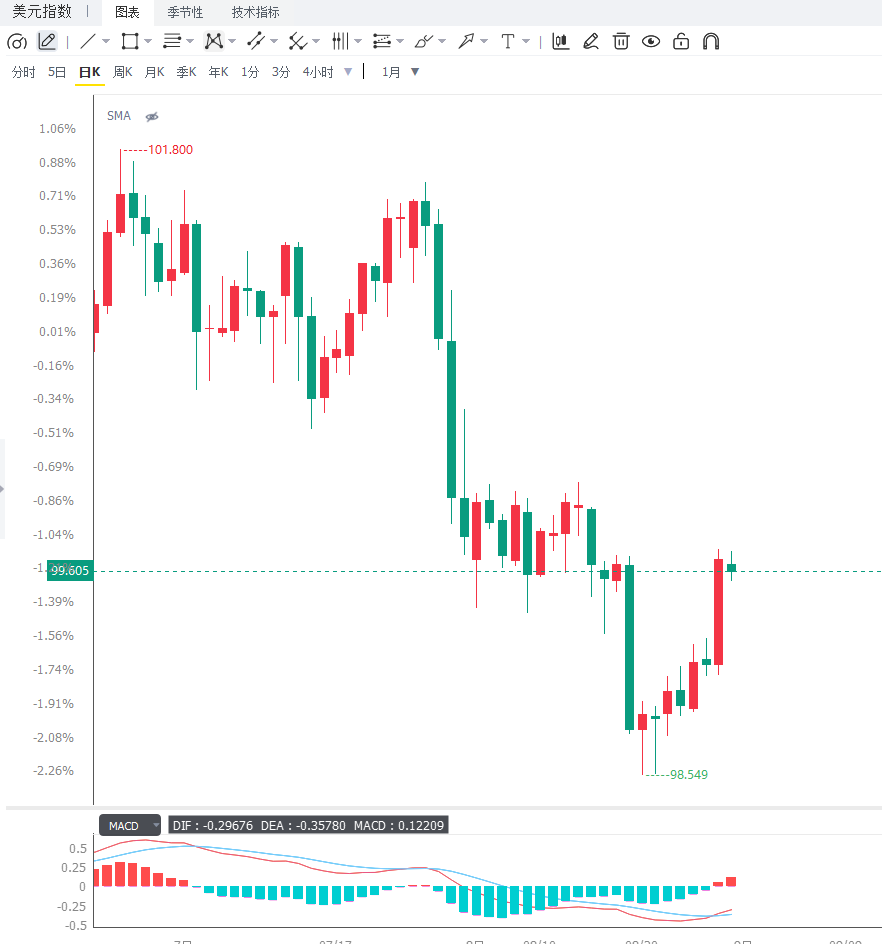
The US dollar index edged lower in early Asian trading on Monday, consolidating at higher levels after a sharp rise on Friday. It was last trading around 99.58, down about 0.1% on the day. Market sentiment suggests the dollar has recently regained support from policy expectations, but short-term upward momentum has weakened. Investors are currently digesting changes in interest rate expectations due to the Federal Reserve's shift to a more hawkish policy stance, while awaiting further confirmation of the resilience of the US economy and inflation from this week's US employment data.  The dollar's strong rebound last Friday was mainly driven by a speech from Federal Reserve Chairman Kevin Warsh. At the Jackson Hole symposium, Warsh emphasized that while some inflation data released this summer were better than expected, these figures were insufficient to prove a substantial change in the underlying inflation trend in the United States. As long as price pressures do not fall towards the Fed's 2% target at a sufficiently clear pace, monetary policy will remain cautious. This led the market to quickly increase expectations for further policy tightening in September. Currently, the market expects the probability of the Fed keeping interest rates unchanged in September to have fallen to 39.4%, a significant decrease from nearly 60% a week ago. In other words, the market has reintroduced a September rate hike into its main policy scenario. This change in interest rate expectations has directly boosted the attractiveness of dollar assets and become an important basis for the recent rebound in the dollar index. If subsequent US inflation and employment data continue to be strong, the probability of a September rate hike may further increase, and the upside potential of the dollar index will also expand accordingly. However, the current dollar rise is not without constraints. The dollar index fell back to around 99.58 on Monday, indicating that the market began to take profits after quickly digesting hawkish policy expectations. At the same time, technical indicators show that the short-term momentum of the dollar has weakened. The US dollar index is currently slightly above its 20-day exponential moving average, but has not yet broken through the important Fibonacci resistance around 99.73. The RSI is below 50, indicating that while the bulls have regained some advantage, a strong one-sided upward trend has not yet formed. This week's US economic data will be the core driver of the dollar's next phase of movement, with the non-farm payroll report being particularly noteworthy. The performance of the job market not only relates to US economic growth expectations but also directly affects the Federal Reserve's judgment on inflation and interest rates. If new job growth and wage data continue to show resilience, the market may further increase the probability of a Fed rate hike in September, thereby pushing the dollar index towards the 100 level. If the job market cools significantly, recent hawkish policy expectations may be revised, and the dollar's rebound may be suppressed again. Changes in the energy market add complexity to the dollar's trajectory. Following the renewed escalation of tensions between the US and Iran, if energy prices continue to rise, it will increase global inflationary pressures and may delay the rate-cutting process of major central banks. For the Federal Reserve, rising energy prices may slow the decline in inflation, thus providing a justification for maintaining high interest rates or even further tightening policy. This factor may support the dollar in the medium term. Meanwhile, rising oil prices may also put some pressure on global economic growth. If energy costs continue to rise, both business production costs and consumer spending will increase, thereby weakening economic activity. The market therefore needs to observe whether the oil price increase is a short-term geopolitical risk premium or has begun to transform into a sustained supply shock. Currently, Persian Gulf oil exports are still gradually recovering, so the oil price increase has not yet fully transformed into a global oil supply crisis. From the perspective of global financial markets, the US dollar is currently in an important repricing phase. Previously, the market had begun to bet on a looser US monetary policy, but Warsh's hawkish remarks changed some of these expectations, allowing the dollar to regain its interest rate advantage. However, at the same time, concerns about the US fiscal situation, long-term Treasury yields, and global investors' valuations of US assets remain, meaning that for the dollar to form a sustained upward trend, more economic data is needed for confirmation. Currently, three key areas should be focused on: First, US non-farm payrolls, unemployment rate, and average hourly earnings, which will directly affect the Fed's policy expectations for September; second, US core inflation performance, if core PCE remains significantly higher than 2%, the Fed's reasons for maintaining a tight stance will be further strengthened; and finally, whether the dollar index can break through the 100 mark. If the US dollar index can effectively break through key technical resistance, and the fundamentals continue to support a high-interest-rate environment, the dollar may enter a new round of upward movement. Conversely, if non-farm payroll data is significantly lower than expected and US inflation continues to cool, the market may bet again that the Federal Reserve will pause further rate hikes, and the dollar index may seek support again near 99 or even 98.50. Therefore, the core contradiction in the current dollar market has gradually shifted from "whether to cut interest rates" to "whether to tighten policy again in September," which will significantly increase the importance of this week's economic data. From a daily chart perspective, the dollar index is currently trading around 99.58, slightly above the 20-day EMA at 99.55, but still under pressure from the 50% Fibonacci retracement level near 99.73. The overall technical pattern is a high-level consolidation after a rebound. The RSI is approximately 48.25, still below the 50 midline, indicating that the previous upward momentum of the dollar has weakened, and a clear overbought condition has not yet formed in the short term. The first resistance level to watch is 99.73. A decisive break above this level on the daily chart would target 100.22, followed by 100.83. On the downside, the first support level to watch is the 20-day EMA at 99.55. A break below this level could lead to a pullback to the 61.8% Fibonacci retracement level around 99.24. If the bears gain further dominance, 98.54 will become the next important support level, with the next support level around 97.65 being the recent low. Overall, 99.73 is a key technical level for determining whether the US dollar index can continue its rebound. Looking at the 4-hour chart, the US dollar index has experienced a pullback after a rapid rise, and the short-term trend is gradually shifting from a strong rebound to consolidation. The area around 99.55 is currently a crucial short-term support/resistance level. As long as the price remains above this area, the dollar may retest 99.73. If the 4-hour chart shows a decisive break above 99.73, then 100.22 and 100.83 will become the next targets. Conversely, if the price falls below 99.55 and further breaks below 99.24, it would indicate a significant weakening of the short-term rebound momentum, and the dollar index might fall back towards 98.54. Given that this week's non-farm payroll data could trigger rapid fluctuations in the dollar and interest rate expectations, the validity of the short-term breakout still needs to be confirmed by both trading momentum and economic data.
  Editor's Summary: The US dollar index is currently at a crossroads between renewed hawkish expectations from the Federal Reserve and weakening technical momentum. Warsh's speech significantly increased expectations of a September rate hike, providing policy support for the dollar. Meanwhile, rising oil prices due to geopolitical risks may prolong the high-interest-rate cycle in the US through inflation. If non-farm payrolls continue to show resilience, the probability of further tightening by the Fed may continue to increase, and the dollar is expected to continue its rebound. If the job market cools significantly, recent hawkish expectations may cool rapidly. Therefore, the core of the dollar's performance this week is not simply about technical breakouts, but rather whether economic data can validate the current pricing of a rate hike.
The dollar's strong rebound last Friday was mainly driven by a speech from Federal Reserve Chairman Kevin Warsh. At the Jackson Hole symposium, Warsh emphasized that while some inflation data released this summer were better than expected, these figures were insufficient to prove a substantial change in the underlying inflation trend in the United States. As long as price pressures do not fall towards the Fed's 2% target at a sufficiently clear pace, monetary policy will remain cautious. This led the market to quickly increase expectations for further policy tightening in September. Currently, the market expects the probability of the Fed keeping interest rates unchanged in September to have fallen to 39.4%, a significant decrease from nearly 60% a week ago. In other words, the market has reintroduced a September rate hike into its main policy scenario. This change in interest rate expectations has directly boosted the attractiveness of dollar assets and become an important basis for the recent rebound in the dollar index. If subsequent US inflation and employment data continue to be strong, the probability of a September rate hike may further increase, and the upside potential of the dollar index will also expand accordingly. However, the current dollar rise is not without constraints. The dollar index fell back to around 99.58 on Monday, indicating that the market began to take profits after quickly digesting hawkish policy expectations. At the same time, technical indicators show that the short-term momentum of the dollar has weakened. The US dollar index is currently slightly above its 20-day exponential moving average, but has not yet broken through the important Fibonacci resistance around 99.73. The RSI is below 50, indicating that while the bulls have regained some advantage, a strong one-sided upward trend has not yet formed. This week's US economic data will be the core driver of the dollar's next phase of movement, with the non-farm payroll report being particularly noteworthy. The performance of the job market not only relates to US economic growth expectations but also directly affects the Federal Reserve's judgment on inflation and interest rates. If new job growth and wage data continue to show resilience, the market may further increase the probability of a Fed rate hike in September, thereby pushing the dollar index towards the 100 level. If the job market cools significantly, recent hawkish policy expectations may be revised, and the dollar's rebound may be suppressed again. Changes in the energy market add complexity to the dollar's trajectory. Following the renewed escalation of tensions between the US and Iran, if energy prices continue to rise, it will increase global inflationary pressures and may delay the rate-cutting process of major central banks. For the Federal Reserve, rising energy prices may slow the decline in inflation, thus providing a justification for maintaining high interest rates or even further tightening policy. This factor may support the dollar in the medium term. Meanwhile, rising oil prices may also put some pressure on global economic growth. If energy costs continue to rise, both business production costs and consumer spending will increase, thereby weakening economic activity. The market therefore needs to observe whether the oil price increase is a short-term geopolitical risk premium or has begun to transform into a sustained supply shock. Currently, Persian Gulf oil exports are still gradually recovering, so the oil price increase has not yet fully transformed into a global oil supply crisis. From the perspective of global financial markets, the US dollar is currently in an important repricing phase. Previously, the market had begun to bet on a looser US monetary policy, but Warsh's hawkish remarks changed some of these expectations, allowing the dollar to regain its interest rate advantage. However, at the same time, concerns about the US fiscal situation, long-term Treasury yields, and global investors' valuations of US assets remain, meaning that for the dollar to form a sustained upward trend, more economic data is needed for confirmation. Currently, three key areas should be focused on: First, US non-farm payrolls, unemployment rate, and average hourly earnings, which will directly affect the Fed's policy expectations for September; second, US core inflation performance, if core PCE remains significantly higher than 2%, the Fed's reasons for maintaining a tight stance will be further strengthened; and finally, whether the dollar index can break through the 100 mark. If the US dollar index can effectively break through key technical resistance, and the fundamentals continue to support a high-interest-rate environment, the dollar may enter a new round of upward movement. Conversely, if non-farm payroll data is significantly lower than expected and US inflation continues to cool, the market may bet again that the Federal Reserve will pause further rate hikes, and the dollar index may seek support again near 99 or even 98.50. Therefore, the core contradiction in the current dollar market has gradually shifted from "whether to cut interest rates" to "whether to tighten policy again in September," which will significantly increase the importance of this week's economic data. From a daily chart perspective, the dollar index is currently trading around 99.58, slightly above the 20-day EMA at 99.55, but still under pressure from the 50% Fibonacci retracement level near 99.73. The overall technical pattern is a high-level consolidation after a rebound. The RSI is approximately 48.25, still below the 50 midline, indicating that the previous upward momentum of the dollar has weakened, and a clear overbought condition has not yet formed in the short term. The first resistance level to watch is 99.73. A decisive break above this level on the daily chart would target 100.22, followed by 100.83. On the downside, the first support level to watch is the 20-day EMA at 99.55. A break below this level could lead to a pullback to the 61.8% Fibonacci retracement level around 99.24. If the bears gain further dominance, 98.54 will become the next important support level, with the next support level around 97.65 being the recent low. Overall, 99.73 is a key technical level for determining whether the US dollar index can continue its rebound. Looking at the 4-hour chart, the US dollar index has experienced a pullback after a rapid rise, and the short-term trend is gradually shifting from a strong rebound to consolidation. The area around 99.55 is currently a crucial short-term support/resistance level. As long as the price remains above this area, the dollar may retest 99.73. If the 4-hour chart shows a decisive break above 99.73, then 100.22 and 100.83 will become the next targets. Conversely, if the price falls below 99.55 and further breaks below 99.24, it would indicate a significant weakening of the short-term rebound momentum, and the dollar index might fall back towards 98.54. Given that this week's non-farm payroll data could trigger rapid fluctuations in the dollar and interest rate expectations, the validity of the short-term breakout still needs to be confirmed by both trading momentum and economic data. Editor's Summary: The US dollar index is currently at a crossroads between renewed hawkish expectations from the Federal Reserve and weakening technical momentum. Warsh's speech significantly increased expectations of a September rate hike, providing policy support for the dollar. Meanwhile, rising oil prices due to geopolitical risks may prolong the high-interest-rate cycle in the US through inflation. If non-farm payrolls continue to show resilience, the probability of further tightening by the Fed may continue to increase, and the dollar is expected to continue its rebound. If the job market cools significantly, recent hawkish expectations may cool rapidly. Therefore, the core of the dollar's performance this week is not simply about technical breakouts, but rather whether economic data can validate the current pricing of a rate hike.
- Risk Warning and Disclaimer
- The market involves risk, and trading may not be suitable for all investors. This article is for reference only and does not constitute personal investment advice, nor does it take into account certain users’ specific investment objectives, financial situation, or other needs. Any investment decisions made based on this information are at your own risk.