Bessant: Japan will push up the yen! The market has already priced in a September rate hike; can the 160 level hold?
2026-09-01 08:01:02
U.S. Treasury Secretary Bessenter stated during the G20 finance ministers' meeting that he believes the Japanese government and central bank will take action to strengthen the yen, adding, "I have information that the market doesn't have." When asked if he was referring to interest rate hikes, he said, "I think the market is pricing that in." The yen strengthened following his comments, with the dollar trading around 159.75 against the yen, still close to the intervention-sensitive level of 160. 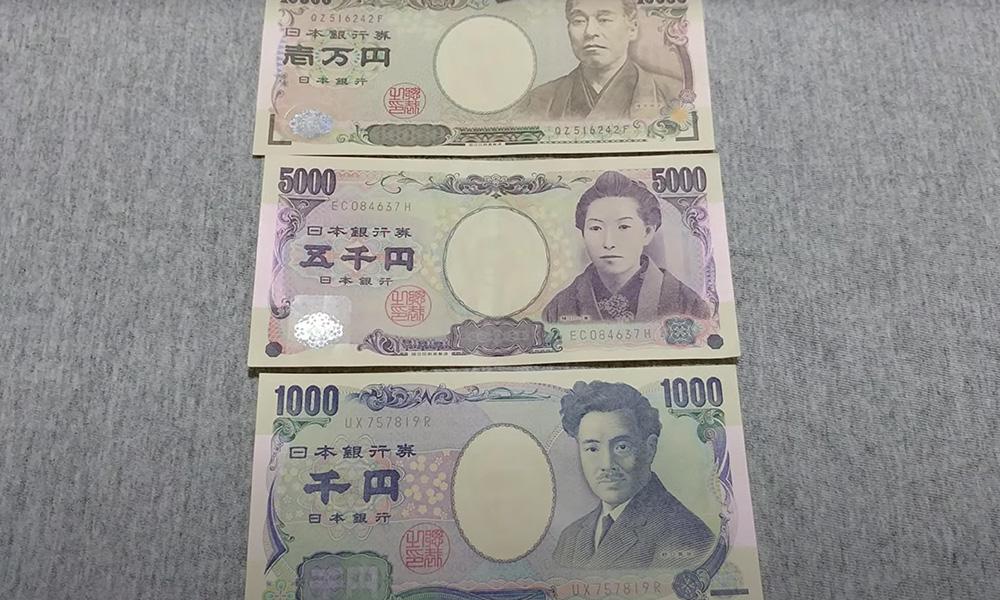
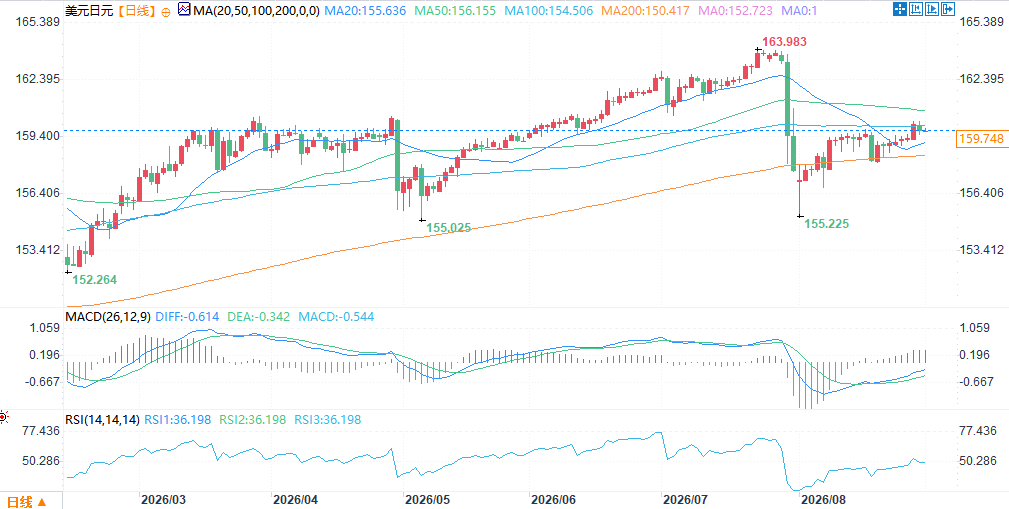 (USD/JPY daily chart, source: FX678) At 7:54 Beijing time, USD/JPY was trading at 159.75.
Bessant pushed the Bank of Japan to raise interest rates during the G20 summit.
U.S. Treasury Secretary Scott Bessant's remarks during the G20 finance ministers' meeting quickly drew attention in the foreign exchange market. He explicitly stated his belief that the Japanese government and the Bank of Japan would take action to strengthen the yen, emphasizing that "I have information that the market doesn't have." When pressed on whether this referred to an interest rate hike, Bessant responded, "I think the market is pricing that in." These remarks conveyed confidence in Japan's policy path, directly driving a short-term strengthening of the yen. Yesterday, the USD/JPY pair closed near 159.75, still close to the widely recognized intervention-sensitive level of 160, but having recovered somewhat from a weaker range. According to media reports, Bessant held bilateral meetings with Bank of Japan Governor Kazuo Ueda and the Japanese Finance Minister during the G20 summit. During the talks, he actively pushed for further interest rate hikes by the Bank of Japan and called on Japan to present a clearer and more sustainable fiscal plan. Analysts pointed out that Bessant's move was not simply exerting pressure, but rather based on his assessment of the fundamentals of the Japanese economy: with inflation approaching or exceeding the target and wage growth established, continuing ultra-loose policies is no longer sustainable. Bessant had previously stated publicly on multiple occasions that the reflation phase of "Abenomics" was largely over, and that Japan should allow policy to transition naturally, stabilizing inflation expectations and supporting the exchange rate through moderate interest rate hikes. The market reacted swiftly. Bessant's remarks reinforced the already largely priced-in September rate hike expectations, leading to partial unwinding of carry trades and renewed activity among yen bulls. Although the USD/JPY exchange rate remains high, investors are beginning to reassess the pace of interest rate differential narrowing. If the Bank of Japan provides clearer policy communication, coupled with signals of fiscal sustainability, the yen is expected to receive more sustained support, rather than relying solely on short-term intervention. Bessant's "insider information" suggests that his communication with high-ranking Japanese officials touched upon specific policy timelines and paces, providing the market with additional confidence anchors beyond publicly available data. Overall, this series of interactions during the G20 summit is shifting the focus of the yen's trajectory from simple exchange rate intervention to the Bank of Japan's own monetary policy normalization process.Bessant ruled out the willingness to coordinate intervention, and interest rate hikes became the main lever supporting the yen.
In his G20 statements, Bessant explicitly ruled out any intention of joint intervention in the near term. He pointed out that he did not believe the recent yen's movements had been "disorderly," a judgment that contrasts sharply with the market environment at the end of July when the US and Japan unusually coordinated their intervention. At that time, the yen depreciated sharply, hitting multi-decade lows and raising concerns about spillover risks to global markets; while the current trend, described by Bessant as "quite controlled," suggests that Washington is currently not very interested in intervening again. This stance places more hope for yen support on the Bank of Japan's own policy decisions than on direct external intervention. Sources revealed that the Bank of Japan may raise interest rates at its policy meeting on September 17-18 and consider a more aggressive pace of rate hikes than the current approximately twice-a-year pace. If the rate hike occurs in September rather than being postponed to October, the market may form an expectation that the Bank of Japan will shift to a quarterly rate hike pace, which would have a far greater structural support for the yen than a single action. Once the expectation of narrowing interest rate differentials strengthens, it will weaken the yen's attractiveness as a funding currency, attract some capital inflows, and increase the relative attractiveness of yen assets. Bessant has repeatedly emphasized that intervention must be complemented by "policy and fundamentals," otherwise its effects will be unsustainable; he views interest rate hikes as a key tool for correcting the yen's undervaluation and stabilizing inflation expectations. This statement has reduced market bets on short-term intervention, shifting focus to Japan's domestic policy path. Analysts believe that if the Bank of Japan acts in September and releases more positive signals afterward, the yen is expected to break free from its fragile model of relying solely on intervention and enter a more sustainable appreciation channel driven by interest rate differentials. At the same time, Bessant's exclusion of joint intervention reflects the US's increased tolerance for current yen volatility and a certain respect for Japan's policy autonomy. Overall, interest rate hikes have become the main lever supporting the yen, and their pace and communication effectiveness will directly determine the direction and strength of the yen's medium-term trend.USD/JPY: Bessant's comments reinforced expectations of an interest rate hike, but the 160 level remains a "hard nut to crack."
Bessant's remarks at the G20 summit had a direct yet subtle impact on the USD/JPY exchange rate. His statement that he "believes Japan will take action to strengthen the yen" was interpreted by the market as strong support for a September rate hike, pushing the yen higher in the short term yesterday, with USD/JPY falling from around 160 to around 159.75. However, the exchange rate remains around 159.75, just a step away from the intervention-sensitive 160 level. The positive effect of Bessant's remarks faces three constraints. First, he explicitly stated that he does not believe the recent yen movement is disorderly, effectively ruling out the possibility of coordinated intervention in the short term, meaning the yen lacks a hard "policy floor." Second, the market has already priced in a September rate hike to within 80%-90%, and the positive impact has been fully priced in. Unless the Bank of Japan releases unexpected signals (such as a quarterly rate hike pace or higher terminal interest rate guidance), the yen's upside potential is limited. Third, the US-Japan interest rate differential remains around 250-275 basis points. Even if the Bank of Japan raises its interest rate to 1.25%, the gap with the Federal Reserve's policy rate of 3.5%-3.75% will still be significant. In the short term, the USD/JPY exchange rate is likely to fluctuate between 158.50 and 160.50. If the Bank of Japan raises interest rates in September and hints at a quarterly pace of rate hikes, the yen may move towards 158. If the rate hike expectation fails to materialize or Warsh's speech continues to strengthen the dollar, the exchange rate may break through 160 and trigger a new round of intervention discussions. Further statements from US and Japanese officials during the G20 summit will be a key short-term variable. (USD/JPY daily chart, source: FX678) At 7:54 Beijing time, USD/JPY was trading at 159.75.
- Risk Warning and Disclaimer
- The market involves risk, and trading may not be suitable for all investors. This article is for reference only and does not constitute personal investment advice, nor does it take into account certain users’ specific investment objectives, financial situation, or other needs. Any investment decisions made based on this information are at your own risk.