Gold Trading Alert: US-Iran airstrikes trigger a double whammy of falling oil and US Treasury prices, with gold prices breaking below the 100-day moving average and hitting a more than two-week low.
2026-09-02 07:47:03
On Tuesday (September 1), spot gold fell sharply by more than 2%, hitting a low of $4,322 per ounce, its lowest point since August 19, before finally closing near $4,328. US gold futures also plunged nearly 1.9%, settling at around $4,396. After breaking below the 200-day moving average of around $4,528, gold prices opened the floodgates of technical selling, further breaching support near the 100-day moving average of $4,360. This decline was not an isolated technical correction, but rather the result of a confluence of factors, including soaring US Treasury yields, a stronger dollar, geopolitical conflicts driving up inflation expectations, and a rapid upward revision of the probability of a Fed rate hike. Escalating tensions in the Middle East provided very limited safe-haven buying for gold; interest rate and exchange rate pressures dominated, making gold particularly vulnerable in this round of macroeconomic repricing. On Wednesday (September 2), spot gold fluctuated around $4,330 in early Asian trading. 
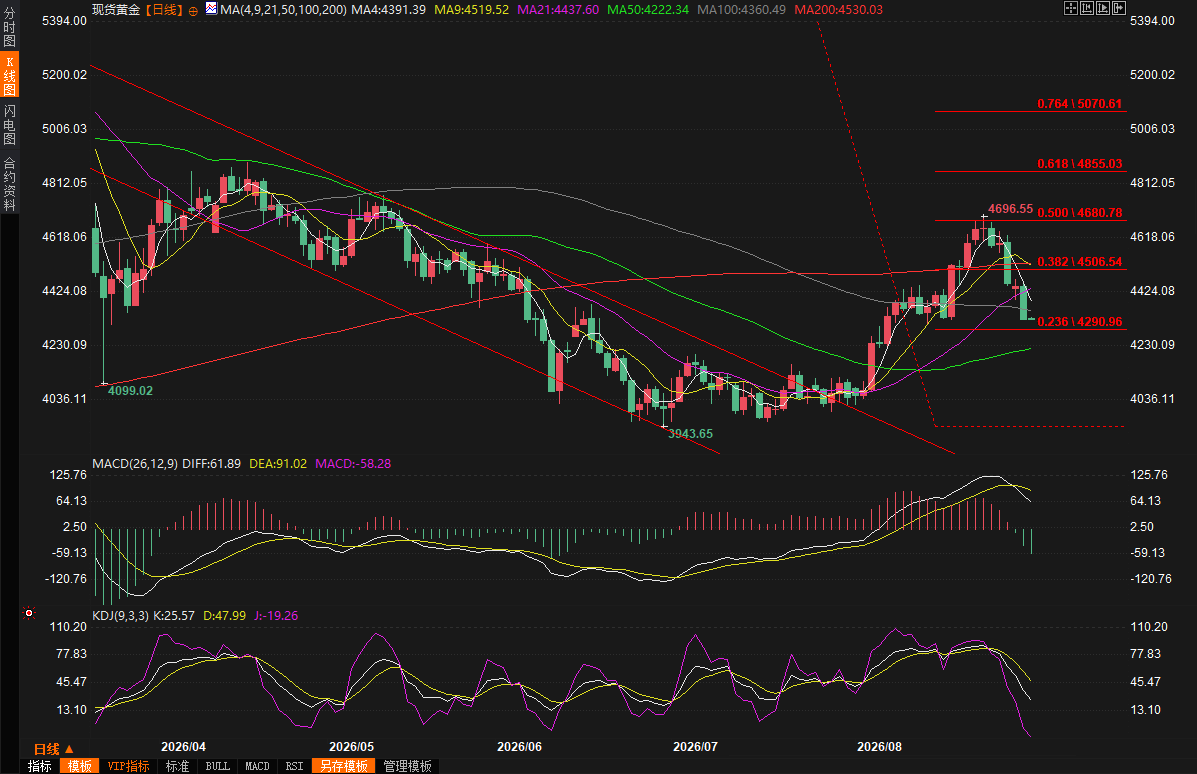 (Spot gold daily chart, source: FX678) At 07:42 Beijing time, spot gold is currently trading at $4334.77 per ounce.
A technical breakdown became a direct accelerator of the decline.
From a purely price action perspective, the recent drop in gold prices was actually foreshadowed. Last Friday (August 28th), spot gold broke below the 200-day moving average, which was around $4528 at the time. This is a key moving average considered by many institutions and traders as a watershed for the medium-term trend. A decisive break below this level often triggers stop-loss and position-cutting by algorithmic trading and trend-following funds. Analyst Jim Wyckoff explicitly pointed out in an interview that the market had seen significant technical selling pressure, and the rise in global government bond yields to multi-year highs further amplified this downward momentum. After breaking below the moving average, gold prices did not rebound quickly; instead, they remained under pressure for several trading days, ultimately breaking below $4350 on September 1st and reaching a low of $4322. Such breakdowns often have a self-reinforcing characteristic. When prices break below important technical levels, previously hesitant short sellers accelerate their entry, while long positions are forced to stop-loss and exit, creating a chain reaction. As a non-interest-bearing asset, gold is extremely sensitive to changes in real interest rates. When the 10-year US Treasury yield touched 4.8%, a new high since January 2025, the opportunity cost of holding gold rose sharply. Funds, after comparing returns, naturally flowed into Treasury bonds or dollar assets, thus gold lost its potential support. In the short term, the path of least resistance for gold is generally considered to be sideways movement or a weak consolidation, and silver is unlikely to remain unaffected. Once a technical breakout is confirmed, a stronger fundamental reversal is usually required for recovery, and the current market clearly lacks the conditions for such a reversal.US Treasury yields and a stronger dollar form a core resistance loop.
What truly made it difficult for gold to breathe was the synchronized changes in the US Treasury and foreign exchange markets. The 10-year US Treasury yield rose to a 19-month high, while the two-year and ten-year yields both reached their highest levels since January 2025. The 30-year US Treasury yield also rose, reaching around 5.288% at one point. Simultaneously, the US dollar index strengthened to around 99.65. Rising yields directly pushed up real interest rate expectations, while a strong dollar made dollar-denominated gold more expensive for holders of other currencies. The combination of these two factors significantly weakened gold's appeal. A deeper reason lies in the market's repricing of inflation and monetary policy. Renewed tensions in the Middle East pushed up oil prices, with Brent crude settling at over $4 to $94.65, and US crude simultaneously climbing above $90.22, both reaching five-week highs. Diesel futures even hit a 52-month high, with a cumulative increase of approximately 51% over the past 10 weeks, and the crack spread also reached a historical high. The rapid rise in energy prices has reignited inflation concerns, prompting traders to quickly raise their estimates of the probability of a Federal Reserve rate hike. The CME Group's FedWatch tool shows the probability of a 25 basis point rate hike in September has risen to approximately 66%, significantly higher than the previous week. Fed officials have also adopted a hawkish stance, with Governor Barr explicitly stating that a rate hike should be implemented if inflation fails to cool quickly, and Chairman Warsh emphasizing that "there is still work to be done" if there is a lack of confidence in a return to the 2% inflation target. In this environment, a closed loop of bond market sell-offs, rising yields, and a stronger dollar has left gold with virtually no escape. While Treasury Secretary Bessant attempted to downplay inflation concerns, arguing that yields more accurately reflect accelerating growth and stable inflation expectations, the market clearly prefers to vote with its feet, choosing to reduce its gold holdings in a rising interest rate environment.Escalating geopolitical conflicts reinforce the logic of interest rates
U.S. Central Command announced the completion of strikes against targets of Iran's Islamic Revolutionary Guard Corps, an operation lasting approximately six and a half hours that precisely targeted air defense positions, radar systems, maritime assets and facilities, mine-laying capabilities, and communications sites. This operation was positioned as a direct response to recent Iranian attempts to attack merchant ships and U.S. personnel in the Strait of Hormuz. Currently, more than 50,000 U.S. troops are deployed throughout the Middle East on high alert. Iran swiftly responded, with the Revolutionary Guard claiming to have launched a large-scale ballistic missile strike on the Prince Hassan Air Base in Jordan, targeting hangars storing RQ-4 Global Hawk and MQ-9 Reaper drones, and claiming damage to multiple drones and casualties. Iranian officials also warned that if adversaries attempt to block Persian Gulf oil exports, then no one will be able to export oil. The shipping risks in the Strait of Hormuz have once again been brought to the forefront, further exacerbated by the news of attacks on two supertankers. The escalation of the US-Iran conflict should have been a potential boon for gold. However, the surge in oil prices has led to concerns about inflation and tightening policies, rather than a simple influx of safe-haven buying into gold. Signs are increasingly evident that the conflict is shifting from military confrontation to economic standoff. Iran's hardline stance and the US's threats of new sanctions have created lingering concerns about energy supply disruptions. However, this geopolitical premium is primarily reflected in crude oil and related commodities, while gold is under pressure due to upward revisions in interest rate expectations. Historical experience shows that when geopolitical risks are primarily transmitted through increased inflation and real interest rates, gold's safe-haven properties often temporarily fail. The renewed conflict has driven up energy prices, but it has also reinforced market expectations that the Federal Reserve may further tighten policy, ultimately creating a net negative impact on gold.Economic data reinforces the baseline scenario of "no interest rate cuts or even interest rate hikes".
Domestic data from the United States also provides solid support for this logic. The ISM Manufacturing PMI fell to 54.6 in August from 55.6 in July. Although still within the expansionary range, the new orders index declined from 56.7 to 53.7, while the supplier delivery index rose to 59.3, indicating that supply chain pressures persist. The input cost price index remained unchanged at a high of 71.1, indicating that price pressures have not dissipated. The intertwining of AI-related expansion and rising costs due to tariffs and conflicts further reinforces expectations of sticky inflation. Meanwhile, JOLTS job openings rebounded to 7.271 million in July, an increase of 89,000 from the previous month, indicating that the labor market as a whole maintained a balance of "neither hiring nor significant layoffs." Layoffs fell to 1.666 million, a layoff rate of only 1.0%, showing that companies remain cautious in their hiring but have not entered a significant contraction phase. These data collectively point to one conclusion: the labor market remains robust, inflationary pressures have not completely subsided, and the probability of the Federal Reserve maintaining or even raising interest rates at its September meeting has increased. Investors are closely watching Wednesday's ADP private sector employment report and Friday's non-farm payroll data. If the employment data remains robust, expectations of an interest rate hike may intensify further; a significant weakening could provide a brief respite for gold. However, based on current information, the market has already priced in a higher interest rate environment as the baseline scenario, thus limiting gold's medium-term upside potential. While the manufacturing sector is still expanding overall, complaints from businesses about rising input costs have increased significantly, further reinforcing policymakers' concerns about inflation.Reassessment of short- and medium-term paths
In summary, gold's fall below 4350 and its new two-week low is a result of a combination of factors, including a technical breakdown, rising interest rates, a stronger dollar, and geopolitical inflation premiums. While the Middle East conflict has boosted oil prices and safe-haven demand, it has failed to reverse the downward pressure on gold from rising real interest rates. In the short term, gold is likely to continue its weak and volatile pattern, with strong resistance concentrated around the previously broken 200-day moving average. On the downside, attention should be paid to whether a larger technical oversold rebound will occur. In the medium term, the key variables that can truly reverse the trend remain the movement of real interest rates and the dollar. Only when inflation concerns ease, interest rate hike expectations decline, or geopolitical conflicts escalate in some unexpected way to the point of threatening global financial stability, will gold be able to regain upward momentum. In the short term, the low of 4310 on August 14 is a key support level. Before breaking below this level, the possibility of a consolidation should be considered. The 100-day moving average at 4360 is the initial resistance level, and the 4400 level is a further resistance level. Before recovering this level, there is still a risk of further declines. If the 4310 support level is breached, then pay attention to the 50-day moving average around 4222.40. (Spot gold daily chart, source: FX678) At 07:42 Beijing time, spot gold is currently trading at $4334.77 per ounce.
- Risk Warning and Disclaimer
- The market involves risk, and trading may not be suitable for all investors. This article is for reference only and does not constitute personal investment advice, nor does it take into account certain users’ specific investment objectives, financial situation, or other needs. Any investment decisions made based on this information are at your own risk.