Federal Reserve report: Gold has not replaced US Treasury bonds as the world's number one reserve asset.
2026-09-04 17:36:04
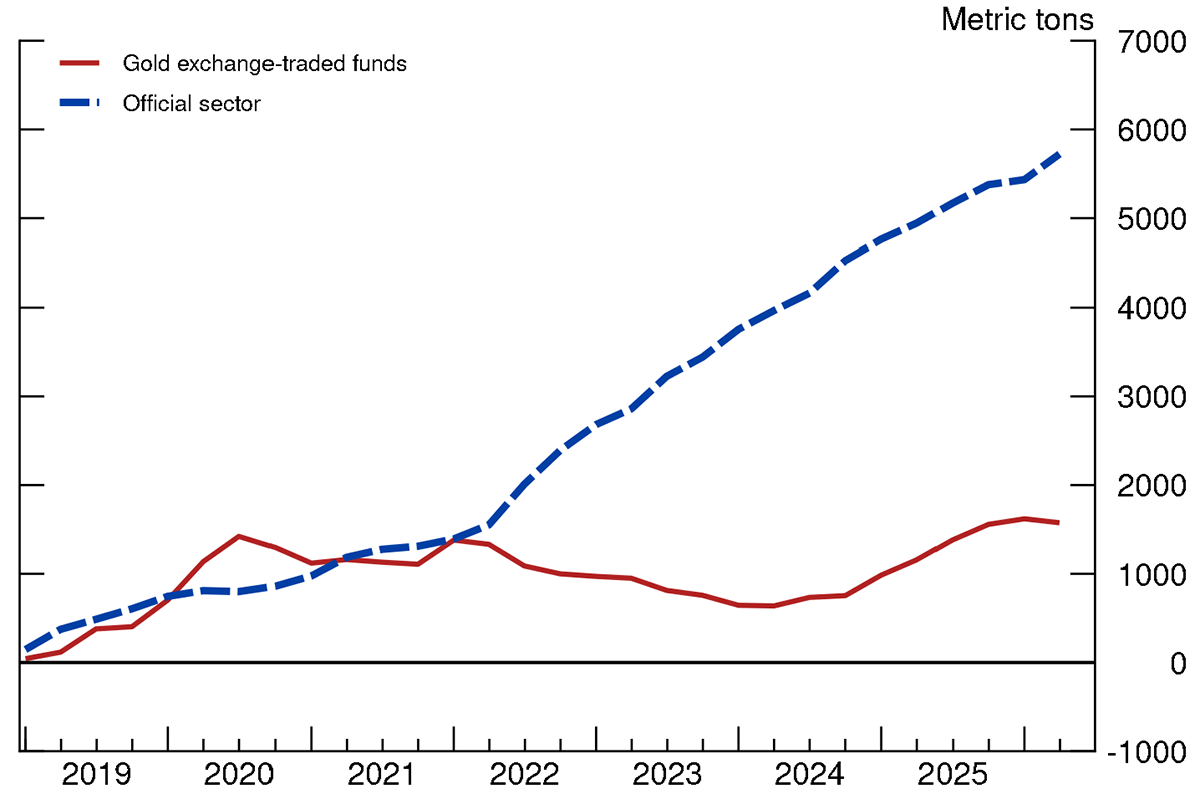
Many media outlets and policy researchers, upon seeing a set of figures, concluded that by 2025, the total market value of global gold reserves would exceed the size of official holdings of US Treasury bonds, making gold the world's most popular reserve asset, replacing US Treasury bonds. However, a research report released by the Federal Reserve in September 2026 points out that this judgment is inaccurate. Directly comparing two sets of raw data is inherently flawed and does not accurately reflect the actual allocation preferences of central banks in reserve assets. We can clarify this by examining the data and facts presented in the report. 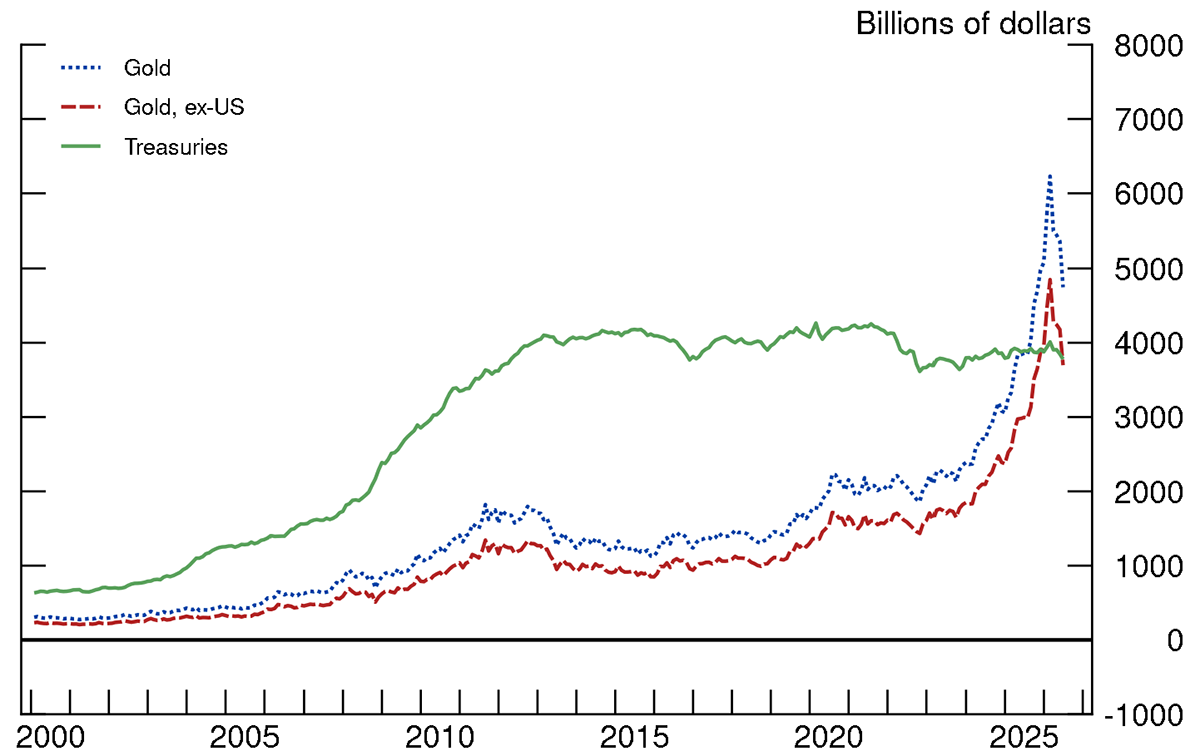 (Figure 1. Global Gold Reserves and Foreign Official Holdings of US Treasury Bonds, data as of June 2026.) The surge in gold market capitalization is not a result of central bank intervention. The rapid increase in global gold reserve market capitalization after 2024 was primarily driven by rising private sector demand, rather than central bank purchases. While central bank gold purchases did significantly increase gold buying in 2022, they subsequently stabilized at a high level without further increases. The real explosive growth came from private investor demand at the end of 2024, with substantial funds flowing into physical gold ETFs, directly driving up gold prices. In other words, the significant gold price increase in 2025 was a result of combined demand from both private investors and official central banks. However, relying solely on central bank purchases would not have been sufficient to push gold prices to this high level.
  (Figure 2. Cumulative Gold Purchases, data as of Q2 2026.) Gold reserve statistics include the United States, while US Treasury bond statistics completely exclude the United States . This inconsistency in statistical methods is the key reason for the misconception that "gold has surpassed US Treasury bonds." The statistics on foreign official holdings of US Treasury bonds only include overseas official institutions and do not include the holdings of the Federal Reserve and the United States itself. However, global gold reserve statistics include gold held by the US government, and the United States is the world's largest holder of gold reserves, accounting for 22% of global gold reserves. This huge stock inflates the overall market value of global gold reserves and amplifies gold's presence in cross-border reserve assets. For most of 2025, if US gold holdings were excluded, the total market value of global gold reserves would decrease by $0.8 to $1.1 trillion. At the end of 2025, the original balance sheet data showed that global gold reserves, including those of the United States, totaled $5.1 trillion, and $4 trillion excluding the US. Both figures were higher than the $3.9 trillion in US Treasury bonds held by foreign officials at the time. However, this surpassing was essentially due to changes in gold price valuations, not to the continuous and substantial increases in gold holdings by central banks over the past 18 months. By June 2026, even with a slight increase in the physical ounces of gold, global gold reserves, denominated in US dollars and excluding US gold, had once again been surpassed by the size of US Treasury bonds held by foreign officials. Most of the current gold reserves are old stock from 50 years ago. A large portion of the world's existing gold reserves is historical stock left over from the Bretton Woods system, and is completely different in nature from the reserve assets newly added in recent years. While many emerging market central banks have been continuously buying gold since 2008, the vast majority of global gold reserves were accumulated before the actual end of the Bretton Woods system in 1971. In contrast, the vast majority of US Treasury bonds held by foreign governments were acquired after 2000, and the groups of countries with large gold reserves do not overlap with those with large foreign exchange reserves. Currently, countries that actively balance their reserves between gold and US Treasury bonds represent only a small portion of the total global gold stock. The top five gold holders—the United States, Germany, Italy, France, and the IMF—collectively hold 52% of global gold reserves, but these five entities have hardly added any significant amounts of gold since the 1970s. Furthermore, the United States, Germany, France, and Italy have not accumulated large amounts of foreign exchange reserves; at current market prices, gold accounts for over 80% of their international reserves. If these five major gold holders are excluded and the reserve structures of other countries are examined separately, US Treasury bonds still constitute a significantly larger share of their reserve portfolios than gold.
 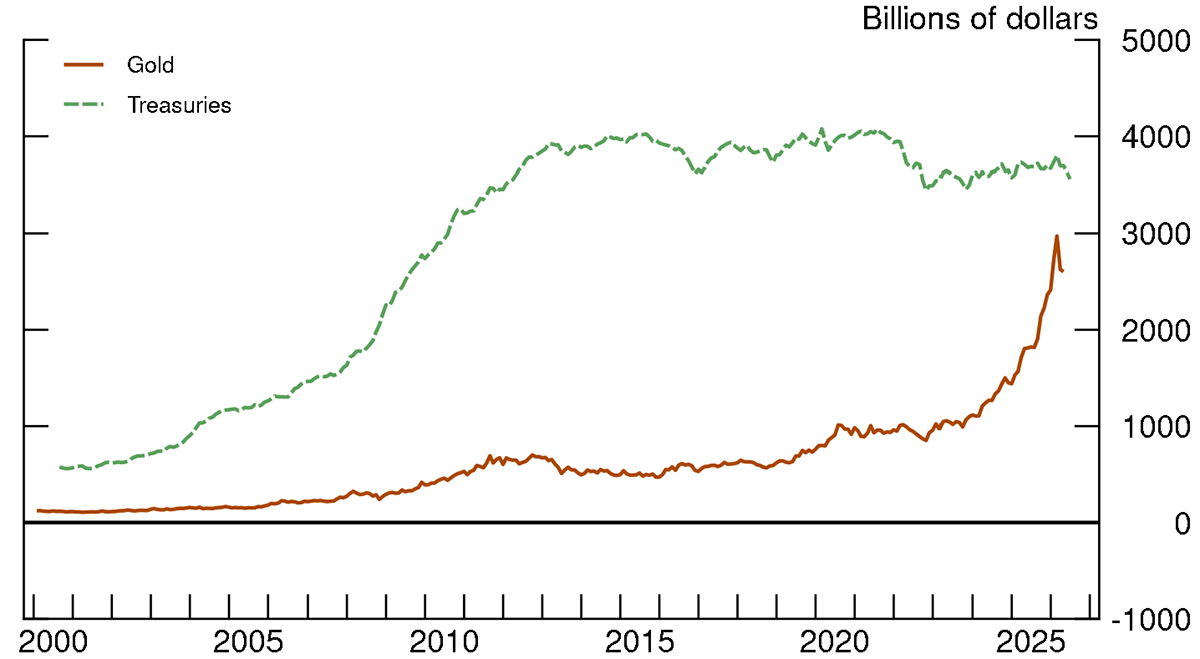 (Figure 3. Adjusted Global Gold Reserves and Foreign Holdings of US Treasury Bonds, excluding the US, Germany, France, Italy, and the IMF) Emerging Countries' True Choices: US Treasury Bonds Remain the Main Reserve. In June 2026, excluding the aforementioned entities, foreign official holdings of US Treasury bonds exceeded gold reserves by approximately $1 trillion. However, this figure has a margin of error; it could be an overestimation or an underestimation. Firstly, IMF official statistics do not fully include gold purchase records from some official institutions after 2021. The World Gold Council's estimate of total official gold purchases is significantly higher than the increase in global gold reserves recorded in IMF statistics, indicating some unreported official gold purchases. Secondly, some overseas official investors use custodian institutions outside the US to hold US Treasury bonds, so the true foreign official holdings of US Treasury bonds are likely higher than the figures published by the US Treasury Securities and Exchange Commission (TIC). Even if we include all unstated official gold purchases estimated by the World Gold Council since 2022, excluding the US, Germany, France, Italy, and the IMF, the scale of US Treasury bonds held by foreign official entities still exceeds their official gold holdings by approximately $0.6 trillion. There is no "gold replacing US Treasury bonds"; on the contrary, it clearly shows that for the vast majority of countries, US Treasury bonds remain the absolute core reserve asset. Central banks are indeed gradually increasing their gold holdings, but have never abandoned US Treasury bonds. The report also does not deny the trend of official institutions continuously allocating gold: since 2008, global official departments have consistently been net buyers of gold, with the pace of purchases accelerating significantly after 2022. Some of these purchases are due to geopolitical considerations, such as financial sanctions and international relations, to diversify reserve risks. However, even after 2021, when several large foreign exchange reserve holders sold hundreds of billions of dollars in reserve assets to stabilize their currencies, from 2022 to April 2026, foreign official investors still net purchased nearly $200 billion in US Treasury bonds, which is sufficient proof that US Treasury bonds remain a very core asset in the reserve portfolios of countries worldwide. Conclusion Directly comparing the total market value of global gold reserves with foreign official holdings of US Treasury bonds can mislead us in judging the true status of gold and US Treasury bonds in the international reserve portfolio. This comparison is largely an illusion created by the valuation effect of gold prices and the ancient gold reserves of a few countries. The brief overtaking of US Treasury bonds in the market value of gold reserves in 2025 was a book change brought about by the private market pushing up gold prices, not a proactive shift in holdings by central banks or an abandonment of US Treasury bonds. Established gold-holding countries have not made any new gold purchases for decades, and emerging countries still rely on US Treasury bonds as their core reserves, with gold serving only as a supplementary safe-haven asset. Central banks are indeed steadily increasing their gold holdings to diversify risk, but US Treasury bonds remain the core asset of the global reserve system and have not been replaced. Appendix: Data Series and Estimation Construction Global gold reserve data is taken from the IMF International Financial Statistics, and data on foreign official holdings of US Treasury bonds is taken from the TIC International Capital Statistics published by the US Treasury Department. This estimate, excluding the five largest gold holders, reflects foreign official holdings of US Treasury bonds. The calculation method involves first deducting the securities-type foreign exchange reserves of France, Germany, and Italy recorded in the IMF's International Reserves and Foreign Exchange Liquidity Database from the total foreign official holdings of US Treasury bonds, and then deducting the US Treasury bonds held by various international and regional organizations in the TIC data. This estimate can be understood as the lower limit of foreign official holdings of US Treasury bonds after excluding the US, Germany, France, Italy, and the IMF. Furthermore, sovereign wealth funds and other official investors are not required to report their gold holdings as official reserves and also participate in gold investment, which is one reason why official statistics underestimate the actual amount of official gold purchases.
(Figure 1. Global Gold Reserves and Foreign Official Holdings of US Treasury Bonds, data as of June 2026.) The surge in gold market capitalization is not a result of central bank intervention. The rapid increase in global gold reserve market capitalization after 2024 was primarily driven by rising private sector demand, rather than central bank purchases. While central bank gold purchases did significantly increase gold buying in 2022, they subsequently stabilized at a high level without further increases. The real explosive growth came from private investor demand at the end of 2024, with substantial funds flowing into physical gold ETFs, directly driving up gold prices. In other words, the significant gold price increase in 2025 was a result of combined demand from both private investors and official central banks. However, relying solely on central bank purchases would not have been sufficient to push gold prices to this high level. (Figure 2. Cumulative Gold Purchases, data as of Q2 2026.) Gold reserve statistics include the United States, while US Treasury bond statistics completely exclude the United States . This inconsistency in statistical methods is the key reason for the misconception that "gold has surpassed US Treasury bonds." The statistics on foreign official holdings of US Treasury bonds only include overseas official institutions and do not include the holdings of the Federal Reserve and the United States itself. However, global gold reserve statistics include gold held by the US government, and the United States is the world's largest holder of gold reserves, accounting for 22% of global gold reserves. This huge stock inflates the overall market value of global gold reserves and amplifies gold's presence in cross-border reserve assets. For most of 2025, if US gold holdings were excluded, the total market value of global gold reserves would decrease by $0.8 to $1.1 trillion. At the end of 2025, the original balance sheet data showed that global gold reserves, including those of the United States, totaled $5.1 trillion, and $4 trillion excluding the US. Both figures were higher than the $3.9 trillion in US Treasury bonds held by foreign officials at the time. However, this surpassing was essentially due to changes in gold price valuations, not to the continuous and substantial increases in gold holdings by central banks over the past 18 months. By June 2026, even with a slight increase in the physical ounces of gold, global gold reserves, denominated in US dollars and excluding US gold, had once again been surpassed by the size of US Treasury bonds held by foreign officials. Most of the current gold reserves are old stock from 50 years ago. A large portion of the world's existing gold reserves is historical stock left over from the Bretton Woods system, and is completely different in nature from the reserve assets newly added in recent years. While many emerging market central banks have been continuously buying gold since 2008, the vast majority of global gold reserves were accumulated before the actual end of the Bretton Woods system in 1971. In contrast, the vast majority of US Treasury bonds held by foreign governments were acquired after 2000, and the groups of countries with large gold reserves do not overlap with those with large foreign exchange reserves. Currently, countries that actively balance their reserves between gold and US Treasury bonds represent only a small portion of the total global gold stock. The top five gold holders—the United States, Germany, Italy, France, and the IMF—collectively hold 52% of global gold reserves, but these five entities have hardly added any significant amounts of gold since the 1970s. Furthermore, the United States, Germany, France, and Italy have not accumulated large amounts of foreign exchange reserves; at current market prices, gold accounts for over 80% of their international reserves. If these five major gold holders are excluded and the reserve structures of other countries are examined separately, US Treasury bonds still constitute a significantly larger share of their reserve portfolios than gold. (Figure 3. Adjusted Global Gold Reserves and Foreign Holdings of US Treasury Bonds, excluding the US, Germany, France, Italy, and the IMF) Emerging Countries' True Choices: US Treasury Bonds Remain the Main Reserve. In June 2026, excluding the aforementioned entities, foreign official holdings of US Treasury bonds exceeded gold reserves by approximately $1 trillion. However, this figure has a margin of error; it could be an overestimation or an underestimation. Firstly, IMF official statistics do not fully include gold purchase records from some official institutions after 2021. The World Gold Council's estimate of total official gold purchases is significantly higher than the increase in global gold reserves recorded in IMF statistics, indicating some unreported official gold purchases. Secondly, some overseas official investors use custodian institutions outside the US to hold US Treasury bonds, so the true foreign official holdings of US Treasury bonds are likely higher than the figures published by the US Treasury Securities and Exchange Commission (TIC). Even if we include all unstated official gold purchases estimated by the World Gold Council since 2022, excluding the US, Germany, France, Italy, and the IMF, the scale of US Treasury bonds held by foreign official entities still exceeds their official gold holdings by approximately $0.6 trillion. There is no "gold replacing US Treasury bonds"; on the contrary, it clearly shows that for the vast majority of countries, US Treasury bonds remain the absolute core reserve asset. Central banks are indeed gradually increasing their gold holdings, but have never abandoned US Treasury bonds. The report also does not deny the trend of official institutions continuously allocating gold: since 2008, global official departments have consistently been net buyers of gold, with the pace of purchases accelerating significantly after 2022. Some of these purchases are due to geopolitical considerations, such as financial sanctions and international relations, to diversify reserve risks. However, even after 2021, when several large foreign exchange reserve holders sold hundreds of billions of dollars in reserve assets to stabilize their currencies, from 2022 to April 2026, foreign official investors still net purchased nearly $200 billion in US Treasury bonds, which is sufficient proof that US Treasury bonds remain a very core asset in the reserve portfolios of countries worldwide. Conclusion Directly comparing the total market value of global gold reserves with foreign official holdings of US Treasury bonds can mislead us in judging the true status of gold and US Treasury bonds in the international reserve portfolio. This comparison is largely an illusion created by the valuation effect of gold prices and the ancient gold reserves of a few countries. The brief overtaking of US Treasury bonds in the market value of gold reserves in 2025 was a book change brought about by the private market pushing up gold prices, not a proactive shift in holdings by central banks or an abandonment of US Treasury bonds. Established gold-holding countries have not made any new gold purchases for decades, and emerging countries still rely on US Treasury bonds as their core reserves, with gold serving only as a supplementary safe-haven asset. Central banks are indeed steadily increasing their gold holdings to diversify risk, but US Treasury bonds remain the core asset of the global reserve system and have not been replaced. Appendix: Data Series and Estimation Construction Global gold reserve data is taken from the IMF International Financial Statistics, and data on foreign official holdings of US Treasury bonds is taken from the TIC International Capital Statistics published by the US Treasury Department. This estimate, excluding the five largest gold holders, reflects foreign official holdings of US Treasury bonds. The calculation method involves first deducting the securities-type foreign exchange reserves of France, Germany, and Italy recorded in the IMF's International Reserves and Foreign Exchange Liquidity Database from the total foreign official holdings of US Treasury bonds, and then deducting the US Treasury bonds held by various international and regional organizations in the TIC data. This estimate can be understood as the lower limit of foreign official holdings of US Treasury bonds after excluding the US, Germany, France, Italy, and the IMF. Furthermore, sovereign wealth funds and other official investors are not required to report their gold holdings as official reserves and also participate in gold investment, which is one reason why official statistics underestimate the actual amount of official gold purchases.- Risk Warning and Disclaimer
- The market involves risk, and trading may not be suitable for all investors. This article is for reference only and does not constitute personal investment advice, nor does it take into account certain users’ specific investment objectives, financial situation, or other needs. Any investment decisions made based on this information are at your own risk.