Gold is consolidating around $4,400, awaiting guidance from US CPI data.
2026-09-08 09:24:05
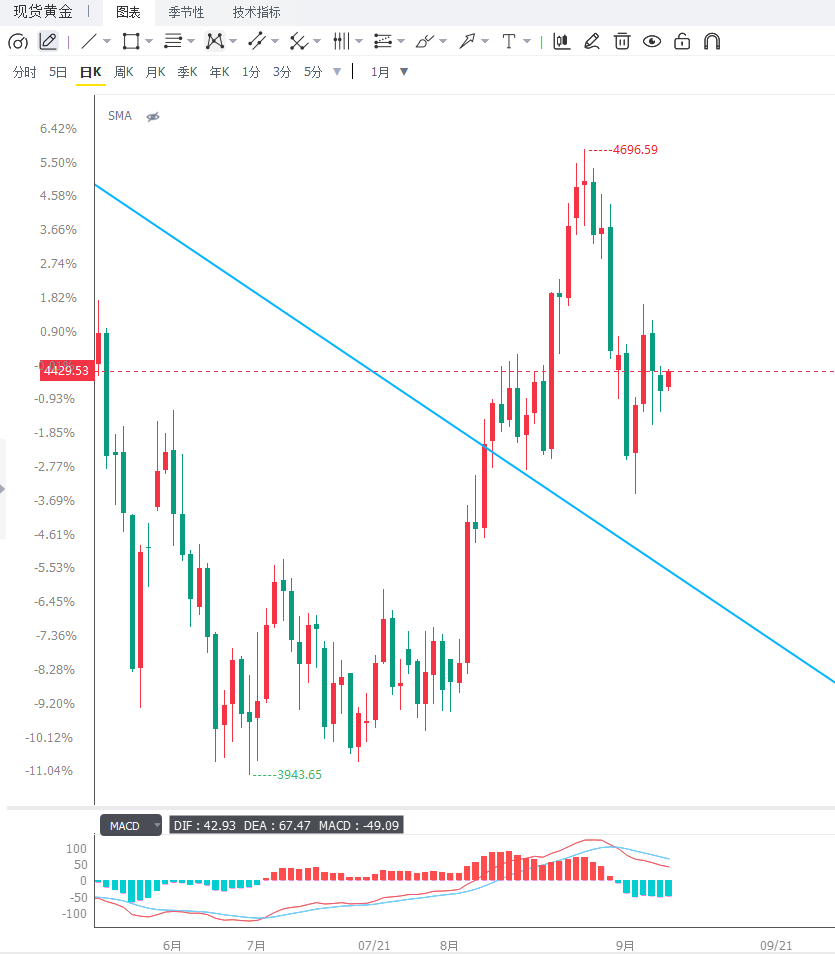
Gold prices continued their weakness at the start of the week, with spot gold falling to around $4410 per ounce in early Asian trading. Previously released US August employment data significantly exceeded market expectations, with non-farm payrolls increasing by 162,000 , significantly higher than the market's previous expectation of approximately 56,000, while the unemployment rate remained at 4.1% . The strong job market performance reinforced market expectations of a possible further increase in US interest rates, putting short-term pressure on gold, a non-interest-bearing asset.  Following the release of the employment data, the interest rate market quickly adjusted its pricing. Currently, the market's expectation of a 25 basis point rate hike at the Federal Reserve meeting on September 16th has risen to approximately 60% , higher than the approximately 50% level before the employment report was released. Higher interest rate expectations typically mean support for the US dollar and US Treasury yields, while increasing the opportunity cost of holding gold. Therefore, gold saw a significant pullback after the non-farm payroll data release. However, relying solely on employment data to judge the medium-term trend of gold remains limited. What the market truly needs to confirm now is whether the resilience of the US economy will further transmit to inflation. If employment remains strong, and rising energy prices push cost pressures back up, then the period of high US interest rates may be prolonged, and gold will face greater valuation pressure in the short term. Conversely, if the upcoming inflation data does not show further increases, then the hawkish impact of the employment data may gradually weaken. This week, the market focus has shifted from the employment market to inflation indicators. The US August Producer Price Index will be released on September 10th , and the Consumer Price Index will be released on September 11th . These two data points will be among the most important macroeconomic variables before the September interest rate decision. The New York Fed's economic calendar shows that both PPI and CPI are scheduled for release this week, while the Fed's September meeting will be held on September 15-16. The market is currently particularly focused on the transmission of energy costs to end-user inflation. If PPI and CPI are higher than expected, the market may further increase its bets on interest rate hikes, leaving room for the dollar and US Treasury yields to continue rising, while gold may retest the $4400 level or even lower. Conversely, if core inflation is moderate, expectations of policy tightening based on employment data may decline, and a weaker dollar will provide a window for a gold rebound. The current market expectation for August's PPI year-on-year growth is approximately 5.2% , compared to 4.7% previously, meaning that the inflation data itself carries significant uncertainty. It is worth noting that this pullback in gold does not signify a fundamental change in the long-term upward trend. Gold prices have previously experienced a significant rise, and the structure of market participants has changed. Besides short-term speculative funds, long-term allocation demand, funds from the physical market, and funds from the derivatives market still provide important support. Therefore, it is more important to pay attention to the strength of the buying support after gold's pullback from its highs, rather than simply interpreting the short-term decline as a trend reversal. From a global asset allocation perspective, gold remains in a complex macroeconomic environment. On the one hand, rising US interest rate expectations, higher US Treasury yields, and a temporary strengthening of the US dollar will directly suppress gold valuations. On the other hand, inflationary risks from rising energy prices, divergent global interest rate paths, and safe-haven demand may increase gold's allocation value. This means that gold may exhibit a pattern of "short-term suppression by macroeconomic headwinds and medium-term support by structural demand" in the near future. Looking at the daily chart, spot gold is currently in a clear correction phase, with prices falling to around $4410, approaching a previous key support area. Current market momentum is weak, but a clear medium-term trend reversal signal has not yet formed. If $4400 can be effectively held, gold prices may still have the potential to recover upwards; the first resistance level to watch is around $4465 , which is both a significant short-term resistance area and a level that needs to be broken to regain strength. Once $4500 is firmly established again, it means that market sentiment may shift back to bullish, with further resistance around $4675. Conversely, if $4400 is breached, the next support level to watch is around $4350 , with further support around $4260. From a 4-hour chart perspective, gold remains in a weak, oscillating short-term structure. The rapid decline following the non-farm payroll data has put pressure on the short-term moving average system, and market momentum has not fully recovered. The market is currently more inclined to wait for inflation data to confirm the direction. If gold prices can stabilize above $4400 and break through $4465 again, a short-term rebound is expected; if the rebound is consistently blocked near $4465, it indicates that the bears still hold the short-term initiative. Once $4400 is effectively broken, the market may further test the $4350 area, or even seek buying opportunities at lower support levels. Overall, gold is currently facing a typical game between macroeconomic policy expectations and long-term allocation needs . Employment data has significantly increased expectations of policy tightening in September, but the key variables that will ultimately determine the market direction are still the PPI and CPI to be released this week. If inflation continues to rise, the pressure for a short-term correction in gold prices may increase further; if inflation is lower than expected, expectations for interest rate hikes may cool down again, and gold is expected to gain momentum for a rebound.
  Editor's Summary: The better-than-expected US non-farm payroll data for August has shifted the biggest short-term pressure on gold back to expectations of Federal Reserve policy, the US dollar, and US Treasury yields. However, the long-term upward trend for gold remains intact, and the market still needs to observe changes in inflation, energy prices, and global asset allocation demand. $4400 will be a crucial dividing line between bullish and bearish sentiment, while PPI and CPI may determine the next trend for gold. Currently, it is more appropriate to focus on breakouts of key support and resistance levels and await a directional move.
Following the release of the employment data, the interest rate market quickly adjusted its pricing. Currently, the market's expectation of a 25 basis point rate hike at the Federal Reserve meeting on September 16th has risen to approximately 60% , higher than the approximately 50% level before the employment report was released. Higher interest rate expectations typically mean support for the US dollar and US Treasury yields, while increasing the opportunity cost of holding gold. Therefore, gold saw a significant pullback after the non-farm payroll data release. However, relying solely on employment data to judge the medium-term trend of gold remains limited. What the market truly needs to confirm now is whether the resilience of the US economy will further transmit to inflation. If employment remains strong, and rising energy prices push cost pressures back up, then the period of high US interest rates may be prolonged, and gold will face greater valuation pressure in the short term. Conversely, if the upcoming inflation data does not show further increases, then the hawkish impact of the employment data may gradually weaken. This week, the market focus has shifted from the employment market to inflation indicators. The US August Producer Price Index will be released on September 10th , and the Consumer Price Index will be released on September 11th . These two data points will be among the most important macroeconomic variables before the September interest rate decision. The New York Fed's economic calendar shows that both PPI and CPI are scheduled for release this week, while the Fed's September meeting will be held on September 15-16. The market is currently particularly focused on the transmission of energy costs to end-user inflation. If PPI and CPI are higher than expected, the market may further increase its bets on interest rate hikes, leaving room for the dollar and US Treasury yields to continue rising, while gold may retest the $4400 level or even lower. Conversely, if core inflation is moderate, expectations of policy tightening based on employment data may decline, and a weaker dollar will provide a window for a gold rebound. The current market expectation for August's PPI year-on-year growth is approximately 5.2% , compared to 4.7% previously, meaning that the inflation data itself carries significant uncertainty. It is worth noting that this pullback in gold does not signify a fundamental change in the long-term upward trend. Gold prices have previously experienced a significant rise, and the structure of market participants has changed. Besides short-term speculative funds, long-term allocation demand, funds from the physical market, and funds from the derivatives market still provide important support. Therefore, it is more important to pay attention to the strength of the buying support after gold's pullback from its highs, rather than simply interpreting the short-term decline as a trend reversal. From a global asset allocation perspective, gold remains in a complex macroeconomic environment. On the one hand, rising US interest rate expectations, higher US Treasury yields, and a temporary strengthening of the US dollar will directly suppress gold valuations. On the other hand, inflationary risks from rising energy prices, divergent global interest rate paths, and safe-haven demand may increase gold's allocation value. This means that gold may exhibit a pattern of "short-term suppression by macroeconomic headwinds and medium-term support by structural demand" in the near future. Looking at the daily chart, spot gold is currently in a clear correction phase, with prices falling to around $4410, approaching a previous key support area. Current market momentum is weak, but a clear medium-term trend reversal signal has not yet formed. If $4400 can be effectively held, gold prices may still have the potential to recover upwards; the first resistance level to watch is around $4465 , which is both a significant short-term resistance area and a level that needs to be broken to regain strength. Once $4500 is firmly established again, it means that market sentiment may shift back to bullish, with further resistance around $4675. Conversely, if $4400 is breached, the next support level to watch is around $4350 , with further support around $4260. From a 4-hour chart perspective, gold remains in a weak, oscillating short-term structure. The rapid decline following the non-farm payroll data has put pressure on the short-term moving average system, and market momentum has not fully recovered. The market is currently more inclined to wait for inflation data to confirm the direction. If gold prices can stabilize above $4400 and break through $4465 again, a short-term rebound is expected; if the rebound is consistently blocked near $4465, it indicates that the bears still hold the short-term initiative. Once $4400 is effectively broken, the market may further test the $4350 area, or even seek buying opportunities at lower support levels. Overall, gold is currently facing a typical game between macroeconomic policy expectations and long-term allocation needs . Employment data has significantly increased expectations of policy tightening in September, but the key variables that will ultimately determine the market direction are still the PPI and CPI to be released this week. If inflation continues to rise, the pressure for a short-term correction in gold prices may increase further; if inflation is lower than expected, expectations for interest rate hikes may cool down again, and gold is expected to gain momentum for a rebound. Editor's Summary: The better-than-expected US non-farm payroll data for August has shifted the biggest short-term pressure on gold back to expectations of Federal Reserve policy, the US dollar, and US Treasury yields. However, the long-term upward trend for gold remains intact, and the market still needs to observe changes in inflation, energy prices, and global asset allocation demand. $4400 will be a crucial dividing line between bullish and bearish sentiment, while PPI and CPI may determine the next trend for gold. Currently, it is more appropriate to focus on breakouts of key support and resistance levels and await a directional move.
- Risk Warning and Disclaimer
- The market involves risk, and trading may not be suitable for all investors. This article is for reference only and does not constitute personal investment advice, nor does it take into account certain users’ specific investment objectives, financial situation, or other needs. Any investment decisions made based on this information are at your own risk.