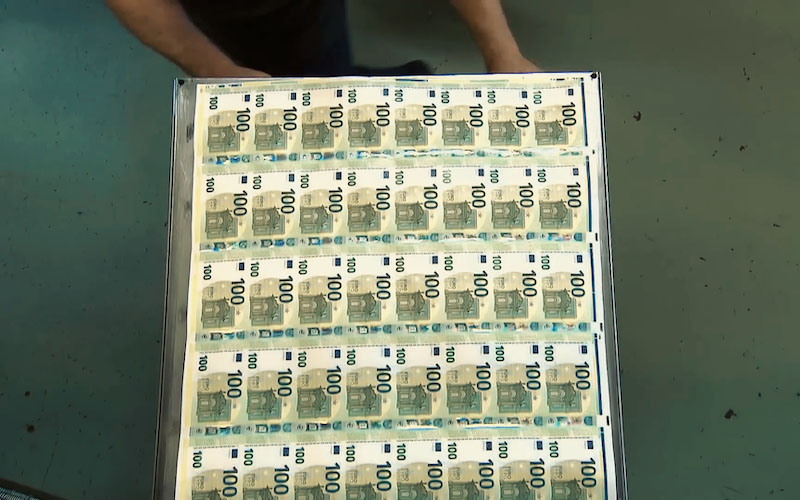
The European Central Bank is set to raise interest rates this week; the euro's future direction will depend on Lagarde's speech.
2026-09-08 11:34:05
The ongoing geopolitical conflict between the US and Iran continues to disrupt the global energy and inflation landscape. The European economy has demonstrated unexpected resilience amidst fluctuating natural gas prices, and market expectations for the European Central Bank's (ECB) monetary policy have shifted dramatically this summer. The upcoming ECB policy meeting, hosted by the German Federal Bank, will be closely watched by the foreign exchange market from September 9th to 10th. ECB President Christine Lagarde will hold a press conference at 20:45 Beijing time on September 10th. MUFG, a research firm, believes that the interest rate hike is already a done deal; the real determinant of the euro and eurozone interest rates will be the policy signals released after the meeting. Following this summer's repricing, the market's threshold for expecting a more hawkish than anticipated statement from the European Central Bank (ECB) has risen significantly. Current market pricing indicates that traders are betting on the ECB implementing an additional 75 basis points of tightening operations by mid-2026 . Against this backdrop, if Lagarde fails to explicitly acknowledge the possibility of another rate hike this year, the market is likely to experience disappointment, and the euro will face mild downward pressure. MUFG states that the risk of market disappointment is actually greater than a hawkish surprise.
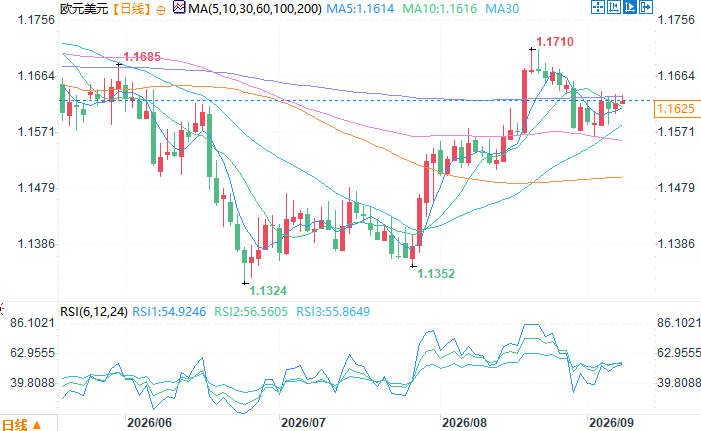 Euro/Dollar daily chart source: EasyTrade. At 11:31 AM Beijing time on September 8, the euro/dollar exchange rate was 1.1625/26.
The interest rate hike has been fully priced in; the decision itself has become a mere formality.
The market has fully priced in the expected 25 basis point rate hike, which is the second rate increase since the outbreak of the US-Iran conflict. MUFG stated that fluctuations in the euro exchange rate and eurozone interest rates will depend more on the ECB's updated policy guidance than on the rate hike decision itself; Lagarde's press conference is the real risk event this week. Following this summer's repricing, the market's threshold for expecting a more hawkish than anticipated statement from the European Central Bank (ECB) has risen significantly. Current market pricing indicates that traders are betting on the ECB implementing an additional 75 basis points of tightening operations by mid-2026 . Against this backdrop, if Lagarde fails to explicitly acknowledge the possibility of another rate hike this year, the market is likely to experience disappointment, and the euro will face mild downward pressure. MUFG states that the risk of market disappointment is actually greater than a hawkish surprise.The resilience of the European economy has boosted expectations of tightening, but the secondary effects of inflation remain a variable.
This summer's shift in market expectations for monetary policy is supported by two main realities. Firstly, following the outbreak of the US-Iran conflict, European natural gas prices surged again, raising renewed concerns about energy inflation. Secondly, the Eurozone economy demonstrated strong resilience, with second-quarter growth rebounding to 0.4%, and business confidence surveys completely erasing the initial decline following the conflict. MUFG's baseline scenario is that the ECB will complete its final rate hike, pushing the policy rate to 3.00%, entering the restrictive interest rate range described by ECB Chief Economist Philip Lane. The institution also points out that there is currently insufficient evidence to demonstrate a large-scale secondary inflationary effect, thus remaining skeptical about a third rate hike; however, if the secondary inflationary effect continues to unfold, the ECB may raise rates further.The euro's dominance over the dollar is due to the dollar's influence, but multiple negative risks lurk beneath the surface.
Even with dovish signals from the European Central Bank (ECB), the short-term movement of the euro against the US dollar will still be largely driven by the dollar's performance. According to MUFG's short-term fundamental analysis, the euro/dollar exchange rate is likely to move towards the lower end of the recent 1.1400-1.1800 range. Besides the ECB policy meeting, the market needs to pay attention to two potential negative factors for the euro. With winter approaching, the risk of rising European natural gas prices is resurfacing, and a rebound in energy costs will again test European inflation and economic prospects. Germany is about to hold local elections, with the Saxony-Anhalt election attracting significant attention; political changes will also disrupt the euro. These risk factors will continue to unfold after the meeting.Conclusion
In summary, this ECB policy meeting was a game of "the outcome is known, but the signals are unknown." A 25 basis point rate hike is almost a certainty; what truly influences the short-term trend of the euro is Christine Lagarde's wording regarding the subsequent rate hike path. The market has already priced in tightening expectations, and any statement that falls short of expectations could easily trigger a euro pullback. At the same time, the euro cannot be judged solely by the ECB; the strength of the US dollar, winter natural gas prices, and German local elections will all be important variables. Forex traders should not solely bet on the ECB's policy outcome but need to consider multiple clues to determine the euro's future direction. Euro/Dollar daily chart source: EasyTrade. At 11:31 AM Beijing time on September 8, the euro/dollar exchange rate was 1.1625/26.
- Risk Warning and Disclaimer
- The market involves risk, and trading may not be suitable for all investors. This article is for reference only and does not constitute personal investment advice, nor does it take into account certain users’ specific investment objectives, financial situation, or other needs. Any investment decisions made based on this information are at your own risk.