The US-Iran conflict is pushing up oil prices and raising interest rate expectations, leading to a three-day consecutive decline in the US dollar – a bizarre logic.
2026-09-09 14:56:10
On Wednesday (September 9) during Asian trading hours, the US dollar index continued its decline, currently down 0.17% to around 98.70, a new low since August 24, and is poised to weaken for the third consecutive trading day. This trend seems contradictory—soaring oil prices are pushing up inflation expectations, and the CME FedWatch tool shows the probability of a September rate hike has climbed to 60%, yet the dollar has not received a corresponding boost. The market is presenting an intriguing signal: rising inflation concerns and rate hike expectations have not translated into upward momentum for the dollar. 
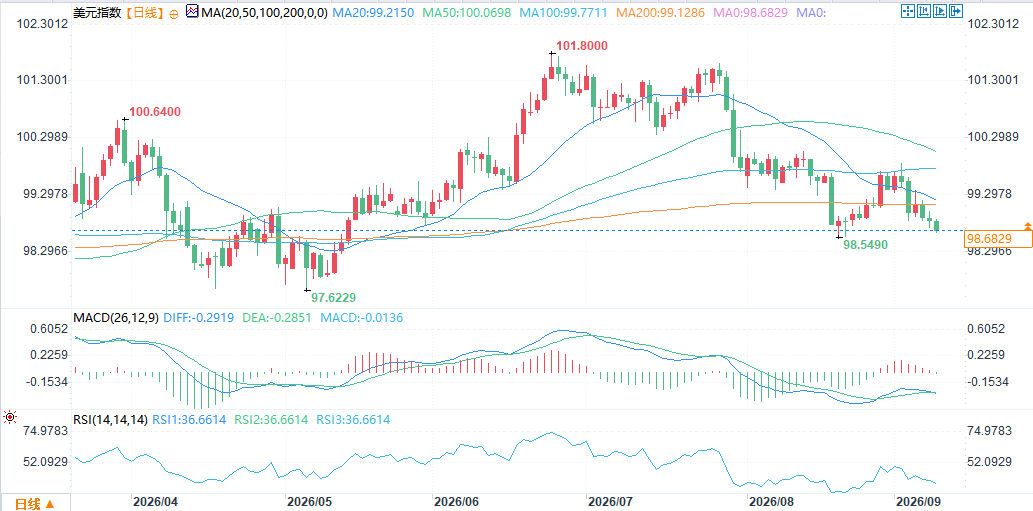 (US Dollar Index Daily Chart, Source: FX678) At 14:55 Beijing time, the US Dollar Index was at 98.68.
Soaring oil prices have fueled inflation expectations, raising the probability of an interest rate hike to 60%.
In recent days, the escalating conflict between the US and Iran has become the core driving factor in the crude oil market. The recent US military strikes against several Iranian oil tankers near Kharg Island have rapidly increased geopolitical risk premiums, pushing Brent crude oil close to the $100/barrel mark. The continued rise in oil prices has directly exacerbated market concerns about the US inflation outlook—the transmission effect of energy prices to broader price levels further increases the inflationary pressures facing the Federal Reserve. The CME FedWatch Tool shows that traders are currently pricing in a 25 basis point rate hike by the Fed in September at approximately 60%, a significant increase from the previous week. According to traditional market logic, an increased probability of a rate hike should provide strong support for the US dollar, but the current dollar trend has contradicted this historical pattern.Why can't a 60% probability of interest rate hikes support the US dollar?
① The market has fully priced in the positive news, and the 60% probability of a rate hike is not new information. The market has gradually digested the expectation of another Fed rate hike over the past few weeks. With the probability of a rate hike rising to 60%, the room for further significant increases is limited, and the marginal pricing effect is diminishing. The US dollar has already received some support due to rate hike expectations and is currently in a vacuum period of "lack of new catalysts after the positive news has been priced in." ② Traders remain cautious ahead of US inflation data release . The US PPI data on Thursday and the US CPI data on Friday are the key variables the market is truly waiting for. Before these, investors are unwilling to take large long positions in the dollar at current levels, as any data deviating from expectations could trigger a rapid pullback. Economists at the National Bank of Canada point out that "in this context, people may ask what can prevent the Fed from raising rates soon and providing support for the dollar in the process," but also cite Fed Chairman Warsh's warning in his Jackson Hole speech—"Yesterday's news can easily be mistaken for what is happening now," and "this observation is particularly relevant in the bond market," meaning that changes in the bond market narrative can quickly blur the policy outlook. ③ The Seesaw Effect Between US Stocks and Risk Sentiment Despite rising expectations of interest rate hikes, the US stock market performed steadily, with factors such as AI spending, economic resilience, and corporate profit growth continuing to support risk appetite. In the absence of a significant deterioration in risk sentiment, the safe-haven demand for the US dollar was partially suppressed.Key variables this week: PPI and CPI data will set the tone.
The market's true directional choice will be made this Thursday and Friday—the release of US Producer Price Index (PPI) and Consumer Price Index (CPI) data will directly influence the pricing logic of the Federal Reserve's September 14-15 policy meeting. Economists at the National Bank of Canada caution against over-interpreting recent data and market volatility, pointing out that in the current environment, understanding the Fed's "hesitation" is more important than simply betting on the direction of interest rate hikes. If inflation data is moderate, the probability of a rate hike may quickly decline, and the dollar will face further downward pressure; if inflation data exceeds expectations, the probability of a rate hike will break through current levels, and the dollar is expected to regain upward support. The market is currently in a "pre-data quiet period," and a directional breakout awaits a clear signal from the inflation data.Summarize
The US dollar index weakened for the third consecutive trading day, despite soaring oil prices fueling inflation concerns and a 60% probability of a September rate hike. This divergence between rising rate hike expectations and a falling dollar reflects a combination of factors, including market pricing in rate hike expectations, traders remaining cautious ahead of key data releases, and robust risk sentiment. Thursday's PPI and Friday's CPI data will be crucial for the dollar to regain upward momentum—moderate inflation could put continued pressure on the dollar, while stronger-than-expected inflation would strengthen rate hike expectations and support the dollar. Until then, the dollar's short-term trend is likely to be one of consolidation. (US Dollar Index Daily Chart, Source: FX678) At 14:55 Beijing time, the US Dollar Index was at 98.68.
- Risk Warning and Disclaimer
- The market involves risk, and trading may not be suitable for all investors. This article is for reference only and does not constitute personal investment advice, nor does it take into account certain users’ specific investment objectives, financial situation, or other needs. Any investment decisions made based on this information are at your own risk.