US Treasury Secretary claims to be manipulating the yen, causing the yen to appreciate rapidly.
2026-09-09 21:30:06
I have repeatedly warned of the impending appreciation of the yen. I wonder if readers have grasped the market trend. As an island nation heavily reliant on energy and food imports, a stable exchange rate is the core foundation for Japan's price stability. The prolonged depreciation of the yen, coupled with a sharp rise in international oil prices, created a double whammy of a weak yen and high oil prices, directly pushing up Japan's import costs. Domestic imported inflation continued to worsen, with price increases repeatedly exceeding market expectations, putting enormous pressure on Japan's economic recovery. This forced Japan to sell US Treasury bonds to buy dollars to support the yen, something the US could not tolerate, as US Treasury bonds also recently faced a sell-off crisis. Therefore, the US and Japan jointly intervened in the market, and the Bank of Japan shifted to a hawkish stance. 
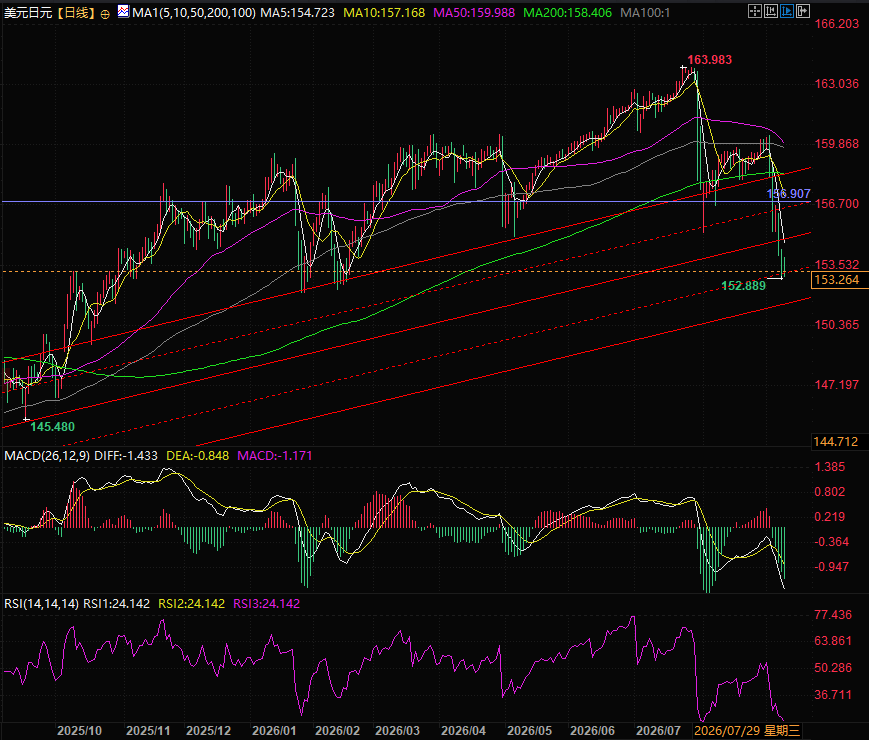 (USD/JPY daily chart, source: FX678) At 21:23 Beijing time, USD/JPY is currently trading at 153.33/34.
The Bank of Japan has turned hawkish and accelerated its tightening, with strong expectations for a September rate hike.
According to sources familiar with the matter at Kyodo News, the Bank of Japan plans to raise its policy rate from 1.0% to 1.25% at its policy meeting on September 17-18. This rate hike will push Japan's borrowing costs to a near 31-year high. This rate hike comes only three months after the June hike, completely breaking the usual semi-annual rate hike pattern established after Japan exited negative interest rate policy in March 2024. It signifies that the Bank of Japan has officially entered an accelerated tightening cycle. Previously, the biggest obstacle to the normalization of Japanese interest rates was Sanae Takaichi, the leader of the ruling Democratic Party, who was preparing to implement Abenomics and pursue an easing policy. The core driver of this accelerated rate hike is the easing of Takaichi's policies, coupled with the risk of runaway inflation triggered by the combination of a weak yen and high oil prices. The fundamental reason for the continued depreciation of the yen is the long-standing large interest rate differential between the US and Japan, and Takaichi's easing expectations. Meanwhile, external pressure from the Trump administration in the United States became a significant driving force. The US was concerned that a weak yen coupled with rising Japanese bond yields would continue to disrupt the US Treasury market and push up US financing costs. US Treasury Secretary Bessenter had previously stated publicly that he was certain the Japanese government and central bank would intervene to stabilize and strengthen the yen's exchange rate. This interest rate hike will effectively tighten liquidity and alleviate Japan's imported inflationary pressures from a fundamental perspective.US Treasury Secretary issues strong warning to short sellers, signaling a full-scale shift in US exchange rate policy towards proactive intervention.
Compared to the Bank of Japan's passive tightening, the US's strong intervention has become the core variable in this round of yen rebound. US Treasury Secretary Bessen recently made significant public statements, completely overturning the market's logic regarding the yen's exchange rate. He stated directly that he is actively promoting the yen's appreciation, leveraging his position as Treasury Secretary to gain access to key information on US-Japan exchange rate intervention, and openly declaring war on yen bears: "I am now the market maker, familiar with the Bank of Japan and Japan's policy movements. Those who want to gamble can go ahead and try." Unlike the Bank of Japan's passive interest rate hikes due to domestic inflation, the US's proactive intervention is the core driving force behind this round of yen stabilization and rebound, reversing the depreciation trend. This statement marks a comprehensive upgrade in US exchange rate policy, shifting from passive emergency intervention to proactive strategic pressure. Through policy deterrence and the expectation of joint intervention, the US aims to support the yen and suppress the USD/JPY exchange rate's rise, with the core objective of safeguarding US domestic financial security. This is mainly divided into two points. First, stabilizing the US Treasury market and preventing yields from spiraling out of control. A weak yen coupled with rising Japanese bond yields will continue to push up US Treasury yields and increase US financing costs. The US's push for yen appreciation and narrowing of the US-Japan interest rate differential can effectively block the transmission of overseas risks and stabilize the core pricing system of US Treasury bonds. Secondly, it proactively mitigates carry trade risks and avoids the risk of a US stock market crash at its current high level. Currently, US stocks are at a high level and highly vulnerable. If the yen suddenly appreciates sharply during this high-risk period, it could trigger a massive unwinding of carry trades and a stampede of capital outflows, easily leading to a sharp drop in US stocks. Therefore, the US is proactively guiding the yen to appreciate steadily, releasing risks gently and proactively during a period of market stability, breaking down a sudden, concentrated crisis into a long-term structural adjustment, and safeguarding the stability of US stocks and the overall US financial market.Deeper strategic objective: To restrain Japan's expansionary fiscal policy and prevent regional debt risks.
The US intervention in the yen's exchange rate simultaneously serves as a precise constraint on Japan's fiscal policy. Japanese Prime Minister Sanae Takaichi has continued Japan's aggressive expansionary fiscal policy, continuously increasing fiscal spending, industrial investment, and public welfare expenditures. The fiscal deficit and debt have been rising year by year, which the US views as a potential risk to global financial markets. Through exchange rate pressure and monetary policy intervention, the US is forcing Japan to tighten its policy pace and curb its excessive fiscal expansion. This aims to prevent the combination of "loose fiscal policy + weak exchange rate" from escalating and to prevent the high debt risk from spreading outwards, impacting global bond and capital markets. This demonstrates the US's precise control over financial risks in the Asia-Pacific region.Institutional Viewpoint:
Regarding market concerns about the risk of a "yen appreciation triggering the unwinding of trillions of dollars in carry trades and igniting a global liquidity crisis," Morgan Stanley offers an optimistic assessment, believing there is no need for excessive panic. The firm's core viewpoints are clear: First, the primary drivers of yen carry trades are global risk appetite and the performance of the technology sector; the yen is merely a low-cost financing tool, not the core driver of market movements. Second, the market has exaggerated the narrative of a large-scale repatriation of Japanese funds; even with interest rate hikes in Japan, domestic asset returns have not improved significantly, limiting the extent of the capital repatriation. Third, even if the yen continues to strengthen, carry trade capital will quickly switch to other low-cost financing currencies, preventing a global sell-off.Market Outlook: USD/JPY Enters Key Battle Zone Between Bulls and Bears
With multiple positive factors converging, the USD/JPY pair has begun a trend reversal, with the yen briefly touching a new high since February at 152.9, establishing a short-term strong trend. The subsequent market movement hinges on two key variables: first, whether the Bank of Japan will raise interest rates in September, and whether Kazuo Ueda's monetary policy statements will lean hawkish; second, whether the US will implement substantial currency intervention and continue its strong policy stance. Overall, under the triple logic of the Bank of Japan's accelerated tightening, strong US support, and manageable carry trade risks, the recent sharp decline in USD/JPY is expected to gradually return to a reasonable range. The monetary policies of the US and Japan, along with geopolitical and financial maneuvering, will continue to dominate future exchange rate movements. (USD/JPY daily chart, source: FX678) At 21:23 Beijing time, USD/JPY is currently trading at 153.33/34.
- Risk Warning and Disclaimer
- The market involves risk, and trading may not be suitable for all investors. This article is for reference only and does not constitute personal investment advice, nor does it take into account certain users’ specific investment objectives, financial situation, or other needs. Any investment decisions made based on this information are at your own risk.