The US dollar index fell for the fourth consecutive day, with inflation data becoming a key variable as the dollar awaits a directional move.
2026-09-10 13:12:07
The US dollar index continued to be pressured in Asian trading on Thursday, falling to around 98.70, marking its fourth consecutive day of decline. The recent contradiction between the dollar's performance and US interest rate expectations has become increasingly prominent. On the one hand, some recent US economic data have been relatively strong, driving market expectations for further tightening by the Federal Reserve; on the other hand, the dollar itself has failed to escape adjustment pressures, indicating that investors are still waiting for clearer inflation signals to confirm the future direction of monetary policy.  Market attention is currently focused on the US Producer Price Index (PPI) and Consumer Price Index (CPI). The PPI will be released on Thursday, and the CPI on Friday; these two data points are likely to be the most important macroeconomic variables before the Federal Reserve's meeting next week. If inflation data continues to exceed expectations, the market may further price in high interest rates or even a rate hike, providing new support for the dollar and US Treasury yields. Conversely, if inflationary pressures are lower than expected, market concerns about further policy tightening may ease, and the dollar may face greater downward pressure. The recent relatively strong performance of the US job market has also changed market expectations regarding the Fed's policy path. According to interest rate market pricing, investors now expect a greater than 60% probability of a rate hike at the Fed's next meeting. However, market surveys show that most economists still expect the Fed to keep interest rates unchanged at its September meeting and may remain on the sidelines for the remainder of the year. This means that there is currently a significant divergence in policy expectations in the financial markets, and any unexpected data could quickly change the short-term direction of the dollar. The recent continued weakening of the dollar also reflects that the market has not fully accepted the further strengthening of expectations for a rate hike. With US Treasury yields at relatively high levels, bond fund flows are beginning to be influenced by interest rate pressures. Market analysts have observed that global investors have recently reduced their allocations to core sovereign bonds faster than to risk assets, with high yields weakening demand for some bonds. This reallocation of funds could further increase volatility in global financial markets and affect the US dollar through interest rates and exchange rates. The key focus going forward is on the actual performance of US PPI and CPI, especially whether core inflation remains sticky. If inflation data is significantly higher than expected, the US dollar index may end its continuous decline and retest the 99 or even 100 level; if the data is lower than expected, the dollar's weakness may continue, while gold is expected to gain stronger upward momentum. Looking at the daily chart of the US dollar index, it is currently trading around 98.70, with the price consistently below the 9-day and 50-day exponential moving averages, maintaining a generally bearish short-term trend. The 9-day moving average is below the 50-day moving average, further reflecting that the short-term trend has not yet shown a clear reversal. The 14-day RSI is around 37, in the weak zone, indicating that the bears still have a certain advantage, but it is not far from the oversold zone, therefore the dollar has a technical rebound demand after its continuous decline. The first resistance level to watch is around 99.00, followed by the area around the 9-day moving average and the 99.40 level near the 50-day moving average. Only a recapture of these moving average areas could significantly improve the short-term weakness of the US dollar. On the downside, support levels to watch are around 98.50, 98.00, and 97.50. If 98.50 is breached, the dollar may further test the 98.00 level; if 98.00 is also decisively broken, the downside potential may further expand. On the 4-hour chart, the dollar index has weakened continuously, but the bearish momentum remains dominant, although the relatively low RSI indicates increased risk of shorting in the short term. If the US PPI is higher than expected, the dollar may rebound quickly and retest the resistance around 99.00; if the data is weak, the index may continue to seek support at 98.00 after breaking below 98.50. Gold may move inversely to the dollar, testing $4465 and $4500 if the dollar continues to weaken; if the dollar rebounds strongly, gold may come under renewed pressure. Therefore, before the release of PPI and CPI, it is more appropriate to focus on the breakout of key support and resistance levels for both the US dollar and gold, rather than simply chasing highs and lows based on short-term fluctuations.
 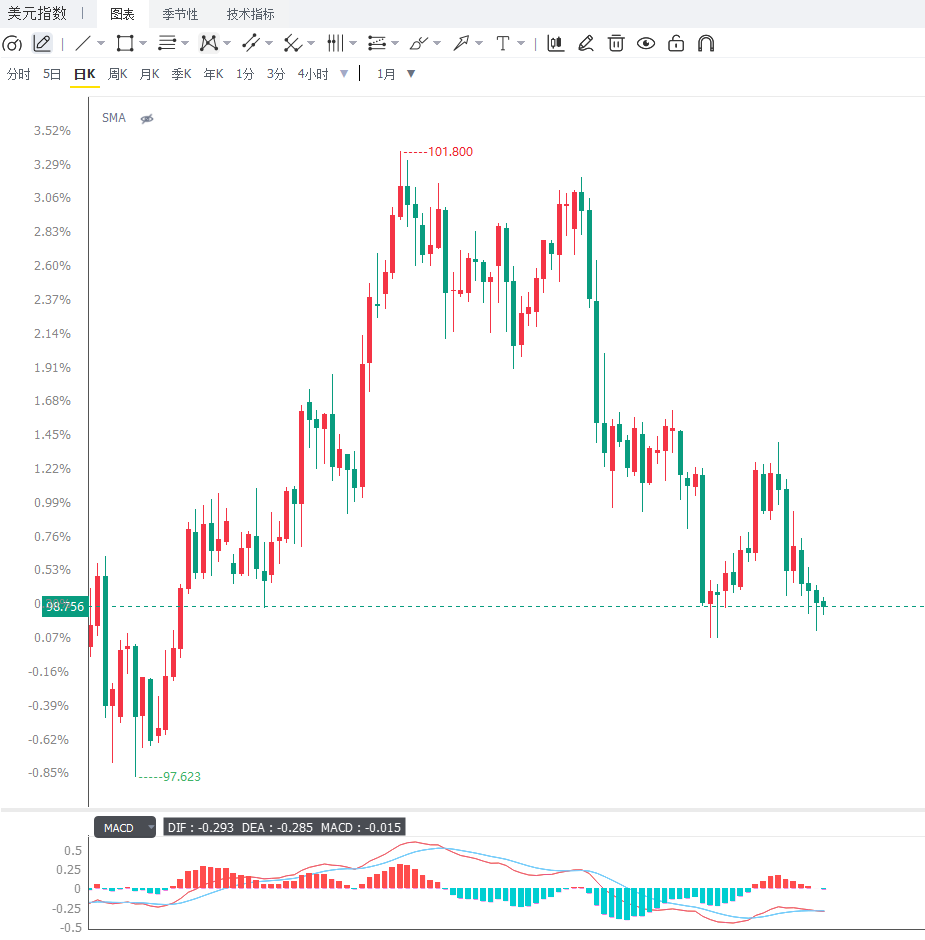 Editor's Summary: The US dollar index fell for the fourth consecutive day to around 98.70, indicating that short-term bears still dominate. However, stronger-than-expected US economic data and rising interest rate hike expectations have limited further downside for the dollar. The market is currently awaiting a repricing of US inflation data on the Fed's policy expectations. If PPI and CPI are significantly higher than expected, the dollar is likely to receive support from interest rate expectations, while gold may face pressure from rising yields. If inflation data is moderate, the dollar's weakness may continue, and gold may see further recovery. In the short term, 98.50 and 98.00 are important support levels for the dollar, while 99.00 and 99.40 are key areas that a rebound needs to break through.
Market attention is currently focused on the US Producer Price Index (PPI) and Consumer Price Index (CPI). The PPI will be released on Thursday, and the CPI on Friday; these two data points are likely to be the most important macroeconomic variables before the Federal Reserve's meeting next week. If inflation data continues to exceed expectations, the market may further price in high interest rates or even a rate hike, providing new support for the dollar and US Treasury yields. Conversely, if inflationary pressures are lower than expected, market concerns about further policy tightening may ease, and the dollar may face greater downward pressure. The recent relatively strong performance of the US job market has also changed market expectations regarding the Fed's policy path. According to interest rate market pricing, investors now expect a greater than 60% probability of a rate hike at the Fed's next meeting. However, market surveys show that most economists still expect the Fed to keep interest rates unchanged at its September meeting and may remain on the sidelines for the remainder of the year. This means that there is currently a significant divergence in policy expectations in the financial markets, and any unexpected data could quickly change the short-term direction of the dollar. The recent continued weakening of the dollar also reflects that the market has not fully accepted the further strengthening of expectations for a rate hike. With US Treasury yields at relatively high levels, bond fund flows are beginning to be influenced by interest rate pressures. Market analysts have observed that global investors have recently reduced their allocations to core sovereign bonds faster than to risk assets, with high yields weakening demand for some bonds. This reallocation of funds could further increase volatility in global financial markets and affect the US dollar through interest rates and exchange rates. The key focus going forward is on the actual performance of US PPI and CPI, especially whether core inflation remains sticky. If inflation data is significantly higher than expected, the US dollar index may end its continuous decline and retest the 99 or even 100 level; if the data is lower than expected, the dollar's weakness may continue, while gold is expected to gain stronger upward momentum. Looking at the daily chart of the US dollar index, it is currently trading around 98.70, with the price consistently below the 9-day and 50-day exponential moving averages, maintaining a generally bearish short-term trend. The 9-day moving average is below the 50-day moving average, further reflecting that the short-term trend has not yet shown a clear reversal. The 14-day RSI is around 37, in the weak zone, indicating that the bears still have a certain advantage, but it is not far from the oversold zone, therefore the dollar has a technical rebound demand after its continuous decline. The first resistance level to watch is around 99.00, followed by the area around the 9-day moving average and the 99.40 level near the 50-day moving average. Only a recapture of these moving average areas could significantly improve the short-term weakness of the US dollar. On the downside, support levels to watch are around 98.50, 98.00, and 97.50. If 98.50 is breached, the dollar may further test the 98.00 level; if 98.00 is also decisively broken, the downside potential may further expand. On the 4-hour chart, the dollar index has weakened continuously, but the bearish momentum remains dominant, although the relatively low RSI indicates increased risk of shorting in the short term. If the US PPI is higher than expected, the dollar may rebound quickly and retest the resistance around 99.00; if the data is weak, the index may continue to seek support at 98.00 after breaking below 98.50. Gold may move inversely to the dollar, testing $4465 and $4500 if the dollar continues to weaken; if the dollar rebounds strongly, gold may come under renewed pressure. Therefore, before the release of PPI and CPI, it is more appropriate to focus on the breakout of key support and resistance levels for both the US dollar and gold, rather than simply chasing highs and lows based on short-term fluctuations. Editor's Summary: The US dollar index fell for the fourth consecutive day to around 98.70, indicating that short-term bears still dominate. However, stronger-than-expected US economic data and rising interest rate hike expectations have limited further downside for the dollar. The market is currently awaiting a repricing of US inflation data on the Fed's policy expectations. If PPI and CPI are significantly higher than expected, the dollar is likely to receive support from interest rate expectations, while gold may face pressure from rising yields. If inflation data is moderate, the dollar's weakness may continue, and gold may see further recovery. In the short term, 98.50 and 98.00 are important support levels for the dollar, while 99.00 and 99.40 are key areas that a rebound needs to break through.
- Risk Warning and Disclaimer
- The market involves risk, and trading may not be suitable for all investors. This article is for reference only and does not constitute personal investment advice, nor does it take into account certain users’ specific investment objectives, financial situation, or other needs. Any investment decisions made based on this information are at your own risk.