The 10-year US Treasury yield broke through 5%, putting pressure on gold prices, yet they remained resilient; the traditional logic behind both is failing.
2026-09-15 10:30:11
The gold market is currently facing increasing short-term headwinds, with a sharp rise in US Treasury yields and a shift in market monetary policy expectations towards a more hawkish stance, continuously raising the opportunity cost of holding non-interest-bearing assets like gold. Historically, rising US Treasury yields have often suppressed gold prices. However, Adam Turnquist, Chief Technical Strategist at LPL Financial, offers a different perspective, arguing that the gold market still possesses solid support, and the traditional correlation between gold, US Treasury yields, and the US dollar is breaking down. In his market commentary released last Friday, he provided a detailed analysis of the driving factors behind the rise in US Treasury yields and the independent resilience shown by gold.
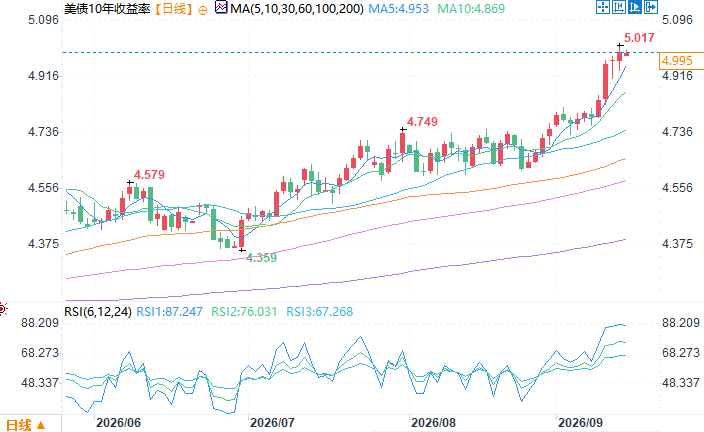 10-year US Treasury yield daily chart. Source: EasyTrade. At 10:28 AM Beijing time on September 15th, the 10-year US Treasury yield was 4.999%.
Multiple factors combined to push the 10-year US Treasury yield above the key 5% mark.
Adam Turnquist stated that a confluence of factors, including inflationary concerns, geopolitical tensions, and potential US fiscal vulnerabilities, caused the benchmark 10-year US Treasury yield to quickly break through the important psychological barrier of 5%. For most of this year, US Treasury yields have exhibited a pattern of "two steps upward, one step downward," but in the past month, the pace of increase has accelerated significantly. Escalating tensions in the Middle East have driven oil prices to multi-month highs, and coupled with continued constraints on oil supply, market concerns about inflation have reignited. Simultaneously, the market is paying close attention to the scale of US debt issuance, and concerns about fiscal risks continue to escalate. Market expectations for US monetary policy have continued to shift towards a hawkish stance, further pushing up US Treasury yields and significantly suppressing gold prices. Turnquist stated, "Rising interest rates and a shift in monetary policy expectations towards a hawkish stance undoubtedly drag down gold prices." However, he also noted that the Federal Reserve has not yet confirmed the current extremely hawkish market expectations, and the US Treasury's previous efforts to stabilize yields have had limited short-term effects. From a technical perspective, US Treasury yields still have room to rise further; the 10-year US Treasury yield opened at 4.97% this week. Since early March, the 10-year US Treasury yield has been on an upward trend, accelerating its rise after breaking through the resistance zone of 4.70% to 4.75%. Turnquist believes this breakout completes a multi-year consolidation pattern, and the 5% level has become the market's focus. If the yield holds above 5%, the next important resistance zone is expected to be the 5.25% to 5.35% range formed between 2006 and 2007. Various momentum indicators also point to rising yields, with positive momentum indicators consistently outperforming negative ones, and the average directional movement index rising in tandem.Traditional market logic failed, and gold prices showed unexpected resilience.
Trnquist believes that even though a 5% US Treasury yield will continue to put pressure on gold, the precious metals market has shown unexpected resilience. In the traditional trading framework, rising US Treasury yields coupled with hawkish policy expectations typically lead to a stronger dollar, creating a double negative for gold prices. However, this correlation has weakened significantly. He states that the rise of "currency devaluation hedging trades" has fueled this divergence. Safe-haven demand, continued gold purchases by central banks, and renewed inflows into physically backed gold ETFs have become significant forces offsetting rising US Treasury yields. More and more analysts are paying attention to the divergence between gold and US Treasury yields. While a 5% US Treasury yield increases the opportunity cost of holding gold and continues to cause short-term price volatility, gold can withstand a high-interest-rate environment, and the dollar has not strengthened accordingly. This indicates that investors' core focus has shifted to broader fiscal and currency purchasing power risks.The underlying market logic is shifting, highlighting gold's hedging properties.
In the past, market analysis of gold largely relied on two main indicators: US Treasury yields and the US dollar index. However, with the increasing weighting of fiscal risks and monetary credit issues, the old pricing models can no longer fully explain gold price movements. In the short term, the disturbances caused by the surge in US Treasury yields will continue, and gold prices will continue to face pressure, experiencing periods of fluctuation and correction. However, capital flows have changed. Central banks around the world are continuously allocating to gold, and ETF funds are flowing back into the market, reflecting global concerns about the long-term purchasing power of sovereign currencies. The market no longer simply views gold as an interest rate-sensitive asset, but rather as a core safe-haven asset to hedge against fiscal deterioration and geopolitical instability.Conclusion
In summary, rising short-term US Treasury yields and hawkish monetary policy expectations remain the direct factors suppressing gold prices. Whether the 10-year US Treasury yield can break through 5% will continue to dominate short-term gold price fluctuations. However, the traditional correlation between gold, US Treasury bonds, and the US dollar has been broken, signaling a change in the underlying market logic. Continued central bank gold purchases and currency depreciation hedging demand continue to support gold prices. Short-term interest rate fluctuations will not alter gold's long-term value as a hedge against systemic fiscal and monetary risks. During this transition between old and new pricing logics, investors need to move beyond a singular focus on US Treasury yields and pay more attention to the long-term variable of global fiscal risk. 10-year US Treasury yield daily chart. Source: EasyTrade. At 10:28 AM Beijing time on September 15th, the 10-year US Treasury yield was 4.999%.
- Risk Warning and Disclaimer
- The market involves risk, and trading may not be suitable for all investors. This article is for reference only and does not constitute personal investment advice, nor does it take into account certain users’ specific investment objectives, financial situation, or other needs. Any investment decisions made based on this information are at your own risk.