A chart shows that weakening large vessel capacity dragged down prices, causing the Baltic Dry Index to decline slightly.
2026-09-16 23:38:09
The latest data shows that the Baltic Dry Index (BDI) closed at 3327 points on September 16, 2026, a new low since September 1, 2026, down 0.98% month-on-month, marking the fifth consecutive day of decline (including zero growth). Looking at the short-term charts, the BDI has seen positive growth 5 times, negative growth 6 times, and zero growth in the last 11 BDI data points. Specifically, the Panamax Freight Index (BPI) closed at 2325 points, down 1.65% from the previous value; the Capesize Freight Index (BCI) closed at 5612 points, down 1.32%; and the Supramax Freight Index (BSI) closed at 1748 points, up 0.69%. For detailed charts of the latest 720-day and 10-year trends of the Baltic Dry Index and its three main sub-indices, please refer to the charts specially created by FX678. 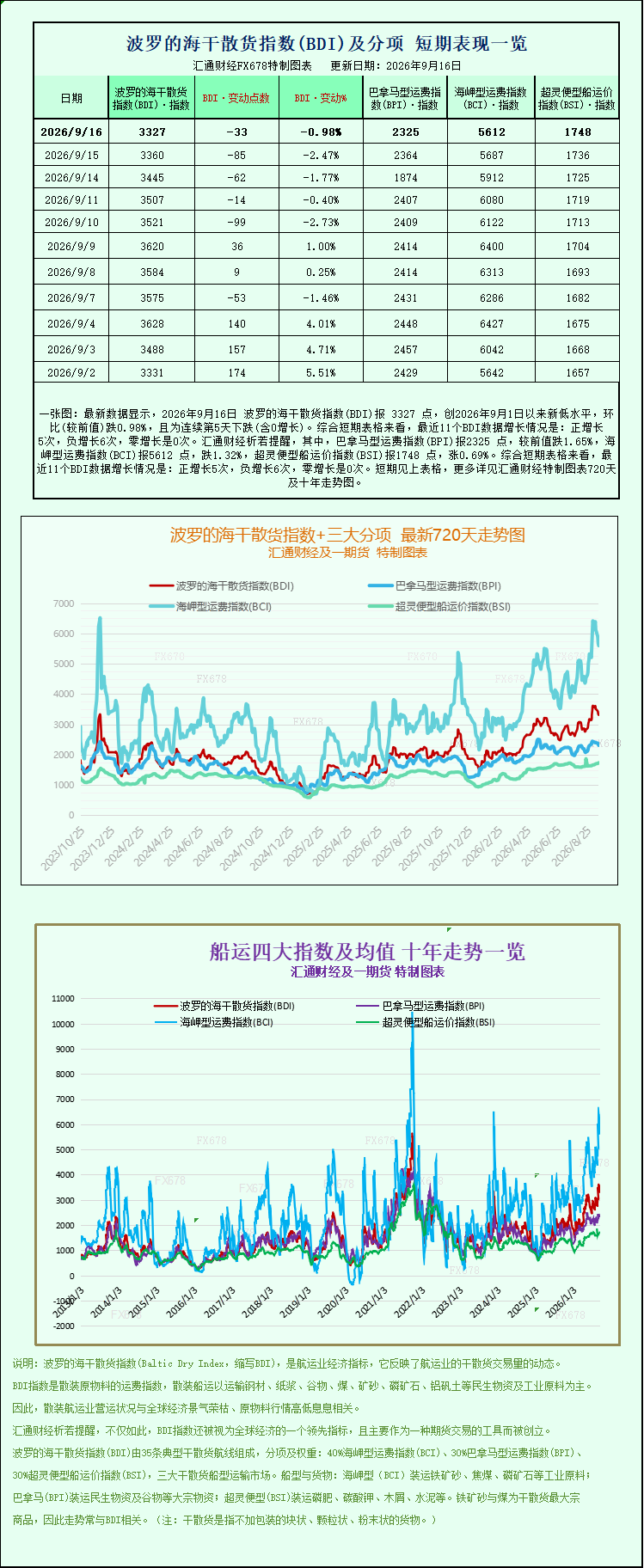 On Wednesday, the international dry bulk shipping market experienced a temporary correction, with the Baltic Dry Index (BDI) falling slightly, revealing a clear structural divergence in the market. The primary driver of this decline was the continued weakening of freight rates for large ocean-going vessels. The profitability of the two main vessel types, Capesize and Panamax, declined simultaneously, while only small and medium-sized vessels bucked the trend with slight increases due to their flexible routes, completely reversing the recovery trend seen at the beginning of the month. Data shows that the Baltic Dry Index, which tracks freight rates for the three major dry bulk vessel types—Capesize, Panamax, and Supramax—fell by 33 points, or approximately 1%, closing at 3327 points. This adjustment represents a phase of market recovery. Although the index has fallen somewhat, it remains within the high range seen since September, without a deep correction, fully demonstrating the resilience and divergence in the current supply and demand dynamics of the dry bulk shipping market. As the core vessel type for long-haul bulk raw material transportation, Capesize vessels were the biggest drag on the index, exhibiting the weakest performance. On the same day, the Capesize freight index fell sharply by 75 points, a drop of 1.3%, to 5612 points. This vessel type mainly carries core industrial raw materials such as iron ore and thermal coal weighing over 150,000 tons, and is the mainstay of trans-Pacific and trans-Atlantic long-haul shipping. Its freight rate fluctuations directly reflect the global trading activity of heavy industrial raw materials. In terms of profitability, the average daily earnings of Capesize vessels decreased by $675 to $47,397, with the profit margin for end-user transportation continuing to narrow. Industry analysts pointed out that the decline in Capesize freight rates was mainly due to a temporary cooling in global iron ore shipping demand. Currently, the global steel industry is in its traditional off-season, with downstream construction and manufacturing industries demanding less steel than expected. Steel mill operating rates in many countries remain low, slowing down the pace of iron ore procurement and restocking, directly leading to a reduction in ocean-going iron ore shipping orders. It is noteworthy that iron ore spot prices rebounded against the trend on the same day, reversing the previous continuous decline, indicating a subtle shift in market sentiment. This price increase was not due to a significant recovery in end-user demand, but rather the result of a market-driven interplay of funds and sentiment. Investors gradually downplayed the negative impact of weak short-term demand in China's steel industry, focusing instead on the implementation of subsequent domestic stimulus policies to stabilize growth. Meanwhile, production cuts by some smaller overseas iron ore miners further tightened short-term raw material supply, providing support for ore prices. However, the rebound in raw material prices did not boost shipping demand, and the supply-demand mismatch kept Capesize freight rates under pressure. In addition to Capesize vessels, the medium-sized Panamax vessel market also continued its downward trend, exacerbating the overall downward pressure on the index. Data shows that the Panamax index fell 39 points, or 1.6%, more than the Capesize index, closing at 2325 points. Panamax vessels, primarily with a deadweight tonnage of 60,000 to 70,000 tons, mainly handle short-to-medium-haul ocean transport of bulk commodities such as thermal coal, grain, and fertilizers, and are widely used on regional trade routes, forming the backbone of the global dry bulk shipping market. Profitability data shows that the average daily revenue of Panamax vessels decreased by $349 to $20,927, indicating a continued contraction in the operating profits of transportation companies. The decline in Panamax freight rates is primarily due to a temporary weakness in global energy and agricultural product trade transportation demand. Entering September, the traditional peak season for coal consumption in the Northern Hemisphere has not yet fully begun, and energy reserves in Europe and the United States are ample, limiting the increase in cross-border orders for thermal coal. Simultaneously, global grain trade has entered a stable period, with harvesting and shipping in major producing regions proceeding at a steady pace. There is no concentrated rush to transport goods, resulting in overall stable but weak transportation demand, making it difficult to support rising freight rates. This, coupled with a slight increase in idle capacity of large vessels recently, has eased the supply-demand relationship, further suppressing freight rate trends. In stark contrast to the sluggish performance of large vessels, small and medium-sized Supramax vessels demonstrated strong market resilience, becoming the only vessel type to see an increase that day. Data shows that the Supramax index rose 12 points, or 0.7%, to close at 1748 points. This vessel type has a smaller tonnage and greater route flexibility, making it suitable for short-haul, small-batch, and multi-category transportation needs. It can cover diversified bulk cargo trade such as building materials, grains, and niche minerals, and is less affected by fluctuations in demand for large industrial raw materials. From a market perspective, the Supramax vessel's counter-trend rise is supported by regional segmented trade. Currently, the activity of global inter-regional trade in small and medium-sized commodities is stable, with sufficient short-haul transportation orders in Southeast Asia, the Middle East, and South America. Furthermore, the supply of small and medium-sized vessel capacity is relatively tight, with a low idle ratio, resulting in a relatively tight supply-demand situation. This allows it to move independently of the large vessel market, exhibiting an independent upward trend and creating a structural differentiation in the overall dry bulk market: "large vessels weaken, small vessels strengthen." Overall, the recent correction in the Baltic Dry Index is the result of multiple factors, including short-term supply-demand adjustments, the off-season effect of commodity demand, and market sentiment dynamics. The current dry bulk shipping market has not yet entered a full-blown downward cycle; the decline in large vessel freight rates is more of a rational correction after the rapid rise at the beginning of the month. The subsequent market trend will heavily depend on the effectiveness of China's pro-growth policies, the pace of recovery in steel industry operating rates, and the recovery of global energy and agricultural trade demand. If domestic stimulus policies continue to take effect and downstream industrial demand recovers, demand for transportation of bulk raw materials such as iron ore and coal is expected to rebound, driving a rebound in freight rates for large vessels and pushing the index back into an upward trend. Conversely, the market may continue its current volatile trend characterized by structural differentiation.
On Wednesday, the international dry bulk shipping market experienced a temporary correction, with the Baltic Dry Index (BDI) falling slightly, revealing a clear structural divergence in the market. The primary driver of this decline was the continued weakening of freight rates for large ocean-going vessels. The profitability of the two main vessel types, Capesize and Panamax, declined simultaneously, while only small and medium-sized vessels bucked the trend with slight increases due to their flexible routes, completely reversing the recovery trend seen at the beginning of the month. Data shows that the Baltic Dry Index, which tracks freight rates for the three major dry bulk vessel types—Capesize, Panamax, and Supramax—fell by 33 points, or approximately 1%, closing at 3327 points. This adjustment represents a phase of market recovery. Although the index has fallen somewhat, it remains within the high range seen since September, without a deep correction, fully demonstrating the resilience and divergence in the current supply and demand dynamics of the dry bulk shipping market. As the core vessel type for long-haul bulk raw material transportation, Capesize vessels were the biggest drag on the index, exhibiting the weakest performance. On the same day, the Capesize freight index fell sharply by 75 points, a drop of 1.3%, to 5612 points. This vessel type mainly carries core industrial raw materials such as iron ore and thermal coal weighing over 150,000 tons, and is the mainstay of trans-Pacific and trans-Atlantic long-haul shipping. Its freight rate fluctuations directly reflect the global trading activity of heavy industrial raw materials. In terms of profitability, the average daily earnings of Capesize vessels decreased by $675 to $47,397, with the profit margin for end-user transportation continuing to narrow. Industry analysts pointed out that the decline in Capesize freight rates was mainly due to a temporary cooling in global iron ore shipping demand. Currently, the global steel industry is in its traditional off-season, with downstream construction and manufacturing industries demanding less steel than expected. Steel mill operating rates in many countries remain low, slowing down the pace of iron ore procurement and restocking, directly leading to a reduction in ocean-going iron ore shipping orders. It is noteworthy that iron ore spot prices rebounded against the trend on the same day, reversing the previous continuous decline, indicating a subtle shift in market sentiment. This price increase was not due to a significant recovery in end-user demand, but rather the result of a market-driven interplay of funds and sentiment. Investors gradually downplayed the negative impact of weak short-term demand in China's steel industry, focusing instead on the implementation of subsequent domestic stimulus policies to stabilize growth. Meanwhile, production cuts by some smaller overseas iron ore miners further tightened short-term raw material supply, providing support for ore prices. However, the rebound in raw material prices did not boost shipping demand, and the supply-demand mismatch kept Capesize freight rates under pressure. In addition to Capesize vessels, the medium-sized Panamax vessel market also continued its downward trend, exacerbating the overall downward pressure on the index. Data shows that the Panamax index fell 39 points, or 1.6%, more than the Capesize index, closing at 2325 points. Panamax vessels, primarily with a deadweight tonnage of 60,000 to 70,000 tons, mainly handle short-to-medium-haul ocean transport of bulk commodities such as thermal coal, grain, and fertilizers, and are widely used on regional trade routes, forming the backbone of the global dry bulk shipping market. Profitability data shows that the average daily revenue of Panamax vessels decreased by $349 to $20,927, indicating a continued contraction in the operating profits of transportation companies. The decline in Panamax freight rates is primarily due to a temporary weakness in global energy and agricultural product trade transportation demand. Entering September, the traditional peak season for coal consumption in the Northern Hemisphere has not yet fully begun, and energy reserves in Europe and the United States are ample, limiting the increase in cross-border orders for thermal coal. Simultaneously, global grain trade has entered a stable period, with harvesting and shipping in major producing regions proceeding at a steady pace. There is no concentrated rush to transport goods, resulting in overall stable but weak transportation demand, making it difficult to support rising freight rates. This, coupled with a slight increase in idle capacity of large vessels recently, has eased the supply-demand relationship, further suppressing freight rate trends. In stark contrast to the sluggish performance of large vessels, small and medium-sized Supramax vessels demonstrated strong market resilience, becoming the only vessel type to see an increase that day. Data shows that the Supramax index rose 12 points, or 0.7%, to close at 1748 points. This vessel type has a smaller tonnage and greater route flexibility, making it suitable for short-haul, small-batch, and multi-category transportation needs. It can cover diversified bulk cargo trade such as building materials, grains, and niche minerals, and is less affected by fluctuations in demand for large industrial raw materials. From a market perspective, the Supramax vessel's counter-trend rise is supported by regional segmented trade. Currently, the activity of global inter-regional trade in small and medium-sized commodities is stable, with sufficient short-haul transportation orders in Southeast Asia, the Middle East, and South America. Furthermore, the supply of small and medium-sized vessel capacity is relatively tight, with a low idle ratio, resulting in a relatively tight supply-demand situation. This allows it to move independently of the large vessel market, exhibiting an independent upward trend and creating a structural differentiation in the overall dry bulk market: "large vessels weaken, small vessels strengthen." Overall, the recent correction in the Baltic Dry Index is the result of multiple factors, including short-term supply-demand adjustments, the off-season effect of commodity demand, and market sentiment dynamics. The current dry bulk shipping market has not yet entered a full-blown downward cycle; the decline in large vessel freight rates is more of a rational correction after the rapid rise at the beginning of the month. The subsequent market trend will heavily depend on the effectiveness of China's pro-growth policies, the pace of recovery in steel industry operating rates, and the recovery of global energy and agricultural trade demand. If domestic stimulus policies continue to take effect and downstream industrial demand recovers, demand for transportation of bulk raw materials such as iron ore and coal is expected to rebound, driving a rebound in freight rates for large vessels and pushing the index back into an upward trend. Conversely, the market may continue its current volatile trend characterized by structural differentiation.
- Risk Warning and Disclaimer
- The market involves risk, and trading may not be suitable for all investors. This article is for reference only and does not constitute personal investment advice, nor does it take into account certain users’ specific investment objectives, financial situation, or other needs. Any investment decisions made based on this information are at your own risk.