The Federal Reserve signaled another interest rate hike this year, and the dollar index rose for the sixth consecutive day, surpassing the 100 mark.
2026-09-17 14:32:12
The US dollar index continued its strength in Asian trading on Thursday, rising for the sixth consecutive trading day and currently trading around 100.20. The Federal Reserve's resumption of interest rate hikes and hawkish signals from Chairman Kevin Warsh are the main factors driving the recent sustained rise in the dollar. Meanwhile, the market is awaiting US initial jobless claims data to further assess the state of the labor market and evaluate the Fed's future policy space.  The Federal Reserve raised the target range for the federal funds rate by 25 basis points to 3.75%–4.00% on Wednesday, in line with market expectations and marking the Fed's first rate hike in three years. Following the policy rate increase, market pricing in future interest rate paths shifted rapidly. According to the CME FedWatch tool, the market currently estimates a 49.8% probability of another rate hike at the October meeting, meaning investors have begun to more fully price in the next policy adjustment. In his post-meeting remarks, Kevin Warsh emphasized that U.S. inflation remains "too high" and has persisted for too long, therefore this rate hike was a carefully considered policy decision. He also stated that further increases in borrowing costs in the coming months remain a policy option if price pressures persist. Compared to previous market expectations of a possible shift to easing monetary policy, this policy statement clearly enhances the dollar's interest rate advantage. From a policy perspective, the Fed is not currently adjusting rates simply due to short-term fluctuations in economic data, but rather focusing more on whether inflation can sustainably decline. Warsh emphasized that the U.S. economic fundamentals remain resilient, thus allowing policymakers to focus more on price stability. As long as economic growth doesn't show a significant slowdown, the Federal Reserve will still have room to maintain higher interest rates or even continue tightening policy, which is a key reason for the recent support for the US dollar. The strengthening of the US dollar is already reflected in the performance of major currency pairs. This week, the US dollar rose approximately 1.22% against the euro, 1.17% against the pound, 1.61% against the yen, 0.88% against the Canadian dollar, 0.86% against the Australian dollar, and 1.64% against the New Zealand dollar. Overall, the US dollar has once again become one of the stronger performing currencies in the major foreign exchange markets. However, the continuous rise of the US dollar also means that it has accumulated some gains in the short term. The US dollar index has now climbed back above the 100 mark, and the market needs to pay attention to whether subsequent economic data can continue to support the Fed's hawkish stance. If initial jobless claims increase significantly, or if subsequent employment and economic data show signs of cooling, market expectations for further interest rate hikes may be readjusted, thus putting pressure on the US dollar to take profits in the short term. Meanwhile, US Treasury yields remain an important transmission variable for the US dollar's movement. The Federal Reserve's continued high policy rates and expectations of further rate hikes are helping to push up short-term yields in the US, while higher yields on dollar-denominated assets enhance the relative attractiveness of the dollar. However, if long-term yields rise primarily due to increased inflation risks, the pressure they could exert on risk assets and global economic growth expectations should be monitored. For the foreign exchange market, the future direction of the dollar will depend on the dynamic changes between Fed policy expectations and economic data. Initial jobless claims data will be a key short-term catalyst, followed by US inflation, employment, and consumption data. If the economy remains resilient and inflation continues to exceed the policy target, the dollar's interest rate advantage may persist; if the economy cools significantly, the risk of a correction after six consecutive days of gains will gradually increase. From a daily chart perspective, the dollar index is currently trading around 100.30, with the price above both the 50-day and 9-day EMAs, maintaining a complete short-term rebound structure. The 14-day RSI has risen to 63.58, approaching overbought territory, indicating that the bulls still hold the initiative, but the potential for further momentum expansion after consecutive gains is somewhat limited. The first support level to watch is the 50-day EMA at approximately 99.69, followed by the 9-day EMA at approximately 99.64, with these two moving averages forming a relatively concentrated support area. As long as the US dollar index continues to trade above 99.64-99.69, the daily chart structure remains bullish. Looking at the 4-hour chart, the US dollar index has recently formed a continuous rebound structure, with the price consistently trading above the short-term moving average system. The 100.00 level has gradually transformed from resistance into significant short-term support. If the price can effectively break through the 100.50 area, it may further test the 101.00 and 101.50 areas; if it rises and then falls back below 100.00, short-term profit-taking should be anticipated, with a potential pullback target around 99.70. Overall, the US dollar remains in a short-term bullish phase, but with the RSI entering relatively high territory, caution is advised regarding potential high-level consolidation.
 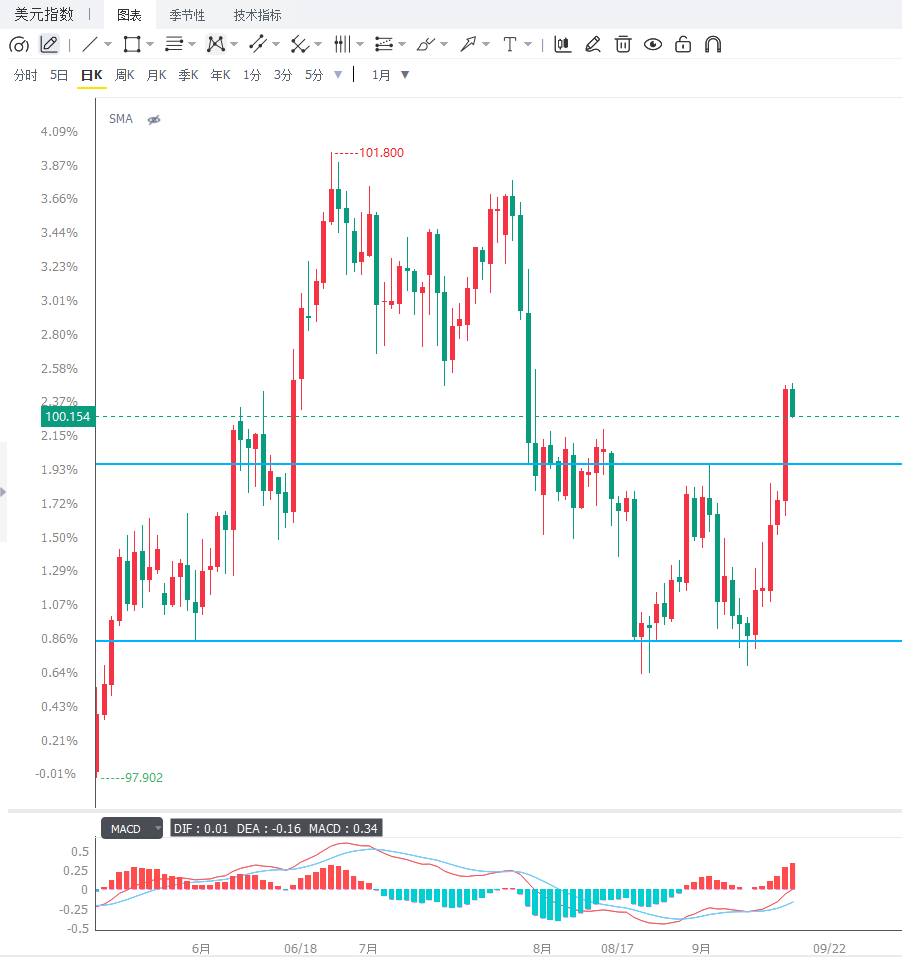 Editor's Summary: The Federal Reserve's renewed interest rate hike and Kevin Warsh's emphasis on persistent inflation have raised market expectations for continued high or even further tightening of US interest rates, causing the US dollar index to rise for the sixth consecutive trading day and stabilize above the 100 mark. In the short term, monetary policy remains a key support for the dollar, but the continuous rise has also increased the risk of a technical correction. Subsequent initial jobless claims, inflation, and employment data will be crucial for the market to reprice the Fed's policy path, while the 99.64-99.69 area is a key support zone for the dollar index in the short term.
The Federal Reserve raised the target range for the federal funds rate by 25 basis points to 3.75%–4.00% on Wednesday, in line with market expectations and marking the Fed's first rate hike in three years. Following the policy rate increase, market pricing in future interest rate paths shifted rapidly. According to the CME FedWatch tool, the market currently estimates a 49.8% probability of another rate hike at the October meeting, meaning investors have begun to more fully price in the next policy adjustment. In his post-meeting remarks, Kevin Warsh emphasized that U.S. inflation remains "too high" and has persisted for too long, therefore this rate hike was a carefully considered policy decision. He also stated that further increases in borrowing costs in the coming months remain a policy option if price pressures persist. Compared to previous market expectations of a possible shift to easing monetary policy, this policy statement clearly enhances the dollar's interest rate advantage. From a policy perspective, the Fed is not currently adjusting rates simply due to short-term fluctuations in economic data, but rather focusing more on whether inflation can sustainably decline. Warsh emphasized that the U.S. economic fundamentals remain resilient, thus allowing policymakers to focus more on price stability. As long as economic growth doesn't show a significant slowdown, the Federal Reserve will still have room to maintain higher interest rates or even continue tightening policy, which is a key reason for the recent support for the US dollar. The strengthening of the US dollar is already reflected in the performance of major currency pairs. This week, the US dollar rose approximately 1.22% against the euro, 1.17% against the pound, 1.61% against the yen, 0.88% against the Canadian dollar, 0.86% against the Australian dollar, and 1.64% against the New Zealand dollar. Overall, the US dollar has once again become one of the stronger performing currencies in the major foreign exchange markets. However, the continuous rise of the US dollar also means that it has accumulated some gains in the short term. The US dollar index has now climbed back above the 100 mark, and the market needs to pay attention to whether subsequent economic data can continue to support the Fed's hawkish stance. If initial jobless claims increase significantly, or if subsequent employment and economic data show signs of cooling, market expectations for further interest rate hikes may be readjusted, thus putting pressure on the US dollar to take profits in the short term. Meanwhile, US Treasury yields remain an important transmission variable for the US dollar's movement. The Federal Reserve's continued high policy rates and expectations of further rate hikes are helping to push up short-term yields in the US, while higher yields on dollar-denominated assets enhance the relative attractiveness of the dollar. However, if long-term yields rise primarily due to increased inflation risks, the pressure they could exert on risk assets and global economic growth expectations should be monitored. For the foreign exchange market, the future direction of the dollar will depend on the dynamic changes between Fed policy expectations and economic data. Initial jobless claims data will be a key short-term catalyst, followed by US inflation, employment, and consumption data. If the economy remains resilient and inflation continues to exceed the policy target, the dollar's interest rate advantage may persist; if the economy cools significantly, the risk of a correction after six consecutive days of gains will gradually increase. From a daily chart perspective, the dollar index is currently trading around 100.30, with the price above both the 50-day and 9-day EMAs, maintaining a complete short-term rebound structure. The 14-day RSI has risen to 63.58, approaching overbought territory, indicating that the bulls still hold the initiative, but the potential for further momentum expansion after consecutive gains is somewhat limited. The first support level to watch is the 50-day EMA at approximately 99.69, followed by the 9-day EMA at approximately 99.64, with these two moving averages forming a relatively concentrated support area. As long as the US dollar index continues to trade above 99.64-99.69, the daily chart structure remains bullish. Looking at the 4-hour chart, the US dollar index has recently formed a continuous rebound structure, with the price consistently trading above the short-term moving average system. The 100.00 level has gradually transformed from resistance into significant short-term support. If the price can effectively break through the 100.50 area, it may further test the 101.00 and 101.50 areas; if it rises and then falls back below 100.00, short-term profit-taking should be anticipated, with a potential pullback target around 99.70. Overall, the US dollar remains in a short-term bullish phase, but with the RSI entering relatively high territory, caution is advised regarding potential high-level consolidation. Editor's Summary: The Federal Reserve's renewed interest rate hike and Kevin Warsh's emphasis on persistent inflation have raised market expectations for continued high or even further tightening of US interest rates, causing the US dollar index to rise for the sixth consecutive trading day and stabilize above the 100 mark. In the short term, monetary policy remains a key support for the dollar, but the continuous rise has also increased the risk of a technical correction. Subsequent initial jobless claims, inflation, and employment data will be crucial for the market to reprice the Fed's policy path, while the 99.64-99.69 area is a key support zone for the dollar index in the short term.
- Risk Warning and Disclaimer
- The market involves risk, and trading may not be suitable for all investors. This article is for reference only and does not constitute personal investment advice, nor does it take into account certain users’ specific investment objectives, financial situation, or other needs. Any investment decisions made based on this information are at your own risk.