Gold Trading Alert: With the dollar weakening and oil prices falling, gold prices rebounded by nearly 2%! Has the bulls sounded their counterattack?
2026-09-18 07:42:10
Global gold markets saw a strong rebound on Thursday (September 17), with spot gold closing up 1.8%, rising above the 100-day moving average of $4320 to settle at $4341.62 per ounce. The price reached a high of $4381.14 during the session, a near one-week high. US December gold futures also rose 0.3% to $4399.70. This rally was driven by multiple factors, including a weaker dollar, declining oil prices, and lower US Treasury yields. Investors are digesting the impact of the latest Fed rate hike while reassessing gold's value as a safe-haven and hedging tool. While short-term volatility is inevitable, medium- to long-term supporting factors are quietly accumulating. On Friday (September 18) in early Asian trading, spot gold traded in a narrow range, currently hovering around $4445 per ounce. 
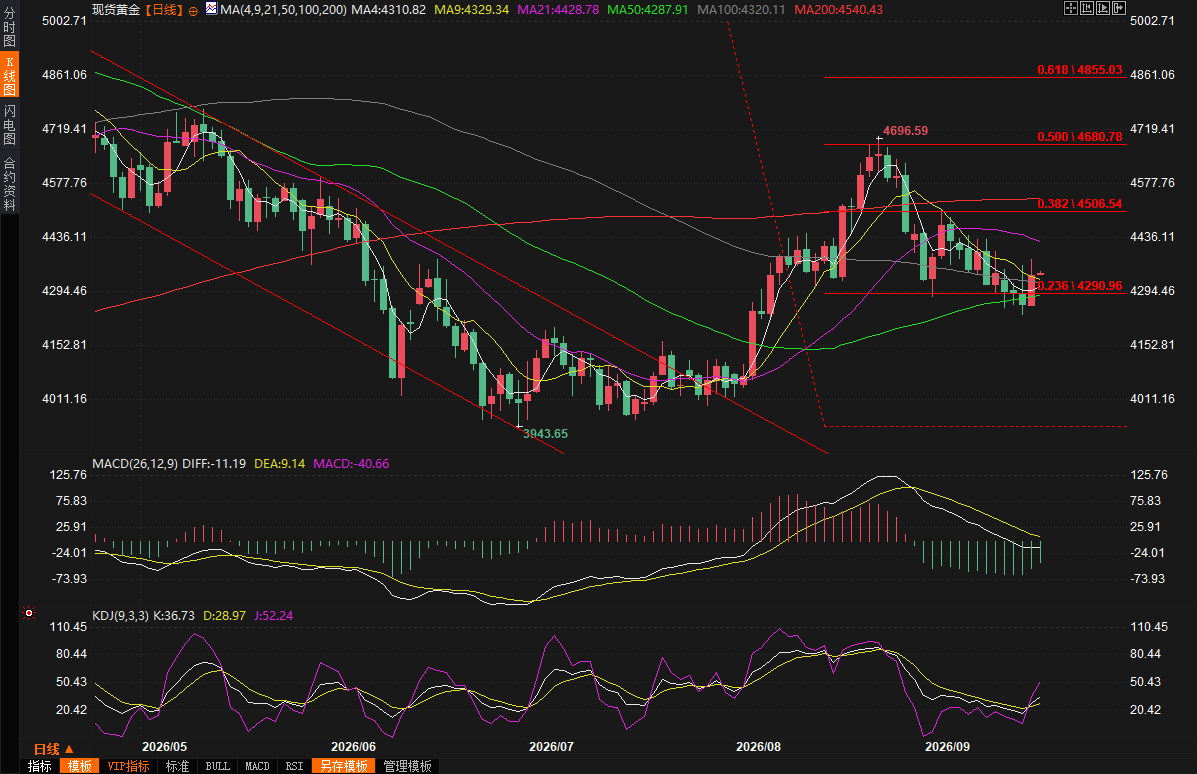 (Spot gold daily chart, source: FX678) At 07:38 Beijing time, spot gold is currently trading at $4344.08 per ounce.
The easing of oil price restrictions and the weakening of the US dollar directly triggered a rebound in gold prices.
There has long been a close negative correlation between gold and energy prices. David Meger, Director of Precious Metals Trading at High Ridge Futures, points out that in a market dominated by inflationary pressures, a sharp drop in energy prices often effectively alleviates some of the pressure on the gold market. Oil prices fell for the second consecutive trading day this week, hitting a one-week low, primarily due to easing market concerns about supply disruptions. Reports indicated that Saudi Arabia would provide more crude oil shipments through Oman, which to some extent mitigated oil price expectations driven up by tensions in the Middle East. Meanwhile, the US dollar index retreated from a seven-week high, falling to around 100.02 at one point during the session. A weaker dollar directly reduces the cost of purchasing dollar-denominated gold for holders of other currencies, thereby stimulating buying interest. The benchmark 10-year US Treasury yield also fell, closing at 4.943% on Thursday, a drop of 6.1 basis points, marking the largest single-day decline in over three weeks. The decline in risk-free yields reduces the opportunity cost of holding gold, further supporting gold prices. These factors combined to cause gold to rebound quickly after hitting a near six-week low in the previous trading session. Market sentiment shifted from cautious to positive, and there were also clear signs of short-term technical recovery.The repercussions of the Fed's rate hikes have not yet subsided, and the struggle between interest rates and inflation remains the core issue.
The Federal Reserve's interest rate hike decision on Wednesday and its subsequent statements remain key variables influencing gold prices. The rate hike was unanimously approved, with the Chairman explicitly supporting it and hinting at further policy tightening in the coming months. This effectively acknowledges that current inflationary pressures have not been effectively controlled, and policymakers remain wary of a potential further deterioration in inflation. The CME Group's FedWatch tool shows that traders expect the probability of another rate hike at the Fed's next meeting in October to have risen to approximately 51%, up from around 44% the previous day. Gold has historically been considered an important tool for hedging against inflation, but a high-interest-rate environment increases the attractiveness of interest-bearing assets, thus putting downward pressure on non-yielding gold. In the short term, the market is still digesting the impact of this hawkish signal, and gold prices are bound to fluctuate. However, UBS, in its report, offers a more forward-looking perspective: widening fiscal deficits, increased debt burdens, a weakening dollar, and the expectation that the Fed will resume easing policies next year should support gold prices in the medium to long term. Short-term volatility may be unavoidable, but directional support is forming. Overseas central bank policies are also evolving in tandem. The Bank of England kept interest rates unchanged on Thursday but warned of inflation and hinted at a possible future rate hike, causing the pound to weaken. Meanwhile, the Bank of Japan is expected to raise interest rates to a 31-year high on Friday and signal its intention to continue pushing up borrowing costs. This divergence in policies among major global central banks has further increased the uncertainty surrounding the dollar's trajectory, indirectly creating opportunities for gold.The geopolitical situation remains a major concern.
Tensions between Iran and the United States and Israel continue to escalate. Zorghader, political advisor to Iran's Supreme Leader, explicitly warned that the Strait of Hormuz will not reopen unless Trump and Netanyahu step down. This strategic waterway connecting the Persian Gulf and the Gulf of Oman is one of the world's main routes for oil and gas transport; before the war, one-fifth of the world's oil and liquefied natural gas were transported through the strait. Trade volumes have plummeted in recent days, with preliminary maritime tracking data showing only three merchant ships passing through the strait on Wednesday. Meanwhile, the conflict in Yemen continues to spread. Saudi Arabia and the Houthi rebels have launched renewed cross-border attacks, and the International Organization for Migration says the latest conflict has displaced more than 100,000 Yemenis. Iran claims to have attacked 10 ships and continues to tighten navigation restrictions in the region. US facilities in Jordan have also been affected, with Iran attacking the Mowafak Sarti airbase, damaging several US aircraft. Logically, such a severe geopolitical situation should provide strong safe-haven demand for gold. However, in reality, the geopolitical conflict, through pushing up oil prices, has indirectly suppressed gold prices. ICBC International's chief economist, Cheng Shi, pointed out that the main impact of this military conflict on the global economy is concentrated on the rise in risk premiums and their cross-market transmission, directly boosting demand for assets such as gold. However, the complexity lies in the fact that the geopolitical conflict simultaneously pushed up inflation expectations through oil prices, thereby strengthening expectations of a tightening by the Federal Reserve, ultimately creating a tug-of-war between "safe-haven buying" and "interest rate suppression" of gold. This tug-of-war was particularly evident in early September. Despite the escalating geopolitical risks, international gold prices were affected by both soaring oil prices and better-than-expected US inflation data, exhibiting weak fluctuations. Only when oil prices fell and supply concerns eased did gold finally have a window for a rebound. The overlooked underlying force: Central bank gold purchases and long-term structural support Amid the short-term noise of the Federal Reserve's policy game and geopolitical disturbances, a more enduring and decisive force is quietly reshaping the underlying logic of the gold market—the continued gold purchases by global central banks. Data from the People's Bank of China is particularly noteworthy. As of the end of August 2026, China's central bank gold reserves stood at 76.73 million ounces (approximately 2,386.57 tons), an increase of 650,000 ounces (approximately 20.22 tons) from the end of July, marking the highest increase since October 2023. This marks the 22nd consecutive month of gold purchases by the People's Bank of China. In terms of pace, since resuming purchases in November 2024, the central bank's purchases have exhibited a pattern of "rapid initial growth, slower growth in the middle period, and a recent resurgence." Since March of this year, the scale of purchases has climbed month by month, expanding from 160,000 ounces in March to 650,000 ounces in August. The People's Bank of China's gold purchases are not an isolated case. The Bank of Korea recently announced an increase in its official gold reserves, marking its first purchase of physical gold since 2013. A survey released by the World Gold Council in June showed that nearly 90% of surveyed central banks believe that global central bank gold reserves will continue to increase in the next 12 months, and 45% of surveyed central banks plan to increase their gold holdings within the next year, a record high for this survey. Analysts point out that geopolitical risks may become the norm, further increasing the willingness of global central banks and markets to buy gold. The core motivation for global central banks to purchase gold lies in de-dollarization and optimizing reserve structures to cope with the weakening of the dollar's credibility and geopolitical risks. The continued gold purchases by central banks and the trend of de-dollarization constitute the basis for the medium- to long-term rise in gold prices.summary
In summary, Thursday's strong rebound in gold prices was a result of a confluence of factors including the US dollar, oil prices, yields, and geopolitical tensions. In the short term, expectations of further Fed rate hikes and fluctuating market sentiment may still cause volatility, requiring close monitoring of the dollar index and US Treasury yields. In the medium to long term, fiscal expansion, debt pressures, potential dollar weakness, and an eventual shift in monetary policy provide a more solid foundation for gold prices. The gold market is emerging from its previous correction, and the rebound has begun. Subsequent price movements will depend on inflation data, central bank statements, and further developments in the geopolitical situation. Today's trading session will also be focused on the US August industrial production month-on-month rate and speeches by Fed officials. (Spot gold daily chart, source: FX678) At 07:38 Beijing time, spot gold is currently trading at $4344.08 per ounce.
- Risk Warning and Disclaimer
- The market involves risk, and trading may not be suitable for all investors. This article is for reference only and does not constitute personal investment advice, nor does it take into account certain users’ specific investment objectives, financial situation, or other needs. Any investment decisions made based on this information are at your own risk.