Gold prices withstood the Fed's rate hikes and held key support levels; with interest rates taking a backseat, what is the core contradiction?
2026-09-21 12:12:11
The Federal Reserve's interest rate hike and signaled further tightening measures this year kept US Treasury yields high, which, according to traditional trading logic, should have put downward pressure on gold. However, towards the weekend, gold prices firmly held the key support level of $4,300, with spot gold closing up 0.66% for the week, ending a three-week losing streak. Many analysts point out that gold's current resilience cannot be explained solely by monetary policy. Market funds are moving beyond short-term interest rate changes and towards broader structural factors: deteriorating US fiscal conditions, sticky inflation, geopolitical risks, and the reallocation of global reserve assets are becoming the core forces driving gold prices. Jeff Sarti, CEO of Morton Wealth, holds a similar view. He stated that the Fed's rate hikes are only a secondary factor compared to the long-term forces driving gold. The backdrop of persistently high US fiscal spending and deficits has pushed monetary policy into a dilemma, and the bond market will ultimately test the sustainability of the current fiscal path. He said, "A single 25 basis point rate hike is just noise; the real signals to watch come from the fiscal front." Ole Hansen, head of commodity strategy at Saxo Bank, analyzed that the impact of this interest rate decision had largely been priced in by the market, with gold almost ignoring the negative impact of the rate hike. He said, "As the weekend approached, gold had already digested the impact of the US rate hike." The decision did not contain any unexpectedly hawkish content, and funds began to refocus on investment demand for gold. Even with recent fluctuations in gold prices, gold ETF holdings have still climbed to a seven-month high. He said, "This shows that some long-term funds, which are less sensitive to interest rates, are still steadily allocating to gold despite persistently high yields." He compared the current market situation with that of 2022-2023, when the Federal Reserve significantly raised interest rates and US Treasury yields soared, yet gold prices did not experience the sustained sharp decline traditionally expected. Long-term buying has hedged against the negative impact of interest rates, and this logic remains unchanged. Interest rate hikes will only slow the pace of gold's rise, not reverse the overall bullish tone.
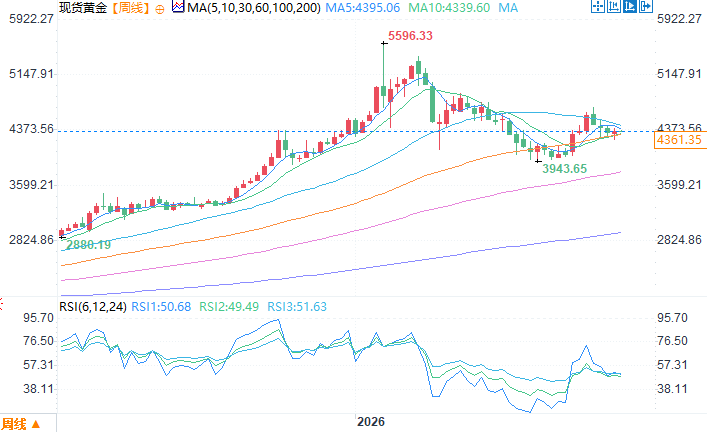 Spot gold weekly chart source: FX678. As of 12:09 PM Beijing time on September 21, spot gold was trading at $4358.35 per ounce.
Interest rate hikes are no longer the decisive variable; fiscal issues are the core contradiction.
The Federal Reserve raised the federal funds rate by 25 basis points last week, with Fed Chairman Kevin Warsh maintaining a hawkish tone to combat persistent inflation. Meanwhile, the 10-year Treasury yield hovered near the key psychological level of 5%. Despite these multiple negative factors, gold did not break down. Chris Vecchio, head of futures and foreign exchange strategy at Tastylive, said that gold's steady performance last week was because investors were no longer solely focused on interpreting the 25-basis-point rate hike. He said that although the Fed signaled continued tightening, the latest economic projections indicate that the magnitude and pace of this rate hike cycle are more moderate than previously expected by the market. The Fed's year-end rate forecast of 4.1% implies limited room for further tightening after the September rate hike, alleviating market concerns about aggressive rate increases. Furthermore, the long-term logic supporting gold prices remains unchanged. Doubts about the stability of US fiscal policy, the continued expansion of government debt, the gradual weakening of overseas demand for US Treasury bonds and the US dollar, and the increasing fragmentation of the global trade landscape have all contributed to both pushing up US Treasury yields and providing continuous buying support for gold. Jeff Sarti, CEO of Morton Wealth, holds a similar view. He stated that the Fed's rate hikes are only a secondary factor compared to the long-term forces driving gold. The backdrop of persistently high US fiscal spending and deficits has pushed monetary policy into a dilemma, and the bond market will ultimately test the sustainability of the current fiscal path. He said, "A single 25 basis point rate hike is just noise; the real signals to watch come from the fiscal front." Ole Hansen, head of commodity strategy at Saxo Bank, analyzed that the impact of this interest rate decision had largely been priced in by the market, with gold almost ignoring the negative impact of the rate hike. He said, "As the weekend approached, gold had already digested the impact of the US rate hike." The decision did not contain any unexpectedly hawkish content, and funds began to refocus on investment demand for gold. Even with recent fluctuations in gold prices, gold ETF holdings have still climbed to a seven-month high. He said, "This shows that some long-term funds, which are less sensitive to interest rates, are still steadily allocating to gold despite persistently high yields." He compared the current market situation with that of 2022-2023, when the Federal Reserve significantly raised interest rates and US Treasury yields soared, yet gold prices did not experience the sustained sharp decline traditionally expected. Long-term buying has hedged against the negative impact of interest rates, and this logic remains unchanged. Interest rate hikes will only slow the pace of gold's rise, not reverse the overall bullish tone.Technical challenges remain, with key resistance levels awaiting a breakthrough.
Despite strong fundamental support, analysts generally believe that gold needs to overcome key technical hurdles to initiate a sustained rebound. Vecchio noted that previous market concerns about a head and shoulders pattern breakout have ultimately proven false, with gold prices holding above the downtrend line extending from the historical high in January. Hansen is also closely monitoring this trend, and gold prices are currently testing the downward channel that began from the August high of around $4700, with short-term resistance concentrated in the $4420-$4440 range. He stated that if gold prices stabilize above this resistance zone, the upside potential will further open up, potentially challenging the 200-day moving average currently around $4540. Vecchio added that if the 10-year US Treasury yield remains below 5% and international oil prices continue to decline, the upward path for gold and silver will be smoother.External markets and subsequent events warrant attention.
This week's economic data is relatively light, and gold prices will be more influenced by the US dollar, US Treasury yields, and related commodities such as crude oil. Global inflationary pressures persist, and most central banks are inclined to tighten policy, but the Swiss National Bank has taken a different path. Charlotte de Montpellier, senior French and Swiss economist at ING, said, "We expect the Swiss National Bank to maintain its policy rate at 0% and continue to use targeted foreign exchange intervention. As long as domestic inflation remains moderate and the Swiss franc remains strong and does not appreciate excessively, the Swiss National Bank can maintain a much looser monetary policy than most central banks." This week will also see the release of US manufacturing data, and several Federal Reserve officials will speak, potentially causing market volatility. The market will be looking for clues about the future path of interest rate hikes and whether high inflation will force the Fed to raise rates again before the end of the year.Conclusion
This round of market activity clearly demonstrates that short-term interest rate hikes are unlikely to unilaterally suppress gold prices. Interest rates are merely a short-term disturbance; underlying US fiscal concerns, global reserve reallocation, and long-term ETF funds collectively form a safety net for gold. However, while fundamentals are improving, technical resistance remains. Whether gold prices can break out of their current range depends on further guidance from the US dollar, US Treasury bonds, and speeches by Federal Reserve officials. Commodity investors need to continuously monitor the interconnected changes in external markets. Spot gold weekly chart source: FX678. As of 12:09 PM Beijing time on September 21, spot gold was trading at $4358.35 per ounce.
- Risk Warning and Disclaimer
- The market involves risk, and trading may not be suitable for all investors. This article is for reference only and does not constitute personal investment advice, nor does it take into account certain users’ specific investment objectives, financial situation, or other needs. Any investment decisions made based on this information are at your own risk.