The Fed's hawkish signals continue to resonate, pushing the dollar index back above 100. Further attention should be paid to expectations of interest rate hikes.
2026-09-21 13:36:14
The US dollar index remained strong in Asian trading on Monday, last trading around 100.30, having regained buying support after two consecutive days of decline. Market repricing of the US interest rate path is the main driver of the dollar's continued strength. On September 16, the Federal Reserve raised the target range for the federal funds rate by 25 basis points to 3.75% to 4.00%, the first rate hike in more than three years, while the policy statement continued to emphasize that inflation remains at a relatively high level.  From a policy expectation perspective, the impact of this round of interest rate hikes has not ended with the decision being finalized. The latest forecasts from the Federal Reserve show that most officials expect further rate hikes this year, and the market's pricing in another rate hike at the October meeting has clearly intensified. According to the CME FedWatch tool, the market expects a probability of another rate hike in October of approximately 56.5%, up from around 42.5% a week ago. This means that the dollar is currently receiving support not only from the short-term interest rate differential brought about by a single rate hike, but also from the expectation that higher interest rates may persist for a longer period. Federal Reserve Chairman Kevin Warsh recently emphasized that US inflation remains too high and has been prolonged, and the latest summer inflation data is insufficient to prove a significant improvement in underlying price pressures. Meanwhile, Minneapolis Fed President Neel Kashkari also stated that US inflationary pressures are not limited to energy prices but are prevalent across multiple sectors of the economy; he also pointed out that US economic growth, productivity, and the job market remain resilient. This policy mix suggests that the Federal Reserve currently has no reason to rush into a more accommodative stance. The policy framework following the September meeting remains focused on curbing inflation. If future economic data continues to show resilience while inflation remains high, market expectations for further interest rate hikes may strengthen further. Conversely, if employment, consumption, or inflation data show a significant cooling, the previously accumulated interest rate premium of the US dollar may experience a temporary pullback. Meanwhile, the US-Japan interest rate differential remains a significant supporting factor for the US dollar. Last week, the Bank of Japan raised its policy rate by 25 basis points to 1.25%, but the 7-2 vote and Kazuo Ueda's cautious policy statements did not significantly strengthen market expectations for further rapid interest rate hikes by the Bank of Japan. The yen subsequently weakened significantly, with the USD/JPY pair rising to near a two-week high. On September 21, the market was still focused on the risk of further intervention in the foreign exchange market by Japanese authorities. The policy expectation gap between the US dollar and the yen persists, providing some support for the US dollar index near the 100 level. However, the rapid depreciation of the yen has already attracted the attention of Japanese officials. If market expectations for intervention further strengthen, the upside potential for the USD/JPY pair may be limited, indirectly affecting the overall performance of the US dollar through the weighting structure of the US dollar index. From a global market perspective, energy price trends remain a crucial variable for the future of the US dollar. On one hand, previous risks to Middle Eastern energy supply pushed up oil prices and exacerbated US inflationary pressures, leading the Federal Reserve to maintain a hawkish stance. On the other hand, recent signs of recovery in some energy transportation and supply have caused oil prices to fall, potentially alleviating some inflationary pressures. Latest market information indicates that Saudi crude oil exports have recovered somewhat, and there are expectations of a gradual recovery in key pipeline supplies, putting downward pressure on oil prices. If energy prices fall further, the market may reassess the inflationary risks previously caused by energy shocks and reduce some long-term interest rate hike expectations; however, if Middle Eastern supplies are again disrupted, a rebound in energy prices could reignite US inflationary pressures, thereby reinforcing the necessity for the Federal Reserve to maintain its tight monetary policy. Therefore, the correlation between oil prices and US dollar interest rate expectations remains a key indicator for the foreign exchange market this week. This week, attention should also be paid to US economic data and speeches by Federal Reserve officials. If the data continues to show resilience in economic activity and a lack of significant downward momentum in inflation, the US dollar may continue to fluctuate at high levels; if economic data weakens significantly, the market may lower its expectations for an October rate hike again, and the short-term upward trend of the US dollar may face a correction. The US dollar index is currently trading around 100.30 on the daily chart. The price remains above the 9-day and 50-day EMAs, with short-term moving averages above long-term moving averages and trending upwards, indicating a still relatively strong short-term structure. The 14-day RSI is around 62.6, in positive territory but not yet in typical overbought territory, suggesting that bulls still hold some initiative. However, as the index continues to approach previous highs, the risk of chasing the rally is gradually increasing. The first support level to watch is around 99.85 near the 9-day EMA, followed by 99.73 near the 50-day EMA. As long as the dollar index continues to trade above this area, the current pullback can be considered a technical consolidation after a strong upward move; a break below 99.70 would significantly weaken the short-term bullish structure. On the upside, watch 100.50 and the previous high around 100.45. A successful break and hold above these levels could lead to a further test of the 101.00 psychological level. On the 4-hour chart, the dollar index is consolidating near the 100 level, still supported by hawkish expectations from the Federal Reserve in the short term. If the price breaks through the 100.45-100.50 area again, the short-term uptrend may extend further; if it fails to break through after several attempts, profit-taking should be watched for. The first short-term support level is 99.85, while 99.70 is a more crucial structural support level; a break below this level could see the price find new buying support around 99.30.
 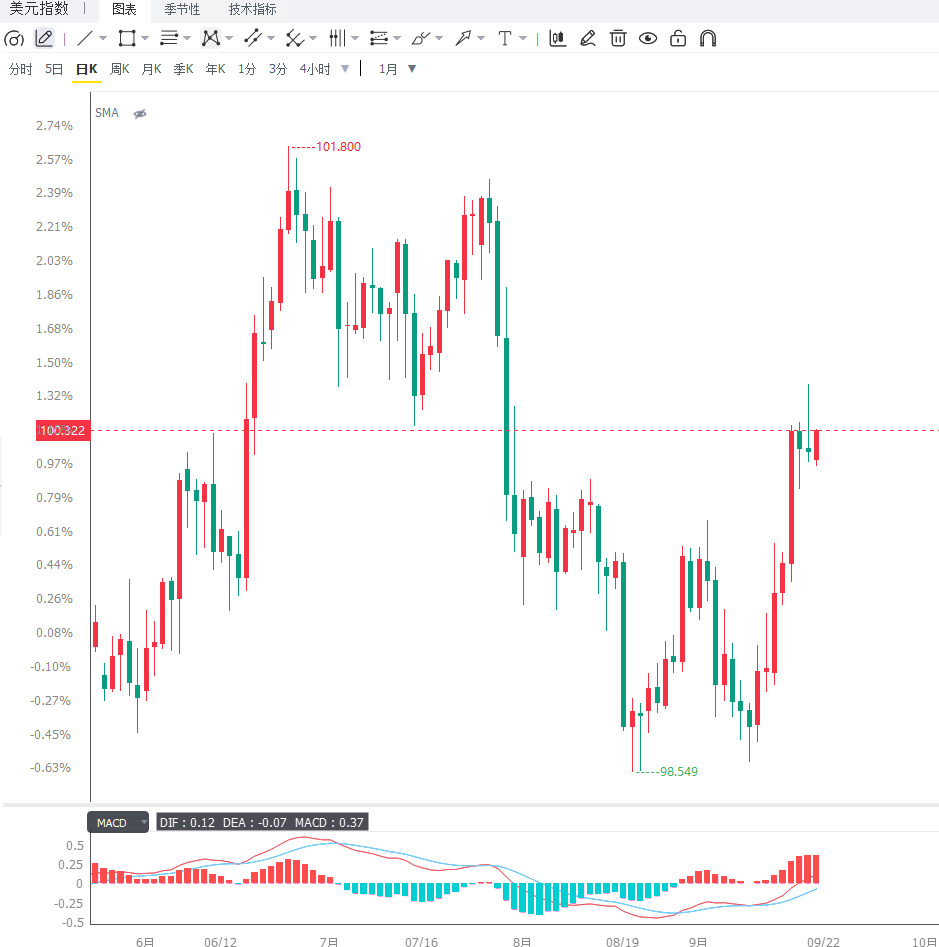 Editor's Summary: The core support for the US dollar index currently comes from the Federal Reserve's hawkish policy path, the US-Japan interest rate differential, and the resilience of the US economy. However, further gains above the 100 level still require new interest rate expectations or economic data to provide impetus. In the short term, the focus is on whether the 100.45-100.50 area can be broken, and whether the support around 99.70 can hold. If the dollar remains above 99.70, the overall outlook remains one of high-level, slightly bullish consolidation; if interest rate expectations cool and the dollar falls below key moving averages, the gains accumulated by the dollar may enter a more significant correction phase.
From a policy expectation perspective, the impact of this round of interest rate hikes has not ended with the decision being finalized. The latest forecasts from the Federal Reserve show that most officials expect further rate hikes this year, and the market's pricing in another rate hike at the October meeting has clearly intensified. According to the CME FedWatch tool, the market expects a probability of another rate hike in October of approximately 56.5%, up from around 42.5% a week ago. This means that the dollar is currently receiving support not only from the short-term interest rate differential brought about by a single rate hike, but also from the expectation that higher interest rates may persist for a longer period. Federal Reserve Chairman Kevin Warsh recently emphasized that US inflation remains too high and has been prolonged, and the latest summer inflation data is insufficient to prove a significant improvement in underlying price pressures. Meanwhile, Minneapolis Fed President Neel Kashkari also stated that US inflationary pressures are not limited to energy prices but are prevalent across multiple sectors of the economy; he also pointed out that US economic growth, productivity, and the job market remain resilient. This policy mix suggests that the Federal Reserve currently has no reason to rush into a more accommodative stance. The policy framework following the September meeting remains focused on curbing inflation. If future economic data continues to show resilience while inflation remains high, market expectations for further interest rate hikes may strengthen further. Conversely, if employment, consumption, or inflation data show a significant cooling, the previously accumulated interest rate premium of the US dollar may experience a temporary pullback. Meanwhile, the US-Japan interest rate differential remains a significant supporting factor for the US dollar. Last week, the Bank of Japan raised its policy rate by 25 basis points to 1.25%, but the 7-2 vote and Kazuo Ueda's cautious policy statements did not significantly strengthen market expectations for further rapid interest rate hikes by the Bank of Japan. The yen subsequently weakened significantly, with the USD/JPY pair rising to near a two-week high. On September 21, the market was still focused on the risk of further intervention in the foreign exchange market by Japanese authorities. The policy expectation gap between the US dollar and the yen persists, providing some support for the US dollar index near the 100 level. However, the rapid depreciation of the yen has already attracted the attention of Japanese officials. If market expectations for intervention further strengthen, the upside potential for the USD/JPY pair may be limited, indirectly affecting the overall performance of the US dollar through the weighting structure of the US dollar index. From a global market perspective, energy price trends remain a crucial variable for the future of the US dollar. On one hand, previous risks to Middle Eastern energy supply pushed up oil prices and exacerbated US inflationary pressures, leading the Federal Reserve to maintain a hawkish stance. On the other hand, recent signs of recovery in some energy transportation and supply have caused oil prices to fall, potentially alleviating some inflationary pressures. Latest market information indicates that Saudi crude oil exports have recovered somewhat, and there are expectations of a gradual recovery in key pipeline supplies, putting downward pressure on oil prices. If energy prices fall further, the market may reassess the inflationary risks previously caused by energy shocks and reduce some long-term interest rate hike expectations; however, if Middle Eastern supplies are again disrupted, a rebound in energy prices could reignite US inflationary pressures, thereby reinforcing the necessity for the Federal Reserve to maintain its tight monetary policy. Therefore, the correlation between oil prices and US dollar interest rate expectations remains a key indicator for the foreign exchange market this week. This week, attention should also be paid to US economic data and speeches by Federal Reserve officials. If the data continues to show resilience in economic activity and a lack of significant downward momentum in inflation, the US dollar may continue to fluctuate at high levels; if economic data weakens significantly, the market may lower its expectations for an October rate hike again, and the short-term upward trend of the US dollar may face a correction. The US dollar index is currently trading around 100.30 on the daily chart. The price remains above the 9-day and 50-day EMAs, with short-term moving averages above long-term moving averages and trending upwards, indicating a still relatively strong short-term structure. The 14-day RSI is around 62.6, in positive territory but not yet in typical overbought territory, suggesting that bulls still hold some initiative. However, as the index continues to approach previous highs, the risk of chasing the rally is gradually increasing. The first support level to watch is around 99.85 near the 9-day EMA, followed by 99.73 near the 50-day EMA. As long as the dollar index continues to trade above this area, the current pullback can be considered a technical consolidation after a strong upward move; a break below 99.70 would significantly weaken the short-term bullish structure. On the upside, watch 100.50 and the previous high around 100.45. A successful break and hold above these levels could lead to a further test of the 101.00 psychological level. On the 4-hour chart, the dollar index is consolidating near the 100 level, still supported by hawkish expectations from the Federal Reserve in the short term. If the price breaks through the 100.45-100.50 area again, the short-term uptrend may extend further; if it fails to break through after several attempts, profit-taking should be watched for. The first short-term support level is 99.85, while 99.70 is a more crucial structural support level; a break below this level could see the price find new buying support around 99.30. Editor's Summary: The core support for the US dollar index currently comes from the Federal Reserve's hawkish policy path, the US-Japan interest rate differential, and the resilience of the US economy. However, further gains above the 100 level still require new interest rate expectations or economic data to provide impetus. In the short term, the focus is on whether the 100.45-100.50 area can be broken, and whether the support around 99.70 can hold. If the dollar remains above 99.70, the overall outlook remains one of high-level, slightly bullish consolidation; if interest rate expectations cool and the dollar falls below key moving averages, the gains accumulated by the dollar may enter a more significant correction phase.
- Risk Warning and Disclaimer
- The market involves risk, and trading may not be suitable for all investors. This article is for reference only and does not constitute personal investment advice, nor does it take into account certain users’ specific investment objectives, financial situation, or other needs. Any investment decisions made based on this information are at your own risk.