Why aren't gold prices rising despite falling interest rates? Unveiling the core pricing and inflection point logic.
2026-09-21 21:06:12
On Monday (September 21st) during the Asian and European sessions, the yields on US 2-30 year Treasury bonds continued to decline throughout the day. Coupled with a pullback in the US dollar index, spot gold ultimately rebounded after testing lower levels. The market also digested profit-taking pressure from previous highs, and gold is currently trading around 4365. Here's a crucial question about the market: A decline in US Treasury yields (corresponding to a rise in US Treasury prices) is traditionally bullish for gold. Why didn't gold rise immediately during the session, but instead dipped first and then gradually recovered towards the end of the day as the dollar weakened? The FTPL framework can explain this contradiction very clearly. That is, in some situations, a decrease in real interest rates may cause gold to fall as well. What are these situations? 
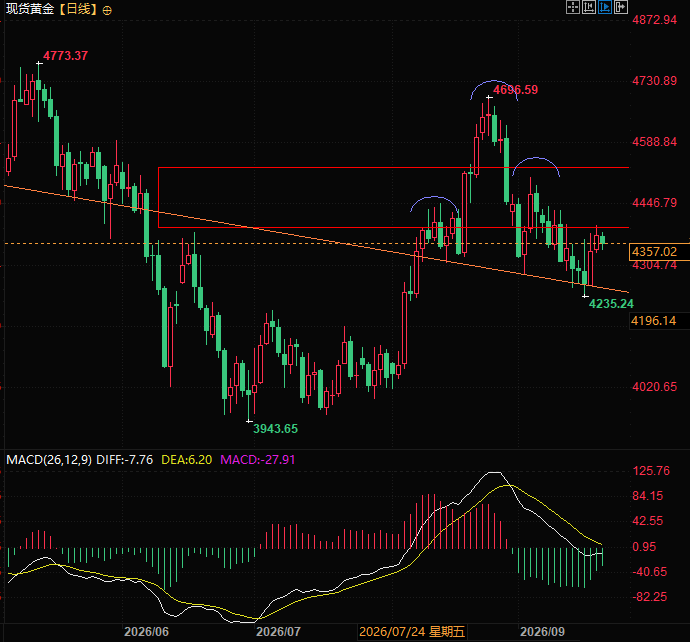 (Spot gold daily chart, source: EasyTrade) At 21:04 Beijing time, spot gold is currently trading at $4357 per ounce.
Price Level Fiscal Theory (FTPL) suggests that higher holding costs can also lead to higher gold prices.
Let me first introduce a formula I've discussed in previous articles: Total US Debt = Price Level x Discounted Total US Government Surplus. This describes how the purchasing power corresponding to the government's current borrowing should ultimately be repaid through future income, which is logical. Therefore, when the government faces a debt crisis, the higher the real interest rate, the greater the government's debt problem and the less likely it is to repay. Assuming the total debt remains constant, the discounted total government surplus decreases significantly due to increased interest payments and a higher discount rate. Only by significantly raising prices, i.e., reducing people's purchasing power, can this deficit be filled. This is why higher interest rates lead to higher gold prices, as significantly higher prices benefit gold as a general equivalent. This theory explains why previously, when interest rates surged, gold prices also surged. And now, with the narrative easing, similarly, today, when interest rates have fallen, gold prices have also fallen, which conveys a similar meaning. After all, we can't always explain gold price corrections as profit-taking; the logic behind this gold price correction is complementary to the logic behind the previous rise.The divergence between US and French bonds: pricing differences in risk premiums
A comparison of recent trends in US and French government bonds best illustrates the impact of fiscal expectations on bond yields. France's fiscal deficit remains at 5% of GDP, the election outlook is fraught with uncertainty, and expectations of tax cuts and pension reductions further amplify deficit pressure. Tax revenues have already reached high levels, leaving little room for further tax increases, and foreign ownership of government bonds is as high as 57%, posing a persistent risk of capital outflow. The market continues to demand higher risk compensation, driving the spread between French and German bond yields upward, approaching the psychological threshold of 1%. The market has even begun discussing the activation threshold of the ECB's TPI tool as a "nuclear option." In contrast, strong US consumption and employment data have changed market expectations regarding the sustainability of US fiscal policy. Economic resilience has increased the tax base, leading the market to believe that US government tax revenue can support the economy, reducing concerns about a potential collapse in long-term US debt, and consequently lowering the fiscal risk compensation required for bonds. Funds are not passively buying US Treasuries due to declining interest rates, but rather actively allocating to them in a high-interest-rate environment—a stark contrast to the French bond market, where fiscal deterioration has led to soaring risk premiums. It was the marginal improvement in market expectations for US fiscal policy that drove down nominal yields on US Treasury bonds, which also affected the core logic behind the previous rise in gold prices.Analysis of the multiple factors influencing recent gold price fluctuations
Nominal interest rate ≠ real interest rate; this is the core contradiction in short-term market trends. Gold prices are directly anchored to real interest rates, not nominal ones. The recent decline in nominal US Treasury yields stems from the market lowering the risk premium for US sovereign debt. In the short term, the US economy is strong, inflation remains sticky, and the decline in TIPS real interest rates is limited. This is the core reason why, even with a slight decline in bond yields, gold did not immediately surge. Only when real interest rates truly decline will the opportunity cost of gold substantially decrease. The dual impact of oil prices and inflation expectations: Today, oil prices fell sharply, but gold prices did not rise significantly. On the one hand, the easing of geopolitical conflicts in the Middle East led to a rapid reduction in geopolitical safe-haven premiums, suppressing the rebound of gold; on the other hand, oil prices do not have a clear positive factor for a significant short-term correction and are likely to continue rising repeatedly in the future. Equity market fund outflows suppress gold in the short term : The continued rise of equity assets such as the Nasdaq, coupled with positive corporate earnings expectations, has led to a preference for risk assets. As a non-interest-bearing asset, gold naturally sees a decrease in demand during periods of economic boom and favorable stock and bond markets. Long positions at higher levels are opting to take profits, leading to a consolidation phase in gold prices. This market movement represents a temporary rebalancing of funds, not a long-term trend reversal.Two Scenario Analysis: The Turning Point for Gold Lies in Fiscal Forecasts
Scenario 1 (Current Baseline Scenario): The US Economy Remains Resilient, and Corporate Profits Remain Satisfactory Market expectations for the US's long-term fiscal surplus remain stable, the fiscal risk premium declines, and nominal yields on US Treasury bonds fluctuate downwards. Gold is in a bottoming-out phase, awaiting a catalyst, with a slow upward pace. Scenario 2 (Potential Medium- to Long-Term Turning Point): Weak Corporate Profit Growth and a Declining Economy High interest rates result in heavy passive expenditures for the US government. If tax revenue cannot cover the continuously rising interest costs, the present value of the government's future total fiscal surplus will continue to shrink, and debt will continue to accumulate. According to the FTPL theory, price levels will be repriced, and long-term inflation expectations will expand significantly. The rise in inflation expectations exceeds the rise in nominal interest rates, leading to a sharp decline in real interest rates. At this point, gold will simultaneously realize two values: resisting long-term inflation caused by sovereign fiscal policy and hedging against economic downturn risks. The opportunity cost of holding gold is significantly reduced, and even if nominal interest rates remain high, gold prices will experience a trend of upward movement. Summary and Technical Analysis: In the short term, strong US economic data has restored market confidence in US Treasuries, pushing nominal interest rates down and gold prices bottoming out. However, the essence of this round of interest rate declines is a decrease in fiscal risk premiums, not monetary easing. With the equity market currently hot, gold is likely to remain in a consolidation phase. Looking at the longer term, the ultimate pricing power for gold lies not only in the Fed's interest rate hikes and cuts, but also in the market's expectations for the long-term fiscal sustainability of the US. If economic growth falls short of expectations and tax revenue cannot keep pace with debt interest expansion, the pricing logic of FTPL will once again dominate the market, and gold will experience a trend-driven rebound. Technically: Spot gold is facing resistance at the lower edge of its trading range, and this rebound has already reflected recent positive news; further upward movement requires additional driving factors. (Spot gold daily chart, source: EasyTrade) At 21:04 Beijing time, spot gold is currently trading at $4357 per ounce.
- Risk Warning and Disclaimer
- The market involves risk, and trading may not be suitable for all investors. This article is for reference only and does not constitute personal investment advice, nor does it take into account certain users’ specific investment objectives, financial situation, or other needs. Any investment decisions made based on this information are at your own risk.