Is the era of cheap yen over? Carry trades face a major test, and global asset valuations will be reassessed.
2026-09-22 10:24:14
On Tuesday (September 22) during Asian trading hours, the US dollar rose slightly against the Japanese yen, currently trading around 157.50, maintaining its high level since September 4. Amid continued pressure on the yen, the Bank of Japan's interest rate hike decision last week and its market reaction have become key clues for understanding the current exchange rate pattern. On Friday (September 18), the Bank of Japan raised its policy rate by 25 basis points to 1.25% by a 7-2 vote, marking another step towards ending decades of ultra-loose monetary policy. However, the market did not respond as expected—the yen fell instead of rising, and the yield on 10-year Japanese government bonds remained around 3%. 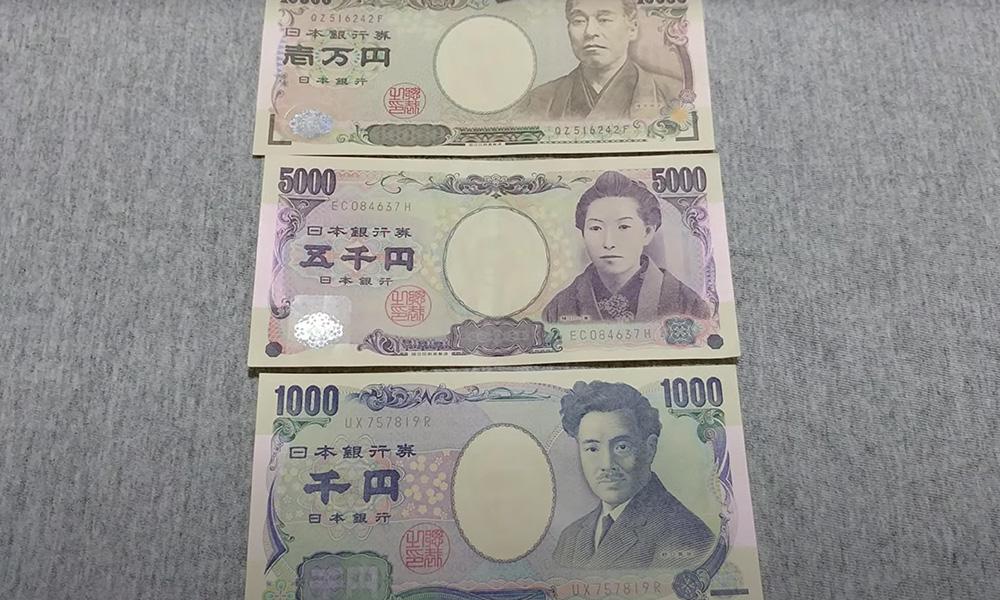
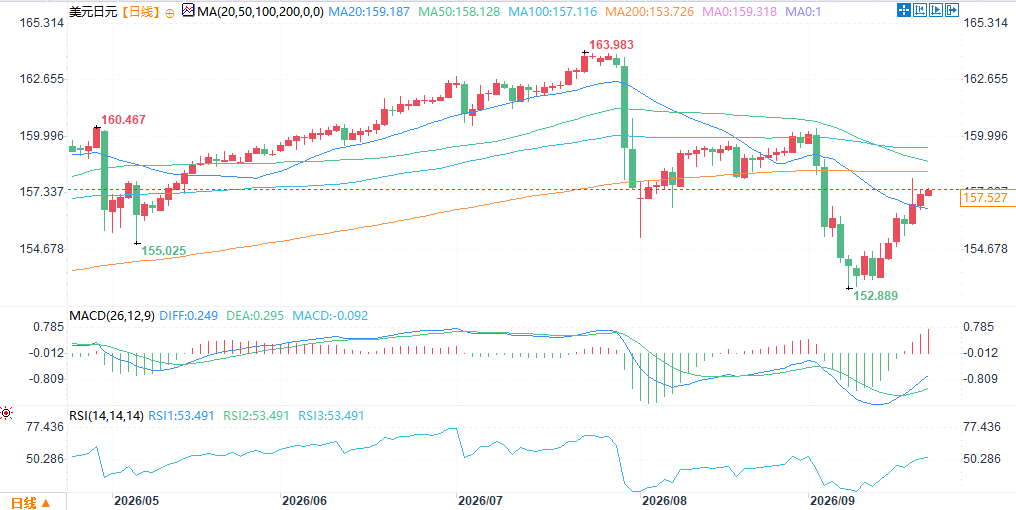 (USD/JPY daily chart, source: FX678) At 10:22 Beijing time, USD/JPY was trading at 157.45/46.
Interest rate hikes failed to boost the yen: the relative interest rate differential is the key.
The Bank of Japan raised its policy rate to 1.25%, but the yen fell sharply against the dollar after the decision, while the yield on 10-year Japanese government bonds remained close to 3%. This reaction reveals a core logic: for the currency market, the absolute level of Japanese interest rates is far less important than the relative returns available in other regions. Japan is moving towards monetary policy normalization, while the US maintains a relatively restrictive stance, and the Federal Reserve has also raised interest rates, keeping the interest rate differential that has long suppressed the yen largely unchanged. Central banks can raise interest rates, but if investors believe the tightening cycle is still relatively shallow compared to other regions, the local currency may not become more attractive.Cheap Yen and Global Carry Trade: The Role of Funding Currency
For years, cheap Japanese funding has underpinned arbitrage trading: borrowing low-cost yen to invest in higher-yielding assets elsewhere. This strategy doesn't need to dominate global markets to have a significant impact. When funding currencies become more expensive or volatile, investors may be forced to quickly reduce their positions. Two rate hikes within three months are not slow. Investors in stocks, emerging market currencies, and long-term bonds should examine the extent to which their valuations rely on cheap Japanese capital. This caution is not without merit: Japanese investors are among the world's largest holders of U.S. Treasury bonds, and continued improvement in domestic bond yields could make capital repatriation more attractive. Even a modest shift in these flows would have a significant impact against the backdrop of governments issuing massive amounts of debt to cover persistent fiscal deficits.Capital repatriation is not inevitable: the 7-2 vote reveals internal divisions.
However, the market should not assume that every interest rate hike in Japan signifies a large-scale capital repatriation. The 7-2 vote illustrates the problem: committee members Toshiro Asada and Ayano Sato opposed the rate hike, arguing that the economy did not yet support a tighter policy. Core inflation had already slowed from 1.8% in July to 1.7% in August. These objections suggest that the path beyond 1.25% is not predetermined. This uncertainty helps explain the yen's reaction: investors can price in a rate hike in advance, and what drives the exchange rate is often what happens next. The Bank of Japan's own guidance remains data-driven, rather than a commitment to rapid further tightening.Lessons from the bond market: Policy rates are not equal to long-term yields.
The bond market also offers a useful lesson: higher policy rates do not automatically translate to higher long-term yields. 10-year Japanese government bond yields are driven by a combination of factors, including inflation expectations, growth, fiscal policy, the future supply of government debt, and overnight interest rates. For global portfolios, Japan is less a single trade and more a source of funding risk. If the yen eventually appreciates significantly, carry trades may be unwound, and overseas assets purchased with Japanese funds may become less attractive. If the yen remains weak despite interest rate hikes, it suggests that Japan's monetary policy normalization is struggling to overcome broader global forces. Neither outcome is particularly reassuring for investors who view cheap Japanese capital as a permanent feature of the market.Summarize
The Bank of Japan's move to raise its policy rate to 1.25% would have seemed extraordinary in the not-too-distant past. However, the more significant change is psychological: investors can no longer assume that Japanese interest rates will remain at negligible levels indefinitely. The failure of this rate hike to boost the yen demonstrates that relative interest rate differentials, rather than absolute levels, are the core drivers of exchange rates. The cost of financing carry trades is rising, and the valuations of global assets reliant on cheap yen capital are facing reassessment. Two paths need to be monitored: a significant appreciation of the yen could trigger a sell-off of overseas assets due to carry trade unwinding; a continued weakening of the yen would indicate that the normalization of Japanese monetary policy is insufficient to counter global forces. In either case, the global financing landscape is changing, and investors need to reassess positions built on the assumption of perpetual cheap Japanese capital. (USD/JPY daily chart, source: FX678) At 10:22 Beijing time, USD/JPY was trading at 157.45/46.
- Risk Warning and Disclaimer
- The market involves risk, and trading may not be suitable for all investors. This article is for reference only and does not constitute personal investment advice, nor does it take into account certain users’ specific investment objectives, financial situation, or other needs. Any investment decisions made based on this information are at your own risk.