Interest rate hikes not enough? Block warns: The real risk is a second-round effect.
2026-09-22 13:52:11
Reserve Bank of Australia Governor Michele Bullock said on Tuesday (September 22) that supply shocks are difficult for monetary policy to handle, and that policy needs to address the second-round effects of such shocks on inflation. These remarks were consistent with her hawkish tone during her testimony to Parliament last Friday. As a result, the Australian dollar rose from below 0.7100 to around 0.7125 against the US dollar. 
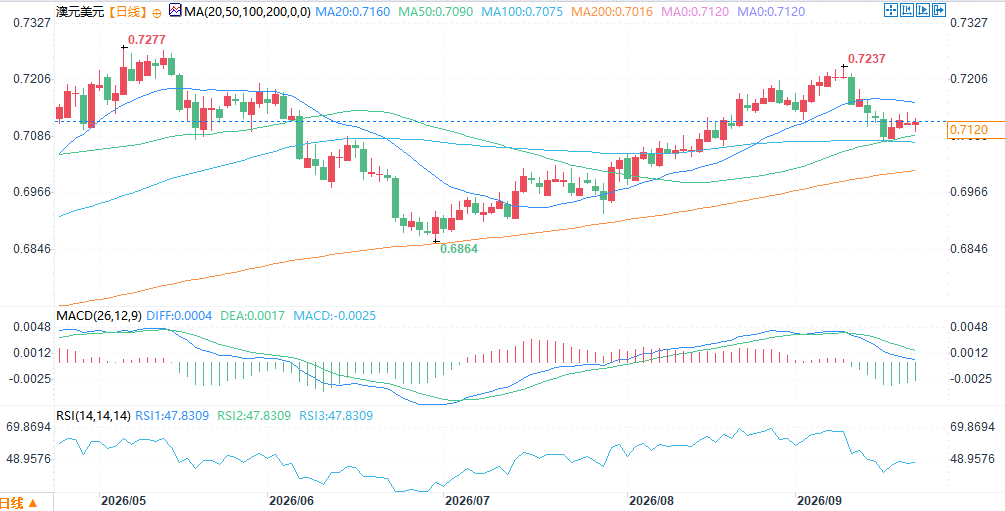 (Australian dollar to US dollar daily chart, source: EasyForex) At 13:50 Beijing time, the Australian dollar to US dollar exchange rate was 0.7121/22.
Supply shocks are difficult to manage; policies need to focus on the second-round effects.
Block stated that supply shocks are difficult for monetary policy to address directly, and that policy needs to focus on the second-round effects of such shocks on inflation. This statement reiterates the familiar constraints facing central banks, but its signal is stronger when combined with a clear focus on second-round effects. Second-round effects refer to how initial cost shocks (such as rising oil prices) gradually transmit to broader wage negotiations and price-setting decisions throughout the economy, potentially making inflation more persistent. Block noted last week that persistent shocks are difficult to "see through," and businesses have become more willing to pass on higher costs to customers. This focus indicates that the Reserve Bank of Australia's vigilance regarding the persistence of inflation remains high, and policy will continue to aim to prevent shocks from solidifying.Consistent with last week's parliamentary testimony, the hawkish tone remains unchanged.
Block's remarks echoed her stance before a parliamentary committee last Friday, where she clearly stated that the upside inflation risks highlighted in her August statement were becoming a reality, noting that policymakers generally believed the neutral interest rate had risen. While today's comments were limited among these earlier remarks, they were entirely consistent with the hawkish tone she has adopted in recent public appearances, without retracting any of last week's hawkish stance. This demonstrates the RBA's consistent commitment to inflation, suggesting the central bank is unlikely to easily shift to easing in the short term.The AI boom exacerbates excess demand in the Australian economy.
Block points out that the AI boom is exacerbating excess demand in the Australian economy. Rising demand for data center construction, related infrastructure investment, and skilled workers is further increasing localized capacity pressures. This factor, combined with supply shocks and already strong demand-side pressures, makes it easier for rising costs to translate into broader price adjustments. Block emphasizes that policy needs to respond precisely because, against a backdrop of already robust demand, the second-round effects of supply shocks are more likely to solidify, thus prolonging the period when inflation deviates from the target.The expectation of an interest rate hike at the September meeting remains solid.
Block's comments came just a week before the Reserve Bank of Australia's September 28-29 meeting, with the market widely expecting a 25 basis point increase in the cash rate from the current 4.35%. Block's remarks so far have shown no indication of deviating from this expected path. However, fireside chats are less scripted than formal speeches, and more specific comments are likely to emerge as the conversation continues. Given the limited amount of material released so far, market pricing in the rate hike path is unlikely to change significantly due to these early statements, maintaining a high probability of a September rate hike.Summarize
Block's remarks continued her recent hawkish tone: supply shocks are difficult to manage, and policy must focus on second-round effects to prevent the initial price shock from solidifying into wage and price-setting behavior. This aligns with her assessment in her congressional testimony last week that upside inflation risks are becoming a reality and the neutral interest rate has risen. The AI boom has exacerbated excess demand, further reinforcing the reasons for policy vigilance. The expectation of a 25 basis point rate hike to 4.60% at the September 28-29 meeting is currently solidified, and further concrete statements following the fireside chat could provide the market with more clues about the rate hike path. (Australian dollar to US dollar daily chart, source: EasyForex) At 13:50 Beijing time, the Australian dollar to US dollar exchange rate was 0.7121/22.
- Risk Warning and Disclaimer
- The market involves risk, and trading may not be suitable for all investors. This article is for reference only and does not constitute personal investment advice, nor does it take into account certain users’ specific investment objectives, financial situation, or other needs. Any investment decisions made based on this information are at your own risk.