Expectations are rising for another Fed rate hike in December, with oil prices and the situation in the Middle East becoming key variables in the subsequent policy path.
2026-09-22 16:50:11
The Federal Reserve has recently returned to the center of market attention. John Willis, macro strategist for the Americas at BNY Mellon, said he expects the Fed to likely raise rates again in December, but caution is still needed regarding the market's current pricing in a further rate hike path until 2027. The core reason is that current inflationary pressures are heavily influenced by energy prices and geopolitical tensions, and how these factors will evolve remains highly uncertain.  On September 16, the Federal Reserve raised the target range for the federal funds rate by 25 basis points to 3.75% to 4.00%, marking its first rate hike in more than three years. The Fed also stated that U.S. economic activity continues to expand at a solid pace, but inflation remains high, and geopolitical tensions have increased uncertainty about the economic outlook. The latest policy projections indicate that policymakers expect another rate hike in 2026. This means that the market's current focus is not just on whether there will be another rate hike in December, but on whether this policy adjustment can effectively suppress persistent inflationary pressures. John Welles believes that the future effectiveness of policy will largely depend on the nature of the current inflationary shock. If price pressures mainly come from the energy and supply sides, then simply relying on further tightening of monetary policy may have limitations; if demand-side inflation continues to be resilient, the Fed may need to maintain a more restrictive policy stance. Energy prices are becoming a crucial variable in this assessment. Recent tensions in the Middle East have driven significant fluctuations in oil prices, which are being transmitted to overall inflation through energy costs. The New York Fed has also previously pointed out that supply disruptions and rising energy prices caused by the Middle East conflict are significant uncertainties affecting the global economic and inflation outlook. Recent oil price movements have shown a significant shift. WTI rebounded on Tuesday after four consecutive days of declines, with the market refocusing on potential US-Iran diplomatic contacts during the UN General Assembly. Latest market data shows that the WTI main contract briefly rose above $93 on Tuesday, but remained significantly below previous highs above $100. The crude oil market is currently influenced by supply recovery, diplomatic expectations, and regional security risks, resulting in substantial price volatility. If tensions in the Middle East continue to ease, the oil supply risk premium may further decline, and a drop in oil prices would help alleviate US inflationary pressures. In this scenario, the necessity for the Federal Reserve to continue tightening policy may decrease, and market expectations for further rate hikes in 2027 may adjust accordingly. However, if the situation in the Middle East deteriorates again, energy supplies are subjected to new shocks, and oil prices rise rapidly once more, then inflationary pressures may once again become a key issue for the Federal Reserve to address. Recently, Federal Reserve officials have repeatedly emphasized that persistent demand pressures and commodity price shocks could keep inflation at a high level. Chicago Fed President Austan Goolsby also stated that if inflation is primarily driven by strong demand, rather than just temporary supply shocks, then further rate hikes may still be necessary. Therefore, there is a clear divergence in market judgments regarding the future policy path of the Federal Reserve. On the one hand, the Fed's latest forecasts still point to further rate hikes in 2026; on the other hand, the market's assessment of the interest rate path in 2027 is more dependent on actual changes in inflation and energy prices. The latest view from BNY Mellon also suggests that current market pricing of policy may need to be readjusted based on the duration of the inflation shock. The bank's latest analysis also points out that the Fed's actual policy path may fall between official forecasts and market pricing. Financial markets have already reflected this. The US dollar has recently remained relatively strong, mainly supported by US interest rate expectations and safe-haven demand, while gold has been suppressed by the higher interest rate environment. On Tuesday, gold prices fell to around $4319, indicating that the market is reassessing the impact of "high interest rates for a longer period" on precious metals. Meanwhile, any significant changes in oil prices could create new cross-asset transmission through inflation expectations, the US dollar, and US Treasury yields. Therefore, investors should currently focus not on the number of Fed rate hikes, but on changes in energy prices, core inflation, consumer demand, and the job market. If energy prices continue to decline and supply-side shocks gradually subside, the Federal Reserve may have more room to maneuver regarding its subsequent policies. If oil prices rebound and are compounded by demand-side pressures, the period of tight monetary policy may be further extended. From a technical perspective, the US dollar index remains relatively strong recently, with interest rate expectations being one of the main factors driving its resilience. If Fed officials continue to release hawkish signals while US Treasury yields remain high, the dollar may continue to find support. Conversely, if oil prices continue to decline and lead to lower inflation expectations, causing the market to reduce its bets on further rate hikes, the dollar may face pressure for a temporary correction. In the gold market, prices have recently fallen to around $4300 and are currently in a short-term correction phase. The key level to watch is $4320. If it reclaims $4320, the short-term weakness may be somewhat repaired; if $4320 is effectively breached, further testing of the $4280 or even $4200 area should be anticipated. In the crude oil market, WTI crude oil halted its four-day losing streak on Tuesday, with the $92-$93 area currently becoming a key battleground in the short term. If prices break above $95 again, the technical correction could extend further, testing the $98.50-$100 area; conversely, a break below $92 could see support around the $90 psychological level and the $87.80 area. The energy market remains highly dependent on the situation in the Middle East and diplomatic developments, and the sustainability of any technical breakout still requires fundamental support.
 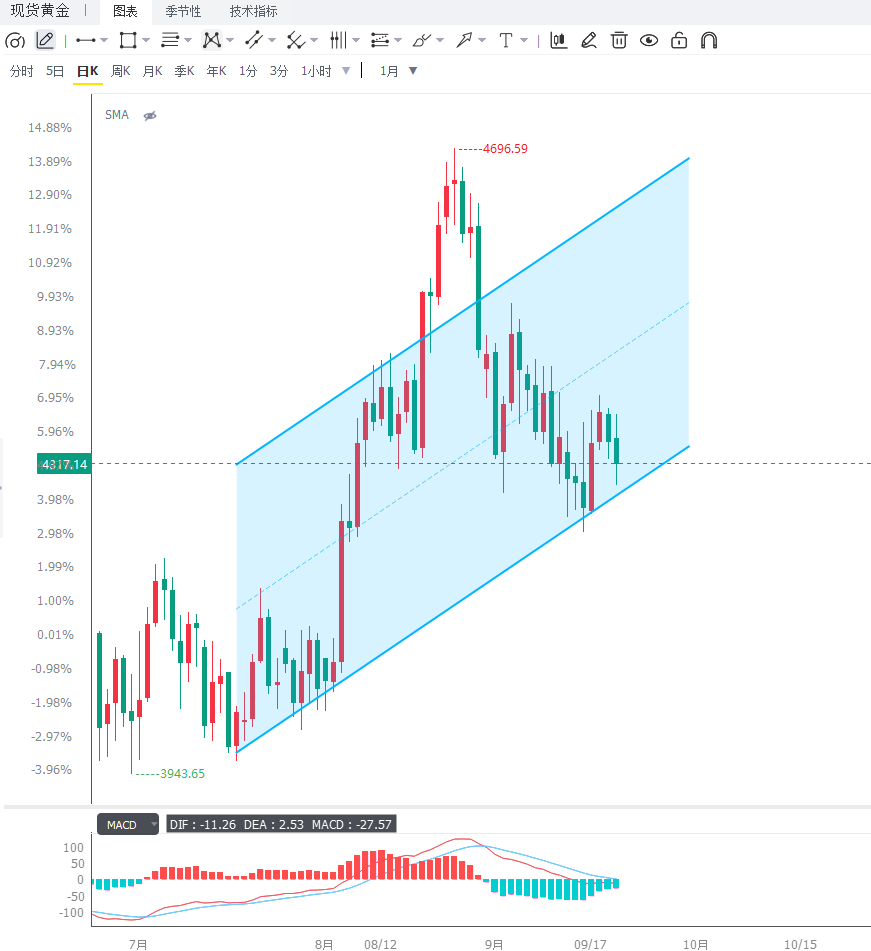 Editor's Summary: Expectations for a further rate hike by the Federal Reserve in December remain strong, but the policy path in 2027 remains highly uncertain. One of the biggest variables currently is the situation in the Middle East and its transmission to oil prices and inflation. If energy prices continue to decline, the Fed's supply-side inflationary pressures may ease; if oil prices rebound, it could force policymakers to extend the tightening cycle. Going forward, the market will need to closely observe the interplay between oil prices, inflation, the US dollar, and US Treasury yields, as this will be a crucial basis for the repricing of gold, foreign exchange, and commodity markets.
On September 16, the Federal Reserve raised the target range for the federal funds rate by 25 basis points to 3.75% to 4.00%, marking its first rate hike in more than three years. The Fed also stated that U.S. economic activity continues to expand at a solid pace, but inflation remains high, and geopolitical tensions have increased uncertainty about the economic outlook. The latest policy projections indicate that policymakers expect another rate hike in 2026. This means that the market's current focus is not just on whether there will be another rate hike in December, but on whether this policy adjustment can effectively suppress persistent inflationary pressures. John Welles believes that the future effectiveness of policy will largely depend on the nature of the current inflationary shock. If price pressures mainly come from the energy and supply sides, then simply relying on further tightening of monetary policy may have limitations; if demand-side inflation continues to be resilient, the Fed may need to maintain a more restrictive policy stance. Energy prices are becoming a crucial variable in this assessment. Recent tensions in the Middle East have driven significant fluctuations in oil prices, which are being transmitted to overall inflation through energy costs. The New York Fed has also previously pointed out that supply disruptions and rising energy prices caused by the Middle East conflict are significant uncertainties affecting the global economic and inflation outlook. Recent oil price movements have shown a significant shift. WTI rebounded on Tuesday after four consecutive days of declines, with the market refocusing on potential US-Iran diplomatic contacts during the UN General Assembly. Latest market data shows that the WTI main contract briefly rose above $93 on Tuesday, but remained significantly below previous highs above $100. The crude oil market is currently influenced by supply recovery, diplomatic expectations, and regional security risks, resulting in substantial price volatility. If tensions in the Middle East continue to ease, the oil supply risk premium may further decline, and a drop in oil prices would help alleviate US inflationary pressures. In this scenario, the necessity for the Federal Reserve to continue tightening policy may decrease, and market expectations for further rate hikes in 2027 may adjust accordingly. However, if the situation in the Middle East deteriorates again, energy supplies are subjected to new shocks, and oil prices rise rapidly once more, then inflationary pressures may once again become a key issue for the Federal Reserve to address. Recently, Federal Reserve officials have repeatedly emphasized that persistent demand pressures and commodity price shocks could keep inflation at a high level. Chicago Fed President Austan Goolsby also stated that if inflation is primarily driven by strong demand, rather than just temporary supply shocks, then further rate hikes may still be necessary. Therefore, there is a clear divergence in market judgments regarding the future policy path of the Federal Reserve. On the one hand, the Fed's latest forecasts still point to further rate hikes in 2026; on the other hand, the market's assessment of the interest rate path in 2027 is more dependent on actual changes in inflation and energy prices. The latest view from BNY Mellon also suggests that current market pricing of policy may need to be readjusted based on the duration of the inflation shock. The bank's latest analysis also points out that the Fed's actual policy path may fall between official forecasts and market pricing. Financial markets have already reflected this. The US dollar has recently remained relatively strong, mainly supported by US interest rate expectations and safe-haven demand, while gold has been suppressed by the higher interest rate environment. On Tuesday, gold prices fell to around $4319, indicating that the market is reassessing the impact of "high interest rates for a longer period" on precious metals. Meanwhile, any significant changes in oil prices could create new cross-asset transmission through inflation expectations, the US dollar, and US Treasury yields. Therefore, investors should currently focus not on the number of Fed rate hikes, but on changes in energy prices, core inflation, consumer demand, and the job market. If energy prices continue to decline and supply-side shocks gradually subside, the Federal Reserve may have more room to maneuver regarding its subsequent policies. If oil prices rebound and are compounded by demand-side pressures, the period of tight monetary policy may be further extended. From a technical perspective, the US dollar index remains relatively strong recently, with interest rate expectations being one of the main factors driving its resilience. If Fed officials continue to release hawkish signals while US Treasury yields remain high, the dollar may continue to find support. Conversely, if oil prices continue to decline and lead to lower inflation expectations, causing the market to reduce its bets on further rate hikes, the dollar may face pressure for a temporary correction. In the gold market, prices have recently fallen to around $4300 and are currently in a short-term correction phase. The key level to watch is $4320. If it reclaims $4320, the short-term weakness may be somewhat repaired; if $4320 is effectively breached, further testing of the $4280 or even $4200 area should be anticipated. In the crude oil market, WTI crude oil halted its four-day losing streak on Tuesday, with the $92-$93 area currently becoming a key battleground in the short term. If prices break above $95 again, the technical correction could extend further, testing the $98.50-$100 area; conversely, a break below $92 could see support around the $90 psychological level and the $87.80 area. The energy market remains highly dependent on the situation in the Middle East and diplomatic developments, and the sustainability of any technical breakout still requires fundamental support. Editor's Summary: Expectations for a further rate hike by the Federal Reserve in December remain strong, but the policy path in 2027 remains highly uncertain. One of the biggest variables currently is the situation in the Middle East and its transmission to oil prices and inflation. If energy prices continue to decline, the Fed's supply-side inflationary pressures may ease; if oil prices rebound, it could force policymakers to extend the tightening cycle. Going forward, the market will need to closely observe the interplay between oil prices, inflation, the US dollar, and US Treasury yields, as this will be a crucial basis for the repricing of gold, foreign exchange, and commodity markets.
- Risk Warning and Disclaimer
- The market involves risk, and trading may not be suitable for all investors. This article is for reference only and does not constitute personal investment advice, nor does it take into account certain users’ specific investment objectives, financial situation, or other needs. Any investment decisions made based on this information are at your own risk.