Gold Trading Alert: Trump Refuses to Discuss Reopening the Strait, Gold Prices Under Pressure Again! Non-Farm Payrolls Coming This Week, a Battle Between Bulls and Bears May Be Imminent.
2026-09-28 07:26:13
On Monday (September 28) in early Asian trading, spot gold opened slightly lower and quickly weakened, falling more than 0.67% to $4257.33 per ounce at one point, continuing the weak trend of last week's weekly decline. Market sentiment clearly turned cautious, with the US dollar index rebounding by about 0.15% in the morning and oil prices opening more than 1% higher, both putting downward pressure on gold prices. The real driving force behind this was the geopolitical risk reassessment signal released by Trump's rejection of Iran's proposal to reopen the Strait of Hormuz, and the resulting strengthened expectations of further tightening by the Federal Reserve. Gold, as a traditional safe-haven asset, is now caught in a double bind of "safe-haven demand and interest rate suppression." 
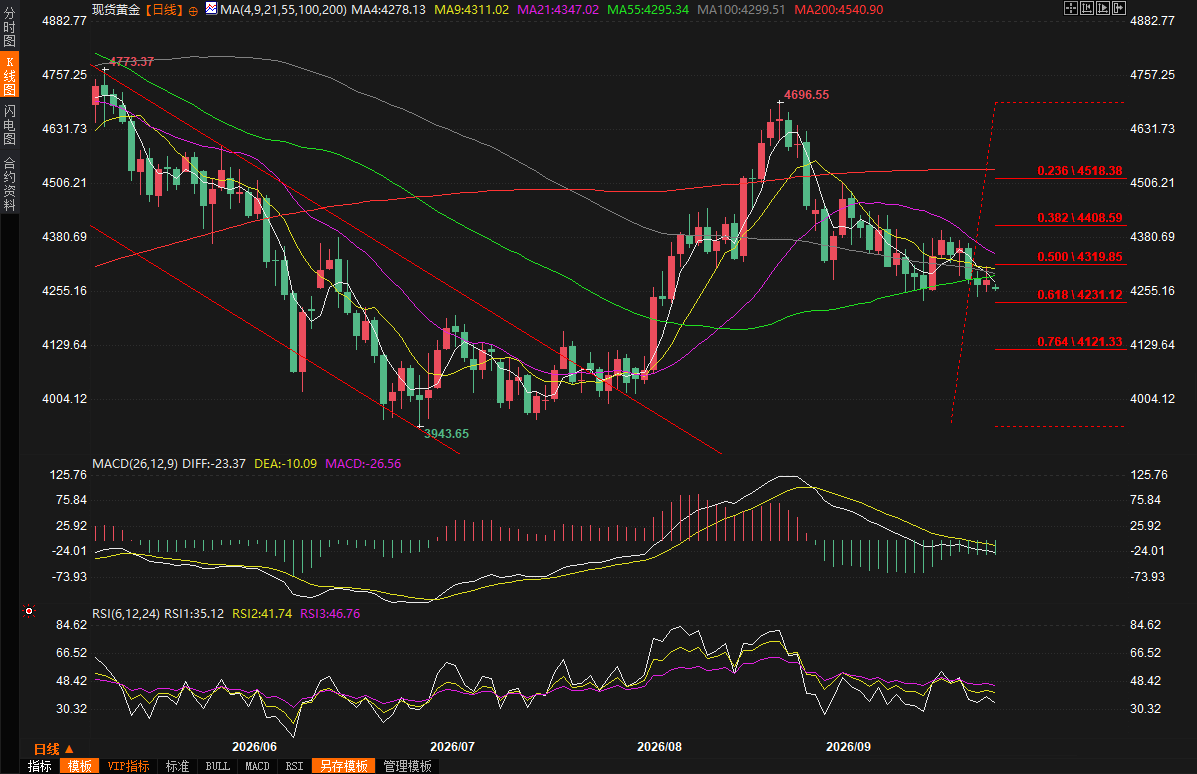 (Spot gold daily chart, source: EasyTrade) At 07:21 Beijing time, spot gold is currently trading at $4265.22 per ounce.
Geopolitical tensions escalate: Trump refuses to discuss reopening the Strait, putting downward pressure on the dollar and oil prices.
The immediate catalyst for this round of gold price decline came from Trump's explicit rejection of Iran's proposal over the weekend. Iran, through channels such as Qatar, had previously demanded the reopening of the Strait of Hormuz within seven days of inspections, the promotion of a regional ceasefire, the unfreezing of at least $12 billion in assets frozen since 1979, the lifting of sanctions on Iranian oil, and an end to the war in Yemen. In an interview, Trump stated bluntly that this was not an agreement he was willing to accept, claiming that Iran was rushing to compromise due to its heavy defeats and overestimating its bargaining power. He also indicated that negotiations with Iran were expected to resume within days , but remained open to the possibility of resuming bombing, saying, "I've been thinking about it," and reportedly, action might be taken after the midterm elections in November. This statement quickly reverberated through the financial markets. The US dollar index recovered some of Friday's losses in early trading, strengthening its safe-haven appeal; meanwhile, oil prices opened more than 1% higher, reflecting market concerns about the continued tensions in the Strait and unresolved supply risks. The Strait of Hormuz, which handled about one-fifth of global oil and gas transport before the conflict, remains a focal point of tension. Iran reiterated that it would not back down on its conditions, emphasizing that diplomacy was the only way out, while also acknowledging that it had not yet received a formal response from the US. This stalemate of "talks without a breakdown, and a breakdown without talks" makes it difficult for the market to price in the true decline of risk premium. Although gold theoretically benefits from geopolitical uncertainty, its safe-haven appeal has been significantly weakened against the backdrop of a stronger dollar and rising oil prices simultaneously pushing up inflation expectations. Investors are more inclined to hold assets that generate returns rather than zero-interest gold.Macroeconomic pressures continue to accumulate: Soaring yields and hawkish signals reduce gold's appeal.
Looking at a longer timeframe, gold prices fell approximately 2.1% last week, with spot gold closing near $4285.90 per ounce on Friday (September 25), a drop of about 19% from its February high. The core reason is the continued rise in US Treasury yields—the 10-year Treasury yield hit a 19-year high, significantly increasing the opportunity cost of holding non-yielding gold. After the Federal Reserve raised interest rates by 25 basis points last week, officials released a consistent hawkish signal, with the market pricing in further rate hikes in October and December rising to 66% and 93%, respectively. High energy prices due to the Middle East conflict further exacerbated the risk of rising inflation, forcing central banks to maintain a tightening framework. Gold has traditionally been seen as an inflation hedge, but during periods of rapid interest rate increases, this attribute often gives way to considerations of funding costs. Analysts point out that the surge in Treasury yields has led to gold recording its fourth weekly decline in the past five weeks. Despite New York negotiators reportedly still exploring a phased path to ending the conflict, including reopening the Strait and lifting the economic blockade, actual progress has been slow. Oil prices, while experiencing a pullback, remain high, and supply concerns have not been fundamentally alleviated. Although the US dollar retreated slightly on Friday, it still rose nearly 1% for the week, strengthening for the second consecutive week, further pressuring dollar-denominated gold. Market concerns about the unpredictability of US fiscal conditions and policies have caused a divergence between rising yields and the dollar's upward trend, but this has not changed the multiple unfavorable factors facing gold.This week is packed with key data and events, potentially creating a window of volatility for gold prices
. Looking ahead to this week, the market will simultaneously face the US non-farm payroll report, the Reserve Bank of Australia's interest rate decision, and speeches from central bank officials in several countries. The US-Iran situation remains a significant variable. The US economic data schedule is packed, including consumer confidence, JOLTS job openings, the PCE price index, and non-farm payrolls. The market expects approximately 100,000 new non-farm payrolls in September, with the unemployment rate potentially rising slightly to 4.2%. Stronger-than-expected data will further reinforce the Fed's tightening path, putting additional pressure on gold prices; conversely, weaker-than-expected data may provide a brief respite. The Reserve Bank of Australia's policy decision and subsequent CPI data, along with Eurozone inflation and economic indicators, will indirectly impact gold prices through exchange rates and risk appetite. Meanwhile, indirect talks between the US and Iran could begin as early as this week, still mediated by Qatar. If negotiations make substantial progress and the risk of reopening the Strait of Hormuz decreases, a drop in oil prices could alleviate inflation concerns, thus reducing downward pressure on gold prices. However, if Trump continues to send strong signals or the conflict escalates further, the linked rise in the US dollar and oil prices may still dominate short-term trends. Gold is currently in a tug-of-war between geopolitical support and macroeconomic pressure; any marginal change on either side could trigger significant volatility. In summary, Trump's rejection of Iran's proposal to reopen the Strait of Hormuz has strengthened the safe-haven appeal of the US dollar and oil prices in the short term. Coupled with high US Treasury yields and the Fed's hawkish stance, this continues to put pressure on gold's attractiveness. However, the uncertainty surrounding the Middle East situation and potential negotiation windows remain, and gold's status as the ultimate safe-haven asset has not been completely negated. Investors need to closely monitor this week's US employment data and the progress of US-Iran interactions, remaining cautious in a highly volatile environment. They should be wary of the downside risks from further interest rate increases, as well as potential oversold rebound opportunities arising from geopolitical easing. Whether gold prices can stabilize ultimately depends on the market's repricing of the balance between "higher interest rates" and "higher risks". (Spot gold daily chart, source: EasyTrade) At 07:21 Beijing time, spot gold is currently trading at $4265.22 per ounce.
- Risk Warning and Disclaimer
- The market involves risk, and trading may not be suitable for all investors. This article is for reference only and does not constitute personal investment advice, nor does it take into account certain users’ specific investment objectives, financial situation, or other needs. Any investment decisions made based on this information are at your own risk.