A chart shows that freight rates for large vessels have weakened significantly, with the Baltic Dry Index falling to a near four-week low.
2026-09-28 22:48:17
Latest data shows that the Baltic Dry Index (BDI) closed at 3268 points on September 28, 2026, a new low since September 1, 2026, down 4.61% month-on-month, the largest drop since March 10, 2026, and marking the second consecutive day of decline (including zero growth). Looking at the short-term charts, the BDI has seen positive growth 5 times, negative growth 6 times, and zero growth in the last 11 BDI data points. Specifically, the Panamax Freight Index (BPI) closed at 2402 points, down 0.21% from the previous value; the Capesize Freight Index (BCI) closed at 5351 points, down 7.49%; and the Supramax Freight Index (BSI) closed at 1790 points, up 0.22%. For detailed charts of the latest 720-day and 10-year trends of the Baltic Dry Index and its three main sub-indices, please refer to the charts specially created by FX678. 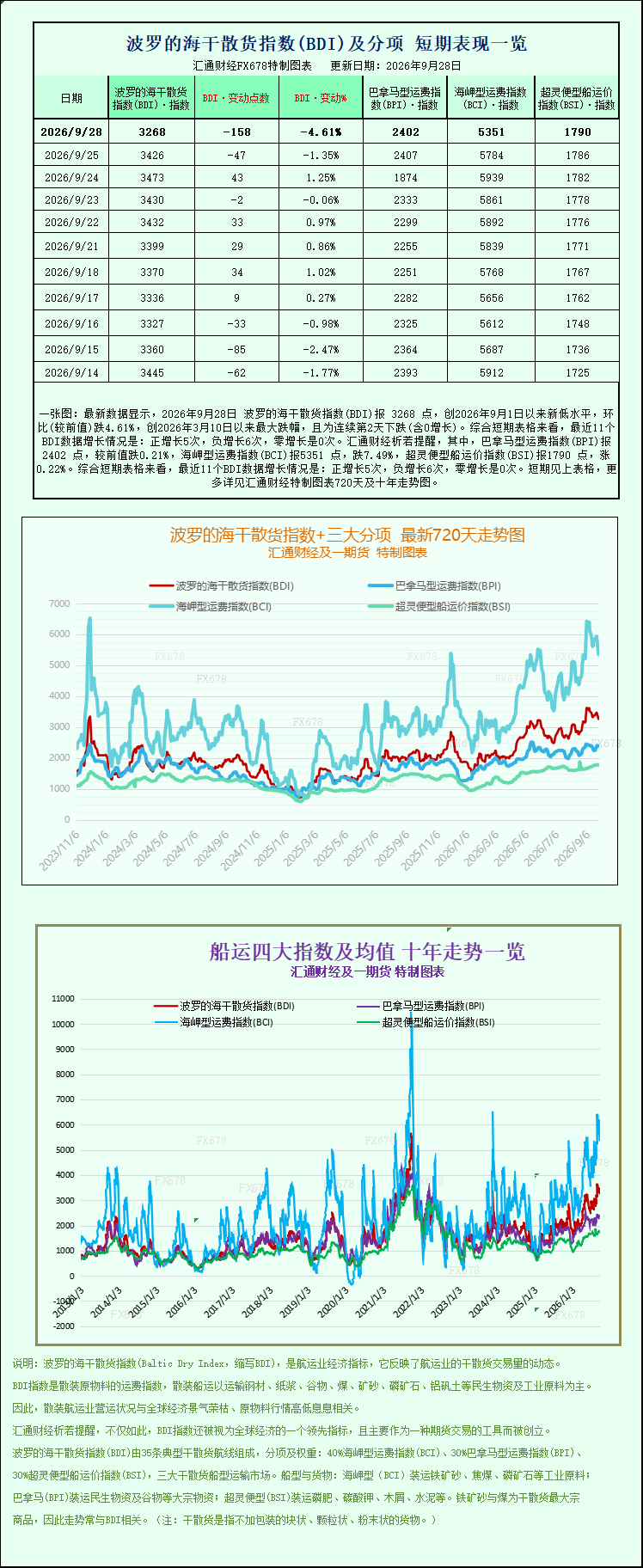 On Monday, the international dry bulk shipping market experienced a significant correction, with the core Baltic Dry Index (BDI) falling sharply. Dragged down by a precipitous drop in large bulk carrier freight rates, the index closed at its lowest point in nearly four weeks since September 1st. The global dry bulk shipping market exhibited a significant divergence in vessel types, with weak demand for industrial raw material transportation becoming the core factor driving the market trend. The latest data released by the Baltic Exchange showed that the index, which tracks freight rates for the three major bulk carrier types—Capemax, Panamax, and Supramax—fell sharply by 158 points, a single-day drop of 4.61%, ultimately closing at 3268 points, completely erasing most of the previous gains and hitting a new low in nearly four weeks. This correction was not a broad-based decline, but rather a structural divergence characterized by "large vessels suffering heavy losses while small vessels saw slight increases," clearly reflecting the current disparity in demand between global industrial commodities and consumer agricultural products and smaller bulk cargoes. As the vessel type with the highest weighting and the strongest impact on the overall market, the Capemax bulk carrier market was the core drag on this sharp decline in the index. Data shows that the Capesize index plummeted 433 points in a single day, a drop of 7.49%, closing at 5351 points, leading the decline in the entire dry bulk market. This vessel type mainly engages in ultra-large tonnage transportation of 150,000 tons and above, primarily carrying industrial raw materials such as iron ore, thermal coal, and metallurgical coal for long-distance transoceanic transport, serving as a key indicator of global industrial supply chain maritime demand. The sharp decline in freight rates also impacted shipowners' actual profits, with average daily charter income for Capesize bulk carriers falling by $3,930 in a single day, to a new average of $45,024. This significant weakening of Capesize freight rates is highly correlated with the sluggish iron ore market. On the same day, domestic Dalian iron ore futures prices also fell to a five-week low, with the loose supply and demand situation continuing to suppress commodity prices. Currently, global iron ore spot supply is generally ample, with shipments from major producing countries remaining high, while iron ore inventories at Chinese ports continue to accumulate, highlighting a supply-demand surplus. More importantly, the domestic steel industry is facing increasing operational pressure, with most steel mills mired in losses. They are proactively reducing blast furnace operating rates and crude steel production, leading to a significant drop in iron ore restocking demand and weak willingness to purchase imports from overseas. This directly weakens the demand for cargo on Capesize vessels, coupled with relatively ample available capacity for large vessels in the short term, further pushing freight rates down. The medium-sized vessel market also continued its weakness, but the decline was much smaller than that of Capesize vessels, showing a relatively stable trend. Data shows that the Panamax index fell slightly by 5 points, a drop of only 0.21%, closing at 2402 points. This corresponds to a decrease of $42 in average daily revenue for Panamax vessels, to $21,620. This vessel type has a deadweight tonnage concentrated between 60,000 and 70,000 tons, mainly transporting bulk commodities such as coal, grain, and fertilizer, catering to both industrial and consumer transport needs. Its more balanced demand structure makes it more resistant to fluctuations, and its impact from weakening industrial raw material demand is relatively limited, resulting in an overall stable market. In stark contrast to the decline in large and medium-sized vessels, the market for small Supramax bulk carriers bucked the trend with a slight increase, becoming the only bright spot in the market that day. The Supramax bulk carrier index rose slightly by 4 points, an increase of 0.22%, closing at 1790 points. These small vessels are flexible in their routes and highly adaptable, mainly handling small-batch, high-frequency orders for transporting grain, building materials, and niche minerals, and are less affected by the cyclical fluctuations of heavy industry. The stable operation of global grain trade and the steady release of regional short-haul shipping demand supported the resilience of small vessel freight rates against the trend, further confirming the current structural differentiation in the dry bulk market. The regional grain shipping market also saw recent developments, providing support for demand for small and medium-sized vessels. Last week, Russian wheat export prices fell in tandem with global grain prices, leading to a more relaxed market supply and demand. Meanwhile, industry analysts have again raised their forecasts for Russian wheat exports in September, primarily due to continued improvements in Baltic port handling and throughput efficiency, easing port congestion, and smooth wheat transport channels. This is expected to lead to a continued release of grain shipping orders, potentially benefiting the small and medium-sized bulk carrier market. Overall, the recent Baltic Dry Index correction is a result of short-term supply-demand mismatch and the cyclical resonance of downstream industries. Currently, weak global industrial demand is suppressing freight rates for large vessels, while demand for staple foods and regional short-haul transportation is supporting the small vessel market, highlighting its structural characteristics. Future market trends will largely depend on the pace of production recovery in China's steel industry, the extent of iron ore restocking, changes in global coal trade demand, and the release of demand during the peak autumn and winter shipping season in the Northern Hemisphere.
On Monday, the international dry bulk shipping market experienced a significant correction, with the core Baltic Dry Index (BDI) falling sharply. Dragged down by a precipitous drop in large bulk carrier freight rates, the index closed at its lowest point in nearly four weeks since September 1st. The global dry bulk shipping market exhibited a significant divergence in vessel types, with weak demand for industrial raw material transportation becoming the core factor driving the market trend. The latest data released by the Baltic Exchange showed that the index, which tracks freight rates for the three major bulk carrier types—Capemax, Panamax, and Supramax—fell sharply by 158 points, a single-day drop of 4.61%, ultimately closing at 3268 points, completely erasing most of the previous gains and hitting a new low in nearly four weeks. This correction was not a broad-based decline, but rather a structural divergence characterized by "large vessels suffering heavy losses while small vessels saw slight increases," clearly reflecting the current disparity in demand between global industrial commodities and consumer agricultural products and smaller bulk cargoes. As the vessel type with the highest weighting and the strongest impact on the overall market, the Capemax bulk carrier market was the core drag on this sharp decline in the index. Data shows that the Capesize index plummeted 433 points in a single day, a drop of 7.49%, closing at 5351 points, leading the decline in the entire dry bulk market. This vessel type mainly engages in ultra-large tonnage transportation of 150,000 tons and above, primarily carrying industrial raw materials such as iron ore, thermal coal, and metallurgical coal for long-distance transoceanic transport, serving as a key indicator of global industrial supply chain maritime demand. The sharp decline in freight rates also impacted shipowners' actual profits, with average daily charter income for Capesize bulk carriers falling by $3,930 in a single day, to a new average of $45,024. This significant weakening of Capesize freight rates is highly correlated with the sluggish iron ore market. On the same day, domestic Dalian iron ore futures prices also fell to a five-week low, with the loose supply and demand situation continuing to suppress commodity prices. Currently, global iron ore spot supply is generally ample, with shipments from major producing countries remaining high, while iron ore inventories at Chinese ports continue to accumulate, highlighting a supply-demand surplus. More importantly, the domestic steel industry is facing increasing operational pressure, with most steel mills mired in losses. They are proactively reducing blast furnace operating rates and crude steel production, leading to a significant drop in iron ore restocking demand and weak willingness to purchase imports from overseas. This directly weakens the demand for cargo on Capesize vessels, coupled with relatively ample available capacity for large vessels in the short term, further pushing freight rates down. The medium-sized vessel market also continued its weakness, but the decline was much smaller than that of Capesize vessels, showing a relatively stable trend. Data shows that the Panamax index fell slightly by 5 points, a drop of only 0.21%, closing at 2402 points. This corresponds to a decrease of $42 in average daily revenue for Panamax vessels, to $21,620. This vessel type has a deadweight tonnage concentrated between 60,000 and 70,000 tons, mainly transporting bulk commodities such as coal, grain, and fertilizer, catering to both industrial and consumer transport needs. Its more balanced demand structure makes it more resistant to fluctuations, and its impact from weakening industrial raw material demand is relatively limited, resulting in an overall stable market. In stark contrast to the decline in large and medium-sized vessels, the market for small Supramax bulk carriers bucked the trend with a slight increase, becoming the only bright spot in the market that day. The Supramax bulk carrier index rose slightly by 4 points, an increase of 0.22%, closing at 1790 points. These small vessels are flexible in their routes and highly adaptable, mainly handling small-batch, high-frequency orders for transporting grain, building materials, and niche minerals, and are less affected by the cyclical fluctuations of heavy industry. The stable operation of global grain trade and the steady release of regional short-haul shipping demand supported the resilience of small vessel freight rates against the trend, further confirming the current structural differentiation in the dry bulk market. The regional grain shipping market also saw recent developments, providing support for demand for small and medium-sized vessels. Last week, Russian wheat export prices fell in tandem with global grain prices, leading to a more relaxed market supply and demand. Meanwhile, industry analysts have again raised their forecasts for Russian wheat exports in September, primarily due to continued improvements in Baltic port handling and throughput efficiency, easing port congestion, and smooth wheat transport channels. This is expected to lead to a continued release of grain shipping orders, potentially benefiting the small and medium-sized bulk carrier market. Overall, the recent Baltic Dry Index correction is a result of short-term supply-demand mismatch and the cyclical resonance of downstream industries. Currently, weak global industrial demand is suppressing freight rates for large vessels, while demand for staple foods and regional short-haul transportation is supporting the small vessel market, highlighting its structural characteristics. Future market trends will largely depend on the pace of production recovery in China's steel industry, the extent of iron ore restocking, changes in global coal trade demand, and the release of demand during the peak autumn and winter shipping season in the Northern Hemisphere.
- Risk Warning and Disclaimer
- The market involves risk, and trading may not be suitable for all investors. This article is for reference only and does not constitute personal investment advice, nor does it take into account certain users’ specific investment objectives, financial situation, or other needs. Any investment decisions made based on this information are at your own risk.