The USD/JPY pair may be facing a "death cross," and why would Trump welcome this?
2026-09-28 23:52:14
The USD/JPY exchange rate chart is about to show a "death cross" pattern, indicating a potential reversal of the long-term upward trend. Several technical signals suggest that US Treasury Secretary Scott Bessenter's earlier statement to the financial markets—"Now I'm in charge"—is indeed true.  The upward momentum of the USD/JPY has clearly subsided, with the yen taking the lead. Meanwhile, an ominous technical pattern known as a "death cross" is brewing, likely to be confirmed early next week. This suggests that the previous rapid upward trend in USD/JPY may have reversed. This rally had impacted the Japanese economy, and Trump is pressuring for a stronger yen, a goal the Bank of Japan has been actively pursuing. While a death cross isn't necessarily a precise timing signal, it can provide evidence that the market may have begun a new trend. Ari Wald, head of technical analysis at Oppenheimer, wrote, "We often say that every major downtrend begins with a death cross, but not every death cross leads to a major drop." Last Friday, USD/JPY fell 1% in the afternoon, its biggest one-day drop in three weeks. The market volatility stemmed from a tweet about Trump supporting a stronger yen, something the Bank of Japan has been pushing for. This sell-off occurred precisely at a key chart level, further confirming that the 17-month uptrend may have ended. When the US Dollar Index (DXY) weakens and the yen strengthens, the USD/JPY exchange rate tends to decline. When governments warn investors to stop buying a particular asset class, the market often moves against the trend and goes long. This is because investors believe that regulators are intervening because they fear the upward trend will continue, and that only direct market intervention can stop it. History is replete with examples of government intervention failing, sometimes spectacularly. These include the 1992 collapse of the British pound, the Asian financial crisis of the late 1990s, and the limited success of the US Treasury's attempts to curb rising long-term Treasury yields. Therefore, when the US and Japan jointly intervened at the end of July to try and halt the continued rise of the USD/JPY exchange rate, many believed the exchange rate would only temporarily decline, and the fundamental factors driving the rise would regain momentum, quickly resuming the upward trend. However, after a brief rebound, the pair broke below the trendline that had started its upward trend from the April 2025 low on September 3rd. Buyers re-entered the market, pushing the exchange rate back up to test this trendline and verify the validity of the break. Last Friday's decline confirmed that the trendline had been breached. This decline occurred after the USD/JPY failed to regain its position above the 200-day moving average. Many chart traders view the 200-day moving average as a dividing line between long-term bull and bear trends. Wald stated, "This pullback after encountering resistance at the 200-day moving average means the currency pair faces the risk of testing the 152 support level, which is close to the year's low for 2026."
 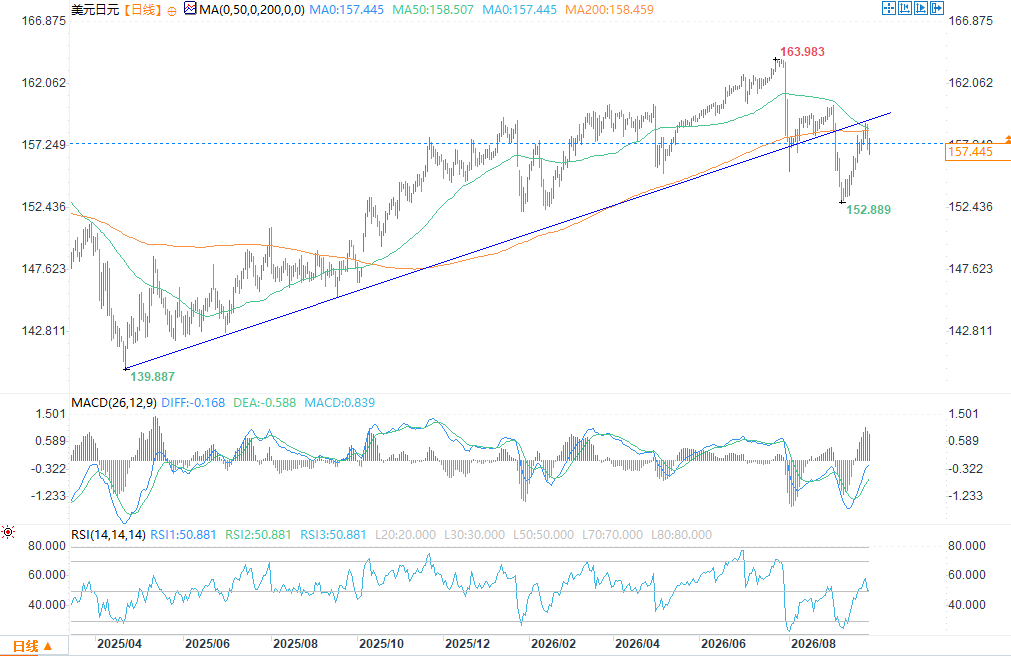 (USD/JPY Daily Chart Source: FX678) Next up is the death cross. A death cross occurs when the widely watched short-term trend indicator, the 50-day moving average, crosses below the 200-day moving average. The market interprets this as a signal that a short-term decline has evolved into a long-term downtrend. Based on the current trajectory of the USD/JPY 50-day and 200-day moving averages, this cross will occur before the end of this week. This will be the first death cross for this currency pair since March 25, 2025. After the last death cross, the exchange rate fell another 6%, bottoming out about a month later. An even earlier death cross occurred on September 9, 2024, with the exchange rate only falling another 1.8%, bottoming out a week later. Even so, Oppenheimer's Wald believes that, from the current technical pattern, this death cross "echoes the overall weakening of market momentum, further supporting the judgment of a trend reversal."
The upward momentum of the USD/JPY has clearly subsided, with the yen taking the lead. Meanwhile, an ominous technical pattern known as a "death cross" is brewing, likely to be confirmed early next week. This suggests that the previous rapid upward trend in USD/JPY may have reversed. This rally had impacted the Japanese economy, and Trump is pressuring for a stronger yen, a goal the Bank of Japan has been actively pursuing. While a death cross isn't necessarily a precise timing signal, it can provide evidence that the market may have begun a new trend. Ari Wald, head of technical analysis at Oppenheimer, wrote, "We often say that every major downtrend begins with a death cross, but not every death cross leads to a major drop." Last Friday, USD/JPY fell 1% in the afternoon, its biggest one-day drop in three weeks. The market volatility stemmed from a tweet about Trump supporting a stronger yen, something the Bank of Japan has been pushing for. This sell-off occurred precisely at a key chart level, further confirming that the 17-month uptrend may have ended. When the US Dollar Index (DXY) weakens and the yen strengthens, the USD/JPY exchange rate tends to decline. When governments warn investors to stop buying a particular asset class, the market often moves against the trend and goes long. This is because investors believe that regulators are intervening because they fear the upward trend will continue, and that only direct market intervention can stop it. History is replete with examples of government intervention failing, sometimes spectacularly. These include the 1992 collapse of the British pound, the Asian financial crisis of the late 1990s, and the limited success of the US Treasury's attempts to curb rising long-term Treasury yields. Therefore, when the US and Japan jointly intervened at the end of July to try and halt the continued rise of the USD/JPY exchange rate, many believed the exchange rate would only temporarily decline, and the fundamental factors driving the rise would regain momentum, quickly resuming the upward trend. However, after a brief rebound, the pair broke below the trendline that had started its upward trend from the April 2025 low on September 3rd. Buyers re-entered the market, pushing the exchange rate back up to test this trendline and verify the validity of the break. Last Friday's decline confirmed that the trendline had been breached. This decline occurred after the USD/JPY failed to regain its position above the 200-day moving average. Many chart traders view the 200-day moving average as a dividing line between long-term bull and bear trends. Wald stated, "This pullback after encountering resistance at the 200-day moving average means the currency pair faces the risk of testing the 152 support level, which is close to the year's low for 2026." (USD/JPY Daily Chart Source: FX678) Next up is the death cross. A death cross occurs when the widely watched short-term trend indicator, the 50-day moving average, crosses below the 200-day moving average. The market interprets this as a signal that a short-term decline has evolved into a long-term downtrend. Based on the current trajectory of the USD/JPY 50-day and 200-day moving averages, this cross will occur before the end of this week. This will be the first death cross for this currency pair since March 25, 2025. After the last death cross, the exchange rate fell another 6%, bottoming out about a month later. An even earlier death cross occurred on September 9, 2024, with the exchange rate only falling another 1.8%, bottoming out a week later. Even so, Oppenheimer's Wald believes that, from the current technical pattern, this death cross "echoes the overall weakening of market momentum, further supporting the judgment of a trend reversal."- Risk Warning and Disclaimer
- The market involves risk, and trading may not be suitable for all investors. This article is for reference only and does not constitute personal investment advice, nor does it take into account certain users’ specific investment objectives, financial situation, or other needs. Any investment decisions made based on this information are at your own risk.