Institutions have lowered their short-term average gold price forecasts, predicting a return to $5,000 by the second quarter of next year.
2026-09-29 13:10:17
Tensions in the Middle East pushed up oil prices, reigniting market concerns about inflation and leading to more aggressive interest rate hike expectations, putting downward pressure on the precious metals market. The 10-year US Treasury yield broke through 5.20%, hitting a 20-year high, with both gold and silver falling below key support levels. Rising bond yields increased the opportunity cost of holding non-interest-bearing precious metals, weakening investment demand. Despite the concentrated short-term negative factors, BMO Capital Markets released its fourth-quarter updated forecast, slightly lowering its three-month target price for gold but significantly raising its long-term gold price target, believing that the foundation of the long-term bull market for gold remains unshaken.
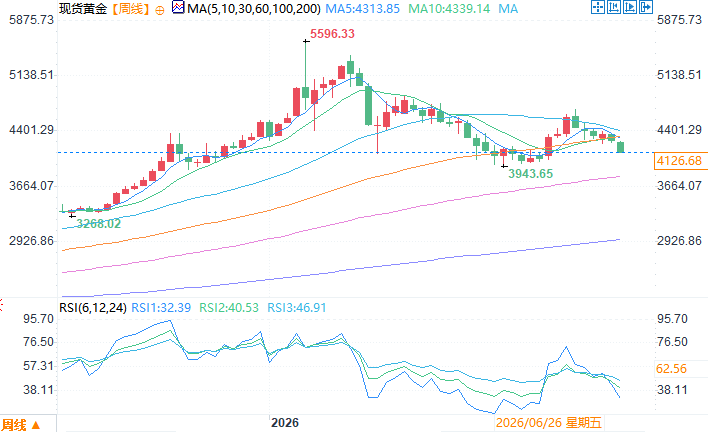 Spot gold weekly chart source: FX678. As of 13:08 Beijing time on September 29th, spot gold was trading at $4128.68 per ounce.
Short-term gold price forecast revised downwards, long-term target significantly raised.
Entering the final quarter of 2026, BMO commodities analysts lowered their three-month gold price forecast, but significantly shifted their long-term outlook to optimism. The bank released its updated fourth-quarter forecast on Monday (September 28), predicting an average gold price of approximately $4,650 per ounce in the fourth quarter, a 2% decrease from its previous forecast of $4,750. The institution adjusted its timeline, believing that gold prices are unlikely to return to $5,000 per ounce until the second quarter of next year. The biggest change in this forecast comes from long-term valuation; the Canadian bank raised its long-term average gold price forecast to $4,000 per ounce, a 29% increase from its previous long-term target of $3,100. Analysts stated that with soaring yields on US Treasury Inflation-Protected Securities (TIPS) and many central banks just beginning their interest rate hike cycles, this forecast adjustment seems counterintuitive. However , against the backdrop of a persistently hawkish market pricing, gold prices have shown unexpected resilience, indicating that emerging themes such as currency depreciation and demand from major Asian countries have a greater impact on gold prices than the traditional yield-driven logic. Analysts believe that the gold-buying behavior of major Asian countries has a strong counter-cyclical attribute. They expect that the demand from central banks of major Asian countries will remain strong throughout the forecast period, providing bottom support for gold prices at higher levels.Two key factors are at play, driving gold prices and gradually freeing it from the constraints of real yields.
BMO analysis suggests that despite lowering short-term expectations, gold still faces asymmetric upside risks for the remainder of 2026. The most crucial short-term factor suppressing gold prices remains US interest rates, but given the high sovereign debt risk, even during a monetary tightening cycle, gold prices still have room to rise. Analysts indicate that gold holds a high priority in asset allocation, and as precious metals gradually decouple from real yields, currency depreciation and de-dollarization are becoming more central drivers, potentially leading to a gradual and orderly rise in gold prices. The year-end gold price trend will depend on the balance of power between two main factors: firstly, the "currency depreciation trade," where rising interest rates and higher term premiums reflect underlying concerns about fiscal sustainability, which is bullish for gold; secondly, the traditional "opportunity cost trade," where rising interest rates suppress gold prices, creating a counterbalancing effect. Analysts believe that the Fed's hawkish statements have temporarily restored policy credibility and somewhat mitigated term premiums, but concerns about currency depreciation could easily resurface. Unless oil prices surge again, the risks to gold prices remain skewed to the upside, maintaining the average price forecast of $4,650 for the fourth quarter.Silver prices are under short-term pressure, while photovoltaic silver reduction technology is changing the long-term supply and demand pattern.
Silver faces similar short-term headwinds to gold. Although short-term uncertainty is high, BMO believes that rising gold prices will drive silver prices upward. Entering the fourth quarter, BMO predicts the average silver price over the next three months will be around $67.40 per ounce, lower than the previous forecast of $71.40. Institutions predict a slowdown in silver's upward momentum at the beginning of next year, with an expected average price of $69.30 in the first quarter, lower than the previous $73.50. Analysts say that in the silver sector, the implementation of silver-saving technologies is faster than expected, photovoltaic installation growth is slowing, and industrial supply and demand are becoming more relaxed. Silver is likely to underperform gold in the coming quarters. In the long term, BMO has raised its long-term average silver price forecast to $47 per ounce, a 31% increase from the previous $36. The core driver of silver prices at the end of the year remains industrial demand from the photovoltaic industry. Before 2025, the photovoltaic industry generally believed that the benefits of silver reduction technologies had been largely realized, but the surge in silver prices to over $120 per ounce in January this year overturned this previous assessment. Several domestic photovoltaic companies have launched silver reduction solutions, using methods such as finer metallized grid lines, reducing silver paste usage, increasing copper substitution ratios, and developing copper-plated silver paste to decrease silver consumption. As these technologies are gradually being implemented, the market has significantly lowered its long-term expectations for silver consumption per unit.Conclusion
In summary, the Middle East conflict, coupled with soaring long-term US Treasury yields, led to a significant short-term correction in gold and silver prices, with prices breaking through key support levels. BMO lowered its short-term price forecasts for gold and silver in the fourth quarter but significantly raised its long-term price averages. The core logic is that fiscal imbalances, currency depreciation, and continued gold purchasing power from major Asian countries are weakening the downward pressure on gold prices from real yields. Regarding silver, the continued implementation of silver reduction technologies in the photovoltaic industry is reducing the elasticity of industrial demand for silver, making it likely to underperform gold in the near future. The focus of future market speculation will be whether the US Treasury term premium will rise again and the speed of the implementation of silver reduction technologies in the photovoltaic industry. Investors need to continuously monitor US Treasury yields, physical gold demand from major Asian countries, and technological progress in the photovoltaic industry. Spot gold weekly chart source: FX678. As of 13:08 Beijing time on September 29th, spot gold was trading at $4128.68 per ounce.
- Risk Warning and Disclaimer
- The market involves risk, and trading may not be suitable for all investors. This article is for reference only and does not constitute personal investment advice, nor does it take into account certain users’ specific investment objectives, financial situation, or other needs. Any investment decisions made based on this information are at your own risk.