Oil prices fell as the US and Iran negotiated in Qatar and air traffic rebounded.
2026-09-29 16:22:15
In late September 2026, international crude oil prices exhibited a trend of high-level fluctuations and a gradual decline in geopolitical premiums, marking a departure from the previous one-sided surge. The core drivers were the continued progress of US-Iran diplomatic negotiations, a recovery in actual navigation in the Strait of Hormuz, and a more rational market expectation, which offset the supply panic caused by geopolitical conflicts. Recently, Brent crude oil has been trading around $105-107 per barrel, and WTI crude oil around $93-94 per barrel. Compared to the most intense phase of the conflict, some of the bubble has been gradually released, and there is still room for further correction. 
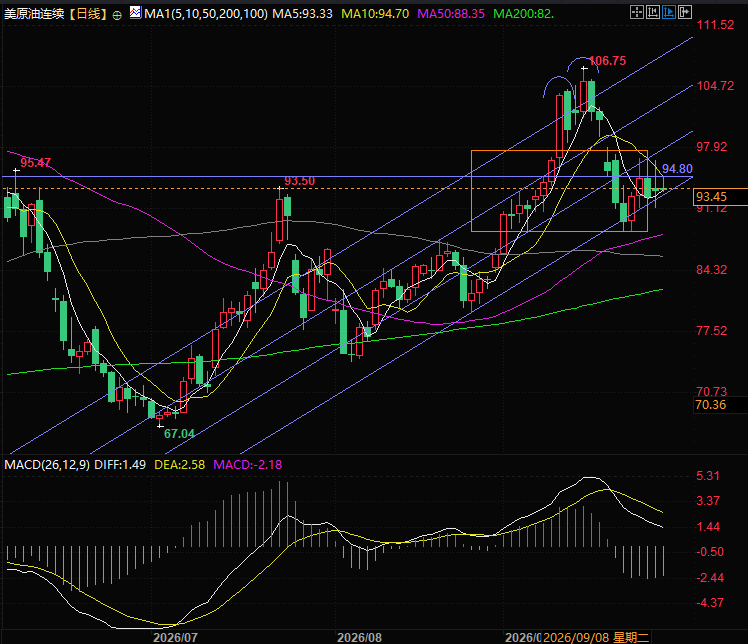 (WTI crude oil futures main contract daily chart, source: EasyTrade) At 16:18 Beijing time, WTI crude oil futures main contract was trading at $93.06 per barrel.
The core reason for the short-term surge and subsequent decline in oil prices: repeated negotiations reshaped market expectations.
This round of oil price fluctuations revolved entirely around the pace of US-Iran negotiations, with the rapid increase and decrease of geopolitical risk premiums becoming the main theme of the market. Previously, Trump's rejection of Iran's proposal to reopen the Strait of Hormuz directly triggered a surge in market risk aversion, causing international oil prices to jump by more than $4 on Monday, reaching a new high. However, market sentiment quickly reversed, and oil prices gave back most of their gains. The core reason was that the door to diplomatic negotiations remained open, and there were signs of easing tensions. Iranian Foreign Minister Araqchi held in-depth consultations with Qatari mediators in New York, clearly hoping that the US would deliver a final response through Qatar by Tuesday. Both sides confirmed that they would conduct indirect negotiations through Qatar and Pakistan, indicating a loosening of the deadlock. The US released a key soft signal: officials confirmed that the negotiation atmosphere was "positive and constructive," and that it was willing to ease sanctions against Iran and unfreeze frozen Iranian assets in exchange for substantial concessions from Iran on its nuclear program. Despite Trump's public denial of market rumors of "concessions to Iran" and his firm stance against Iran developing nuclear weapons, and Iran's official denial of a softening of its nuclear position, the ongoing indirect mediation between the two sides has broken the extreme market expectation of "full-scale confrontation with no room for negotiation," significantly suppressing the geopolitical premium in oil prices. Currently, the core market disagreement focuses on the order of action: Iran demands that the US lift the blockade and sanctions before restarting nuclear negotiations and opening the Strait of Hormuz; the US insists that Iran must make concessions on the nuclear issue before easing sanctions. This disagreement has prevented a unilateral sharp drop in oil prices and also prevented extreme price surges, pushing oil prices into a period of fluctuation and decline.Fundamental support: A substantial recovery in navigation through the Strait of Hormuz has eased supply panic.
Compared to previous market speculation about negotiations falling short of expectations, the recent improvement in actual shipping data across the Strait of Hormuz is the core fundamental support for the steady decline in oil prices, reversing pessimistic expectations of a "complete blockade of the Strait and a disruption of crude oil supply." Data shows that crude oil traffic through the Strait of Hormuz has continued to rebound, with some daily traffic exceeding 20 million barrels. In September, crude oil exports from major Middle Eastern oil-producing countries rebounded to 12.8 million barrels per day, the highest level since the start of the conflict. Although this figure is still lower than the pre-war peak of 18.8 million barrels per day, the trend of supply recovery is clear. Currently, shipping through the Strait has formed a normalized risk-avoidance mode: many oil tankers rely on the Omani coastal route under US military surveillance, sailing at night with their positioning systems turned off and completing crude oil transshipment outside the Strait, effectively circumventing Iranian shipping restrictions. Data from the US Central Command shows that in recent months, it has assisted in 2,000 shipping passages, ensuring the smooth transfer of over 1 billion barrels of crude oil, substantially alleviating global crude oil supply pressure. Meanwhile, restrictions on air travel in the region have been partially eased, with Iraqi Airways resuming passenger routes to and from Iran. The flow of people and trade in the region is picking up, indirectly reflecting a decrease in the intensity of geopolitical confrontation. Only the UAE, Turkey, and Oman remain suspending flights operated by Iranian airlines, and the situation of a complete regional blockade no longer exists.Key factors limiting a sharp decline in oil prices and supporting high-level fluctuations
Although the oil price premium has continued to decline, multiple rigid risks still support oil prices at high levels, making a deep decline unlikely in the short term. First, the US-Iran military standoff has not been resolved. Iranian officials continue to send strong signals, emphasizing that the Strait of Hormuz remains closed and the military is ready to launch a devastating counterattack against any enemy threat. The warning shots fired near Qeshm Island also indicate that the risk of maritime friction remains. Second, the US continues to escalate its maximum pressure campaign against Iran, implementing "Operation Orphan," which has caused the Iranian rial to fall to a historic low, continuously weakening the Iranian regime. The structural contradictions between the two sides are unlikely to be resolved in the short term, and the underlying geopolitical risk remains. Finally, the global refined oil supply bottleneck has not yet been repaired. The Russia-Ukraine conflict, the Houthi attack on Saudi oil refineries, and Ukraine's attack on Russian refining capacity have led to a reduction of 3.5-4 million barrels per day in global crude oil processing capacity. Diesel and gasoline inventories in Europe and the US remain low, and the US strategic petroleum reserve has fallen to its lowest level since 1983. The rigid demand for refined oil supports the bottom of crude oil prices.Outlook for oil price trends
In the short term, oil prices will continue to fluctuate and decline, with the premium gradually clearing. If the US releases information on the progress of negotiations as expected and both sides reach a phased consensus, the market will further price in the expectation of a full opening of the Strait of Hormuz, and oil prices are expected to fall by 10%-15%. Currently, the possibility of Iran compromising is gradually increasing, as can be seen from the decline in oil prices. Recently, the US has gained a slight advantage. At the same time, the longer Iran is subject to economic and oil blockades, the more internal conflicts arise. Recently, a blockade exceeding 75 days is a critical point, and the subsequent impact on domestic oil and gas fields and people's livelihoods will increase. The extreme upside risk has not been eliminated: if the US-Iran negotiations break down and conflicts such as ship attacks occur between the two sides in the Strait of Hormuz, geopolitical risks will escalate again, and international crude oil may rebound to near new highs. In the medium to long term, the US midterm elections will become a key variable. Currently, the American public is strongly dissatisfied with high oil prices and high inflation, and support for the US-Iran conflict remains low. Political pressure will force the US to tone down its hardline stance and promote de-escalation, which is generally beneficial for oil prices to steadily return to a reasonable valuation range. From a technical perspective, although the WTI crude oil futures contract is still holding within an upward channel, it has failed to break through the 0.618 Fibonacci retracement level of 94.80 for three consecutive days, raising concerns about continued weakness. It is very likely to break below the upward channel and turn into range-bound trading or even a downtrend. (WTI crude oil futures main contract daily chart, source: EasyTrade) At 16:18 Beijing time, WTI crude oil futures main contract was trading at $93.06 per barrel.
- Risk Warning and Disclaimer
- The market involves risk, and trading may not be suitable for all investors. This article is for reference only and does not constitute personal investment advice, nor does it take into account certain users’ specific investment objectives, financial situation, or other needs. Any investment decisions made based on this information are at your own risk.