How Treasury Secretary Bessant pushed down the 10-year Treasury yield
2026-09-29 18:00:14
The main reasons for the rise in long-term interest rates are traditional inflationary pressures, interest rate hikes implemented to combat inflation, and a relatively high level of real interest rates. Therefore, the US has not yet experienced a panic sell-off of US Treasury bonds triggered by fiscal problems. However, should a sharp fiscal-driven sell-off occur, the US Treasury may be forced to take more aggressive measures. This article will analyze possible policy scenarios.  US Treasury Secretary Bessant possesses policy tools to lower the 10-year Treasury yield, including expanding bond repurchase operations and suspending long-term Treasury bond issuance. This article proposes a scenario: the US Treasury implements substantial policies targeting the long end of the yield curve, aiming to lower yields. We believe there is currently no need to implement such policies, as the Treasury yield is not abnormally high relative to the Secured Overnight Financing Rate (SOFR). Even if the Treasury intervenes, such as expanding repurchase operations or suspending 20-year Treasury bond issuance, the policy effect will likely be limited to narrowing swap spreads and strengthening the Treasury yield relative to interest rate swaps. A significant impact on the interest rate market would require a more forceful and widespread suspension of long-term Treasury bond issuance. Theoretically, such operations would not affect the SOFR rate, but the current 10-year SOFR rate is already about 50 basis points above a reasonable level. On the positive side, proactive Treasury intervention in the bond market could potentially drive a significant drop in long-term SOFR rates. In an extreme scenario, a combination of policies could potentially push the 10-year Treasury yield back towards the 4% mark. We do not predict this will happen, nor do we recommend implementing such policies. However, various indications suggest that the US Treasury may be considering similar options, but will most likely choose a more moderate version. This is unless there is a genuine sell-off in the US Treasury market—the last one being the "sell-off of America" the week after "Liberation Day." Only with such market turmoil would aggressive intervention have a stronger rationale, aiming to mitigate greater risks arising from the debt path and the real economy. The SOFR curve constitutes the theoretical lower bound for US Treasury yields. First, let's clarify a core point: the formation logic of the 10-year US Treasury yield is rather obscure and allows for subjective interpretation; however, the 10-year SOFR rate can be calculated using mathematical models. This is crucial, as it defines what the Treasury can and cannot do when managing long-term yields. Why is the 10-year SOFR rate a mathematical derivation? All swap dealers will tell you that this rate breaks even on swap transactions and matches the market's expected path for the federal funds rate. The 10-year fixed swap rate equals the average discounted floating rate over the swap's term. We cannot accurately predict the future trend of the federal funds rate, therefore we use market discount pricing as a fair expected path. The SOFR curve represents the risk-free interest rate curve. This risk-free interest rate curve is driven by the market discount level, with the core variable being the inflation trend and the real interest rate needed in the future under the corresponding inflationary environment. Each term corresponds to inflation expectations and the appropriate real interest rate over a period of time, both of which are determined by macroeconomic fundamentals: inflation is determined by supply and demand, while the real interest rate depends on productivity and real economic growth. US Treasury yields are based on the SOFR curve, forming a spread . We haven't mentioned the US fiscal deficit yet, because it's not necessary for theoretical analysis. The fiscal deficit affects real interest rates and inflation, but in reality, the size of the fiscal deficit, the pressure of bond issuance, and the overall debt situation determine the premium of US Treasury yields relative to the risk-free SOFR curve, i.e., the swap spread. If the US still maintains its AAA highest credit rating, US Treasury yields should be in line with the SOFR curve. However, this is not the case in reality; US Treasury yields are higher than the SOFR curve, forming a swap spread. Currently, the 10-year swap spread is slightly below 40 basis points, while the 30-year swap spread is 65 basis points. This reflects the risk premium the Treasury needs to pay due to the deteriorating US fiscal situation. Understanding this difference is crucial for assessing the Treasury's ability to manage long-term interest rates. What the Treasury can attempt is to compress swap spreads; methods include bond repurchase agreements and reducing the issuance of long-term bonds. Following the recent increase in the scale of US Treasury repurchase agreements, long-term swap spreads have narrowed. Therefore, we do not agree with the common claim that "repurchase policies are ineffective"—although long-term yields have not declined, the narrowing of long-term swap spreads indicates that repurchase agreements have been effective. Credit fundamentals and supply and demand determine the pricing of US Treasuries relative to SOFR, i.e., the swap spread.
 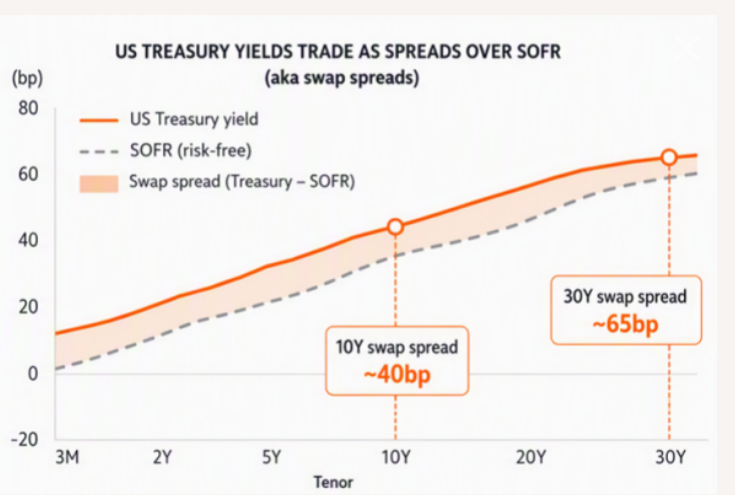 (Theoretically, fiscal deficits will disrupt real interest rates and inflation; however, the premium of US Treasury bonds relative to the risk-free benchmark SOFR is mainly determined by the pressure of bond issuance supply and the size of the debt. If the US still had AAA credit rating, US Treasury yields would completely overlap with SOFR; in reality, the US credit rating is no longer AAA, and US Treasury yields are generally higher than SOFR; the longer the maturity, the larger the swap spread: about 40bp for 10-year bonds and about 65bp for 30-year bonds.) Measures the Treasury can take, and policy constraints: If the Treasury is determined to deeply intervene in the long-term yield curve, it can further intensify its efforts. In an extreme scenario, it could suspend all bidding for 10-year, 20-year, and 30-year Treasury bonds in the foreseeable future, coupled with increased long-term bond repurchases, directly achieving an absolute reduction in the size of the outstanding long-term debt. If this operation is implemented, the long-term US Treasury yield will converge towards the SOFR rate, and may even fall below the SOFR curve, meaning the US Treasury yield will be lower than the SOFR rate. However, this policy will bring a practical problem: during the Fed's interest rate hike cycle, the reduction in long-term bond issuance necessitates a significant increase in the supply of short-term Treasury bills. This upgraded version of "Operation Twist" will not be implemented unless absolutely necessary. In the current environment, we haven't reached that point yet, primarily because swap spreads haven't spiraled out of control. Simply expanding repurchase agreements or suspending, for example, 20-year Treasury bond auctions would be sufficient to further narrow swap spreads, without needing such aggressive measures. Therefore, at this stage, moderate policies are more likely to be implemented. Let's consider an extreme crisis scenario: suppose the 10-year swap spread surges to 100 basis points, or even 200 basis points. Sounds extreme? But it's important to know that so far, the market hasn't experienced a truly violent sell-off of US Treasuries. If that were to happen, US Treasury yields would rise independently, significantly widening the spread relative to the SOFR curve. At that point, the Treasury would have a reason to intervene, aiming to compress long-term swap spreads and push US Treasuries relative to swaps to strengthen again. With sufficiently strong intervention, US Treasury yields could fall below the SOFR rate, but only with the high-intensity policies described earlier. Why is the SOFR rate itself already at a relatively high level? What about the SOFR rate itself? This should be the bottom for US Treasury yields. There's bad news and good news. The bad news: the current 10-year SOFR rate is 4.8%, high due to relatively high real interest rates; and a decline in real interest rates often accompanies a weakening real economy. The good news: the current 10-year SOFR already reflects the market's pricing of the Fed raising interest rates to 4.75%-5%, and the average interest rate remaining within this range over the next ten years (average around 4.8%, in line with the 10-year fixed rate). In our view, this market discount expectation is overly hawkish. Even if the federal funds rate rises to a high level, its long-term average will likely be far below 5%. Our simulations show that if the Fed raises rates to 4.75%-5%, maintains it for two years, and then conservatively cuts rates, with the medium-term average interest rate falling to 4%, then the 10-year SOFR rate should fall by about 50 basis points to around 4.25%, which is the level we consider reasonable for the 10-year SOFR. This also creates a favorable window for policy intervention: the market's over-pricing of continued interest rate hikes has pushed up the 10-year SOFR. If the Treasury intervenes, there is an opportunity to correct this inflated pricing. If the market lowers its medium-term expectations for the federal funds rate, the 10-year SOFR could fall by 50 basis points.
 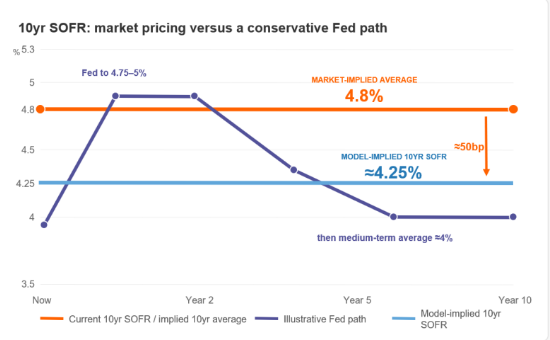 With strong intervention, the 10-year yield is expected to reach 4%. If the Treasury Department implements policies to suppress long-term yields, the path will be two-step: 1. First stage: Push the 10-year Treasury yield to match the SOFR rate, with the yield falling by 40 basis points; 2. Second stage: The policy will drive the 10-year SOFR rate down by about 50 basis points. In total, the 10-year Treasury yield will fall by about 100 basis points, from the current 5.25% to 4.25%, matching the SOFR rate; it may even fall another 25 basis points. This is the logic behind Treasury Secretary Bessant's theoretical ability to push the 10-year Treasury yield to 4%. Of course, a more moderate outcome—the yield steadily falling below 5%—is also an acceptable scenario. Whether this policy is more beneficial or detrimental is another question. Our view is that only when there is a specific sell-off in US Treasury bonds and a sharp widening of swap spreads will aggressive policies be justified (we are not predicting this scenario, but only making a projection). In this case, intervention can be seen as a way to control risk losses for the real economy. Outside of a crisis environment, such "bazooka-style" forceful intervention, from the perspective of long-term policy credibility, may actually do more harm than good.
US Treasury Secretary Bessant possesses policy tools to lower the 10-year Treasury yield, including expanding bond repurchase operations and suspending long-term Treasury bond issuance. This article proposes a scenario: the US Treasury implements substantial policies targeting the long end of the yield curve, aiming to lower yields. We believe there is currently no need to implement such policies, as the Treasury yield is not abnormally high relative to the Secured Overnight Financing Rate (SOFR). Even if the Treasury intervenes, such as expanding repurchase operations or suspending 20-year Treasury bond issuance, the policy effect will likely be limited to narrowing swap spreads and strengthening the Treasury yield relative to interest rate swaps. A significant impact on the interest rate market would require a more forceful and widespread suspension of long-term Treasury bond issuance. Theoretically, such operations would not affect the SOFR rate, but the current 10-year SOFR rate is already about 50 basis points above a reasonable level. On the positive side, proactive Treasury intervention in the bond market could potentially drive a significant drop in long-term SOFR rates. In an extreme scenario, a combination of policies could potentially push the 10-year Treasury yield back towards the 4% mark. We do not predict this will happen, nor do we recommend implementing such policies. However, various indications suggest that the US Treasury may be considering similar options, but will most likely choose a more moderate version. This is unless there is a genuine sell-off in the US Treasury market—the last one being the "sell-off of America" the week after "Liberation Day." Only with such market turmoil would aggressive intervention have a stronger rationale, aiming to mitigate greater risks arising from the debt path and the real economy. The SOFR curve constitutes the theoretical lower bound for US Treasury yields. First, let's clarify a core point: the formation logic of the 10-year US Treasury yield is rather obscure and allows for subjective interpretation; however, the 10-year SOFR rate can be calculated using mathematical models. This is crucial, as it defines what the Treasury can and cannot do when managing long-term yields. Why is the 10-year SOFR rate a mathematical derivation? All swap dealers will tell you that this rate breaks even on swap transactions and matches the market's expected path for the federal funds rate. The 10-year fixed swap rate equals the average discounted floating rate over the swap's term. We cannot accurately predict the future trend of the federal funds rate, therefore we use market discount pricing as a fair expected path. The SOFR curve represents the risk-free interest rate curve. This risk-free interest rate curve is driven by the market discount level, with the core variable being the inflation trend and the real interest rate needed in the future under the corresponding inflationary environment. Each term corresponds to inflation expectations and the appropriate real interest rate over a period of time, both of which are determined by macroeconomic fundamentals: inflation is determined by supply and demand, while the real interest rate depends on productivity and real economic growth. US Treasury yields are based on the SOFR curve, forming a spread . We haven't mentioned the US fiscal deficit yet, because it's not necessary for theoretical analysis. The fiscal deficit affects real interest rates and inflation, but in reality, the size of the fiscal deficit, the pressure of bond issuance, and the overall debt situation determine the premium of US Treasury yields relative to the risk-free SOFR curve, i.e., the swap spread. If the US still maintains its AAA highest credit rating, US Treasury yields should be in line with the SOFR curve. However, this is not the case in reality; US Treasury yields are higher than the SOFR curve, forming a swap spread. Currently, the 10-year swap spread is slightly below 40 basis points, while the 30-year swap spread is 65 basis points. This reflects the risk premium the Treasury needs to pay due to the deteriorating US fiscal situation. Understanding this difference is crucial for assessing the Treasury's ability to manage long-term interest rates. What the Treasury can attempt is to compress swap spreads; methods include bond repurchase agreements and reducing the issuance of long-term bonds. Following the recent increase in the scale of US Treasury repurchase agreements, long-term swap spreads have narrowed. Therefore, we do not agree with the common claim that "repurchase policies are ineffective"—although long-term yields have not declined, the narrowing of long-term swap spreads indicates that repurchase agreements have been effective. Credit fundamentals and supply and demand determine the pricing of US Treasuries relative to SOFR, i.e., the swap spread. (Theoretically, fiscal deficits will disrupt real interest rates and inflation; however, the premium of US Treasury bonds relative to the risk-free benchmark SOFR is mainly determined by the pressure of bond issuance supply and the size of the debt. If the US still had AAA credit rating, US Treasury yields would completely overlap with SOFR; in reality, the US credit rating is no longer AAA, and US Treasury yields are generally higher than SOFR; the longer the maturity, the larger the swap spread: about 40bp for 10-year bonds and about 65bp for 30-year bonds.) Measures the Treasury can take, and policy constraints: If the Treasury is determined to deeply intervene in the long-term yield curve, it can further intensify its efforts. In an extreme scenario, it could suspend all bidding for 10-year, 20-year, and 30-year Treasury bonds in the foreseeable future, coupled with increased long-term bond repurchases, directly achieving an absolute reduction in the size of the outstanding long-term debt. If this operation is implemented, the long-term US Treasury yield will converge towards the SOFR rate, and may even fall below the SOFR curve, meaning the US Treasury yield will be lower than the SOFR rate. However, this policy will bring a practical problem: during the Fed's interest rate hike cycle, the reduction in long-term bond issuance necessitates a significant increase in the supply of short-term Treasury bills. This upgraded version of "Operation Twist" will not be implemented unless absolutely necessary. In the current environment, we haven't reached that point yet, primarily because swap spreads haven't spiraled out of control. Simply expanding repurchase agreements or suspending, for example, 20-year Treasury bond auctions would be sufficient to further narrow swap spreads, without needing such aggressive measures. Therefore, at this stage, moderate policies are more likely to be implemented. Let's consider an extreme crisis scenario: suppose the 10-year swap spread surges to 100 basis points, or even 200 basis points. Sounds extreme? But it's important to know that so far, the market hasn't experienced a truly violent sell-off of US Treasuries. If that were to happen, US Treasury yields would rise independently, significantly widening the spread relative to the SOFR curve. At that point, the Treasury would have a reason to intervene, aiming to compress long-term swap spreads and push US Treasuries relative to swaps to strengthen again. With sufficiently strong intervention, US Treasury yields could fall below the SOFR rate, but only with the high-intensity policies described earlier. Why is the SOFR rate itself already at a relatively high level? What about the SOFR rate itself? This should be the bottom for US Treasury yields. There's bad news and good news. The bad news: the current 10-year SOFR rate is 4.8%, high due to relatively high real interest rates; and a decline in real interest rates often accompanies a weakening real economy. The good news: the current 10-year SOFR already reflects the market's pricing of the Fed raising interest rates to 4.75%-5%, and the average interest rate remaining within this range over the next ten years (average around 4.8%, in line with the 10-year fixed rate). In our view, this market discount expectation is overly hawkish. Even if the federal funds rate rises to a high level, its long-term average will likely be far below 5%. Our simulations show that if the Fed raises rates to 4.75%-5%, maintains it for two years, and then conservatively cuts rates, with the medium-term average interest rate falling to 4%, then the 10-year SOFR rate should fall by about 50 basis points to around 4.25%, which is the level we consider reasonable for the 10-year SOFR. This also creates a favorable window for policy intervention: the market's over-pricing of continued interest rate hikes has pushed up the 10-year SOFR. If the Treasury intervenes, there is an opportunity to correct this inflated pricing. If the market lowers its medium-term expectations for the federal funds rate, the 10-year SOFR could fall by 50 basis points. With strong intervention, the 10-year yield is expected to reach 4%. If the Treasury Department implements policies to suppress long-term yields, the path will be two-step: 1. First stage: Push the 10-year Treasury yield to match the SOFR rate, with the yield falling by 40 basis points; 2. Second stage: The policy will drive the 10-year SOFR rate down by about 50 basis points. In total, the 10-year Treasury yield will fall by about 100 basis points, from the current 5.25% to 4.25%, matching the SOFR rate; it may even fall another 25 basis points. This is the logic behind Treasury Secretary Bessant's theoretical ability to push the 10-year Treasury yield to 4%. Of course, a more moderate outcome—the yield steadily falling below 5%—is also an acceptable scenario. Whether this policy is more beneficial or detrimental is another question. Our view is that only when there is a specific sell-off in US Treasury bonds and a sharp widening of swap spreads will aggressive policies be justified (we are not predicting this scenario, but only making a projection). In this case, intervention can be seen as a way to control risk losses for the real economy. Outside of a crisis environment, such "bazooka-style" forceful intervention, from the perspective of long-term policy credibility, may actually do more harm than good.
- Risk Warning and Disclaimer
- The market involves risk, and trading may not be suitable for all investors. This article is for reference only and does not constitute personal investment advice, nor does it take into account certain users’ specific investment objectives, financial situation, or other needs. Any investment decisions made based on this information are at your own risk.