Gold Trading Alert: Fed's Dovish Stance Causes Oil Prices to Plunge, Gold Prices Stage a Comeback! Can it Reclaim $4300?
2026-09-30 07:50:16
On Tuesday (September 29), the international gold market experienced a dramatic reversal. After plunging nearly 4% on Monday, hitting a more than seven-week low, spot gold rebounded strongly by over 1.5% on Tuesday, briefly rising back above $4,180. On the surface, this appears to be a technical correction driven by short covering; however, at a deeper level, it's the result of a combination of factors: falling oil prices, cooling expectations of a Fed rate hike, a pullback in US Treasury yields, and the ongoing US-Iran negotiations. However, gold prices remain well below the 100-day moving average of $4,288, with the expectation of a rate hike this year hanging like a sword of Damocles, and limited progress in US-Iran negotiations. While gold bulls have gained a breather, it's far from time to celebrate victory. On Wednesday (September 30) in early Asian trading, spot gold traded in a narrow range, currently at $4,183.85 per ounce. 
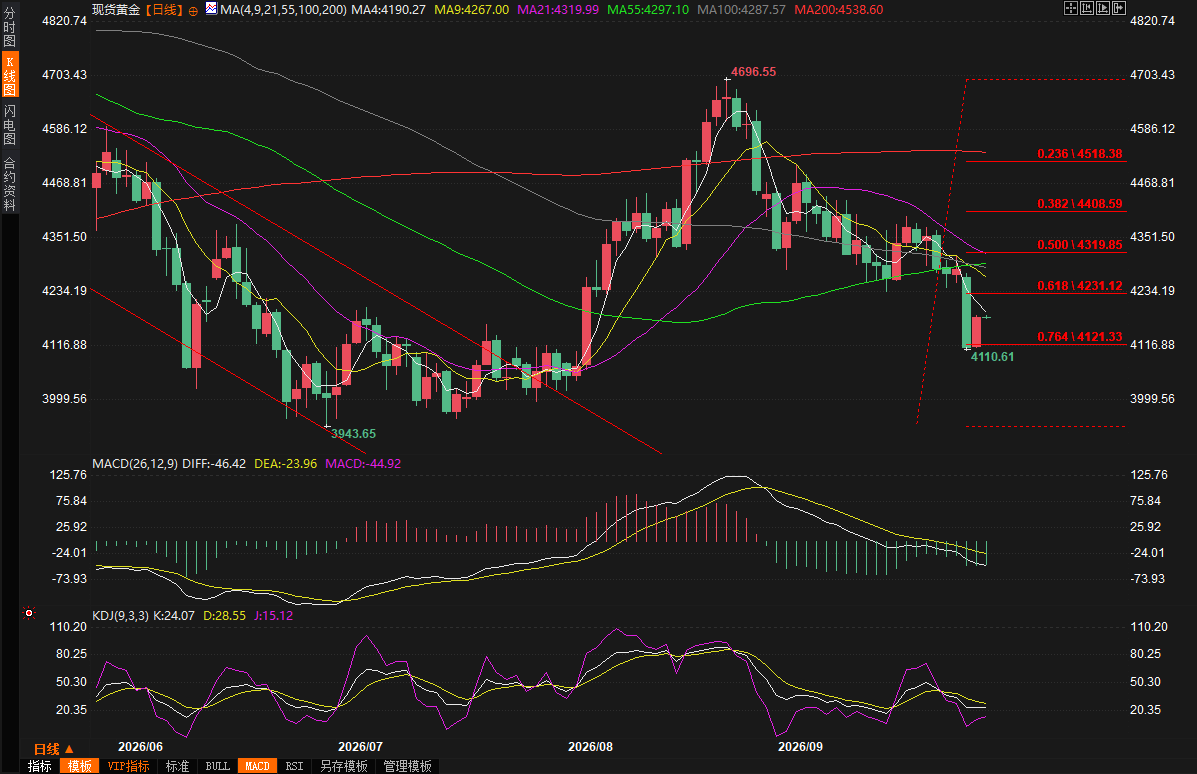 (Spot gold daily chart, source: FX678) At 07:46 Beijing time, spot gold is currently trading at $4282.92 per ounce.
Gold prices have rebounded from a seven-week low; is this a rebound or a reversal?
Spot gold rose 1.6% on Tuesday to settle at $4,181.59 an ounce. The day's low was $4,113.52, slightly above Monday's more than seven-week low of $4,110.61. U.S. gold futures rose about 0.3% to settle at $4,179.70. This rebound came after gold prices fell nearly 4% in the previous session, recording their biggest one-day drop since June 10 and hitting their lowest level since August 5. In other words, Tuesday's rise was more of a correction to panic selling than a complete trend reversal. Peter Grant, vice president and senior metals strategist at Zaner Metals, noted, "Tuesday's move was just a correction to yesterday's decline. I still think gold faces some fairly significant headwinds." He pointed out that rising market expectations for further Fed rate hikes continue to support the dollar, and yields remain high, thus potentially limiting upside for gold. The market will now closely watch Wednesday's personal consumption expenditure (PCE) inflation data and Friday's employment data. It can be said that the strength of the short-term rebound in gold will be directly tested by these two key data points.The plunge in oil prices eased inflation concerns, but uncertainties remain in the US-Iran rivalry.
The first driver of the gold price rebound came from the oil market. On Tuesday, Brent crude futures closed down $2.69, or 2.6%, at $102.59 a barrel; U.S. crude futures closed down $3.22, or 3.5%, settling at $89.38 a barrel. Although Brent crude is still on track to rise about 13% this month and U.S. crude is on track to rise about 4%, the price drop on Tuesday significantly eased market concerns about energy prices pushing up inflation. The release of U.S. strategic petroleum reserves, the resumption of Saudi Arabia's East-West pipeline operation which has allowed tankers to load oil from the Red Sea port of Yanbu, and the recovery of Middle Eastern oil-producing countries' crude oil exports to 16.328 million barrels per day in September, the highest level since the start of the U.S.-Israel war in Iraq at the end of February—these signs have improved the outlook for oil supply, thus weakening gold's short-term appeal as an inflation hedge, but also indirectly easing the pressure on central banks to maintain high interest rates. However, the U.S.-Iran situation remains unpredictable. US President Trump denied making any demands on Iran and refuted media reports that he was willing to ease sanctions and unfreeze funds in exchange for concrete action from Iran on its nuclear program. Iranian President Peskov stated that Tehran was prepared to negotiate on its nuclear program and other issues, but would not accept "bullying or coercion," emphasizing that Iran did not seek war but would defend itself against pressure, threats, and attacks. Iranian Foreign Minister Araqchi stated that only diplomatic means could resolve the conflict, and the proposed agreement would set a seven-day countdown to reopening the Strait of Hormuz and suspending regional hostilities. Mediators are pushing for a renewed US-Iran agreement; a preliminary draft proposes that Iran allow free passage of ships through the Strait of Hormuz in exchange for the US lifting its blockade of Iranian ports. Subsequent measures may include restoring oil waivers, allowing Iran to sell oil, unfreezing some overseas assets, and allowing IAEA inspectors to return to Iran. However, sources have poured cold water on this. AXIOS, citing three sources familiar with the negotiations, reported that Qatari mediators attempted to push for a diplomatic breakthrough this week, but progress was minimal, with neither side willing to concede. A source said that Monday's negotiations made no significant progress and have reached a stalemate; Iran has made some demands that are unacceptable to the US, while the US believes it has the upper hand and sees no need to compromise. US officials even believe that Trump may order the resumption of large-scale military operations after the midterm elections. This stalemate means that geopolitical risks have not disappeared, and safe-haven buying of gold could be reignited at any time. However, the recent drop in oil prices has cooled inflation trading, leaving gold in a tug-of-war between bulls and bears.Amidst internal hawkish and dovish sentiment within the Federal Reserve, expectations for an October rate hike have cooled sharply.
The second key driver of the gold price rebound came from dovish comments from Federal Reserve officials. New York Fed President Williams said on Tuesday that Fed policymakers may only need one more rate hike this year to push inflation back towards the 2% target. “There’s no need to rush things after our policy action at our September meeting,” he said at the University at Buffalo, New York. He stated that observing subsequent data releases before deciding on the next move “should help to understand the economy more clearly.” If the economy generally performs as he predicts, then another increase in the target range for the federal funds rate later this year might be appropriate. Financial markets quickly digested this unusually clear statement. According to the CME FedWatch tool, the market now sees the probability of a Fed rate hike in October at 49.6%, down from 68% the previous day; and the probability of a December rate hike at 91.5%, down from 95% the previous day. Traders quickly reduced their large bets on an October rate hike and now expect the Fed to raise rates only once more this year, most likely at the policy meeting in mid-December. However, the Fed is not monolithic. Fed Governor Barr reiterated on Tuesday that "further policy adjustments" are necessary after high energy prices and strong demand related to artificial intelligence caused inflation to deviate from its 2% target. Chicago Fed President Goolsby stated that inflation has been above the 2% target for five and a half years, which is tantamount to playing with fire; some evidence that inflation is falling is needed, otherwise, by definition, it is not temporary. However, he also indicated that he is among the more optimistic Fed officials and expects an eventual rate cut. St. Louis Fed President Musaleem, speaking in London, emphasized the importance of central bank policymakers explaining their thinking to the public. A central bank that doesn't explain how or why it makes policy decisions leaves the public guessing, creating an additional uncertainty premium. Fed Chairman Warsh, in his first four months as chairman, has revealed little about his views on how interest rates should be adjusted, hoping financial markets will focus less on policymakers' rhetoric and more on economic data. Economists surveyed estimate that the annual inflation rate in August will reach 3.7%, nearly double the target level, as measured by the Fed's preferred metrics. Williams predicts that inflation will be around 3.5% by the end of this year, and will return to the target level in 2028 as price pressures ease next year. This delicate balance of "inflation still high but no rush to raise interest rates" allows gold to breathe, but also limits its upside potential.Bond Market and Data: Yields Rise and Fall, Awaiting PCE and Non-Farm Payrolls
The movement in the US Treasury market also provided a window for a gold rebound. The yield on the interest rate-sensitive two-year US Treasury note fell on Tuesday after dovish comments from Williams. The two-year Treasury yield fell 3.51 basis points to 4.889%, having touched 4.9596% earlier in the session, its highest level since May 2024. The 10-year Treasury yield rose 1.32 basis points to 5.255%, having touched 5.2932%, its highest level since mid-June 2007. The 30-year Treasury yield rose 3 basis points to 5.592%, having touched its highest level since June 2002 in early trading. The spread between the two-year and 10-year Treasury yields, an indicator of economic expectations, is currently positive 36.4 basis points. On the economic data front, a report from the Conference Board showed that the U.S. consumer confidence index fell to its lowest level in over 12 years in September, dropping 6.7 points to 81.9, the lowest since 2014 and far below economists' expectations of 89.2. Households expect the business environment and labor market to weaken over the next six months. Regarding the labor market, job openings fell to 7.08 million in August, compared to a market consensus of 7.23 million and 7.34 million in July. Padhraic Garvey, head of U.S. research at ING, stated that testing higher levels is currently the path of least resistance. The consumer confidence data released that morning was very poor, yet yields rose. He pointed to persistently high inflation, central bank interest rate hikes, and "alarmingly high" inflation-adjusted interest rates. Normally, weak consumer confidence is beneficial for the bond market, but this was not the case today. The market is simply testing upside potential because the reasons driving this trend remain clear. The final reading of the August personal consumption expenditure price index will be released on Wednesday, and the September non-farm payroll report will be released on Friday. These data will directly influence the Fed's next move and will also determine whether the gold rebound can continue.Gold Outlook: Mixed Outlook, Key Factors: Inflation and Employment
In summary, the gold market is currently in a phase of intense clashes between bullish and bearish factors. On the bearish side, the US dollar is rising, nearing multi-month highs, supported by oil price volatility and the recent rapid rise in US Treasury yields. A stronger dollar makes dollar-denominated gold more expensive for overseas buyers, while rising US Treasury yields increase the opportunity cost of holding non-yielding gold. At the same time, rising energy prices could exacerbate inflation, forcing central banks to maintain higher interest rates. Gold prices remain well below the 100-day moving average of $4288, and expectations of a rate hike this year continue to weigh on bullish sentiment. Although US-Iran negotiations have resumed, progress has been limited, with neither side willing to concede. Once the situation eases, oil prices may fall further, inflation concerns will continue to cool, and gold's safe-haven premium will weaken. On the bullish side, expectations for a Fed rate hike in October have cooled sharply, US Treasury yields have retreated from their highs, and weak consumer confidence and job openings data have made the market more cautious about betting on further tightening. If Wednesday's PCE inflation data falls short of expectations, or Friday's non-farm payroll data is weak, the market may further lower its probability of an interest rate hike, potentially causing the dollar and US Treasury yields to decline. Gold could continue its rebound, even challenging the 100-day moving average of $4,288. Conversely, if inflation data exceeds expectations again, and hawkish expectations from the Fed resurface, gold prices could retest support around $4,110, or even hit a more than seven-week low. Peter Grant warned, "I think the upside potential for gold prices may be somewhat limited." Tuesday's rebound in gold was a corrective rally driven by short covering, falling oil prices, and dovish comments, but it has not yet formed a trend reversal. For investors, the current gold market presents both opportunities and risks; the most crucial factor is closely monitoring the latest developments in the PCE, non-farm payroll, and US-Iran negotiations. (Spot gold daily chart, source: FX678) At 07:46 Beijing time, spot gold is currently trading at $4282.92 per ounce.
- Risk Warning and Disclaimer
- The market involves risk, and trading may not be suitable for all investors. This article is for reference only and does not constitute personal investment advice, nor does it take into account certain users’ specific investment objectives, financial situation, or other needs. Any investment decisions made based on this information are at your own risk.