A strong US dollar and expectations of a Federal Reserve rate hike put pressure on silver, with XAG/USD falling back to around $61.
2026-09-30 15:04:18
On Wednesday during Asian trading hours, spot silver (XAG/USD) came under renewed selling pressure, with prices falling back to around $61.00 after encountering resistance near $61.75, a daily decline of approximately 0.70%. Silver had previously rebounded from around $60.30, but the recovery was short-lived as the market returned to caution ahead of key US economic data releases.  Silver's recent price movements have been significantly influenced by changes in the US dollar and expectations of US interest rates. The US dollar index remains high, Federal Reserve officials have signaled further tightening of policy, and US Treasury yields remain high, putting significant holding cost pressure on silver, which does not generate interest income. The market is currently awaiting the US Personal Consumption Expenditures Price Index (PCE) and the final reading of US Q2 GDP. The PCE is one of the key inflation indicators monitored by the Federal Reserve. If inflation data is higher than market expectations, it may strengthen expectations that the Fed will continue its restrictive policy or even raise interest rates further, thus pushing the dollar and US Treasury yields higher, further suppressing silver. Conversely, if the PCE shows easing inflationary pressures while GDP data is weaker than expected, the market may reduce its bets on further Fed tightening, leading to a temporary correction in the dollar's strength, and silver may have some room for a rebound. Currently, the core contradiction for silver remains the strong dollar and interest rate environment, while the technical rebound has not yet formed a trend reversal signal. The previous rebound from around $60.30 is more of a correction after an oversold condition than a new upward trend. From a technical perspective, the 4-hour MACD has just turned slightly positive, indicating a slight easing of short-term downward momentum, but the rebound signal remains weak. Meanwhile, the RSI remains around 35, in relatively weak territory, suggesting the market is still under bearish pressure. The price structure also shows dense resistance above. The $61.80 to $61.85 area initially forms short-term resistance, followed by the psychological level of $62.00. A more crucial area lies between $62.20 and $62.25, which previously served as significant horizontal support but has now become resistance. If silver fails to regain a foothold at this level, the recent weakness may continue. If the price can break through $62.20 to $62.25, the market may further test the 4-hour 200-period EMA, currently around $64.28. This moving average is a crucial technical level for determining whether the short-to-medium-term trend can significantly improve; only a successful recovery would significantly alleviate the overall bearish structure of silver. Looking at the downside, the area around $60.30 is the most immediate support level and the starting point of the recent rebound. If this level is breached, the psychological level of $60.00 will become the next point to watch. If $60.00 is also effectively broken, silver may fall further to the $59.40-$59.35 range, followed by the $59.00 area. If the decline extends further, the bears may target the $57.00 level and further test the August monthly lows around $56.60-$56.55. At that point, the market will need to reassess whether silver has entered a deeper trend correction. From a fundamental perspective, silver possesses both precious metal and industrial metal attributes, so in addition to the US dollar and interest rates, global economic growth expectations will also affect its performance. If US economic data continues to show resilience and the Federal Reserve maintains higher interest rates for a longer period, silver may continue to face dual pressures; if economic activity slows significantly and leads to a decline in interest rate expectations, its precious metal attributes may be strengthened again. In the short term, the importance of US PCE inflation data has increased significantly. If inflation data remains high, silver may retest the $60.30 support level; if inflation cools significantly and pushes the dollar lower, the $61.80 to $62.25 area will be key to determining whether the rebound can extend.
 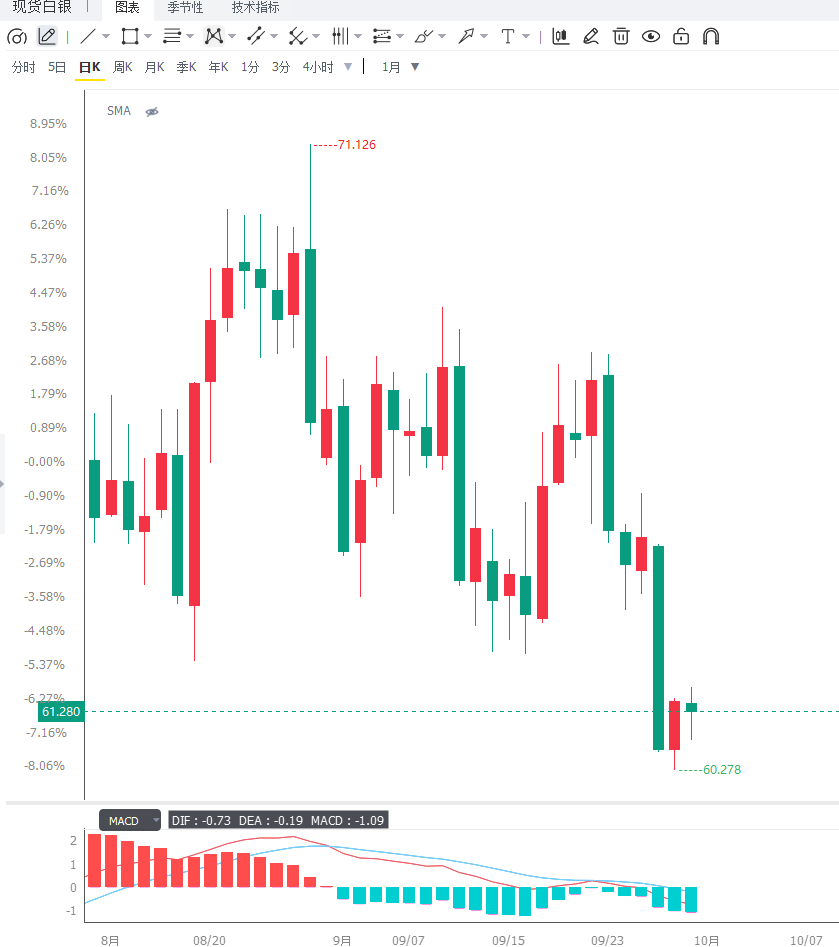 Editor's Summary: Spot silver is currently in a phase of interaction between a strong US dollar, high US interest rate expectations, and a technical oversold rebound. The $60.30 level is providing temporary support, but there is significant resistance in the $61.80 to $62.25 area, meaning the short-term rebound still faces considerable pressure. Future price movements will heavily depend on US PCE inflation and GDP data. If inflation remains high and expectations for further tightening by the Federal Reserve increase, silver may retest $60.30 or even lower; if inflation cools and leads to a decline in the dollar and US Treasury yields, silver is expected to extend its technical recovery. The $62.20 to $62.25 area is currently a key zone for judging whether the short-term trend can improve, while $60.00 and $59.40 to $59.35 are important risk levels to watch.
Silver's recent price movements have been significantly influenced by changes in the US dollar and expectations of US interest rates. The US dollar index remains high, Federal Reserve officials have signaled further tightening of policy, and US Treasury yields remain high, putting significant holding cost pressure on silver, which does not generate interest income. The market is currently awaiting the US Personal Consumption Expenditures Price Index (PCE) and the final reading of US Q2 GDP. The PCE is one of the key inflation indicators monitored by the Federal Reserve. If inflation data is higher than market expectations, it may strengthen expectations that the Fed will continue its restrictive policy or even raise interest rates further, thus pushing the dollar and US Treasury yields higher, further suppressing silver. Conversely, if the PCE shows easing inflationary pressures while GDP data is weaker than expected, the market may reduce its bets on further Fed tightening, leading to a temporary correction in the dollar's strength, and silver may have some room for a rebound. Currently, the core contradiction for silver remains the strong dollar and interest rate environment, while the technical rebound has not yet formed a trend reversal signal. The previous rebound from around $60.30 is more of a correction after an oversold condition than a new upward trend. From a technical perspective, the 4-hour MACD has just turned slightly positive, indicating a slight easing of short-term downward momentum, but the rebound signal remains weak. Meanwhile, the RSI remains around 35, in relatively weak territory, suggesting the market is still under bearish pressure. The price structure also shows dense resistance above. The $61.80 to $61.85 area initially forms short-term resistance, followed by the psychological level of $62.00. A more crucial area lies between $62.20 and $62.25, which previously served as significant horizontal support but has now become resistance. If silver fails to regain a foothold at this level, the recent weakness may continue. If the price can break through $62.20 to $62.25, the market may further test the 4-hour 200-period EMA, currently around $64.28. This moving average is a crucial technical level for determining whether the short-to-medium-term trend can significantly improve; only a successful recovery would significantly alleviate the overall bearish structure of silver. Looking at the downside, the area around $60.30 is the most immediate support level and the starting point of the recent rebound. If this level is breached, the psychological level of $60.00 will become the next point to watch. If $60.00 is also effectively broken, silver may fall further to the $59.40-$59.35 range, followed by the $59.00 area. If the decline extends further, the bears may target the $57.00 level and further test the August monthly lows around $56.60-$56.55. At that point, the market will need to reassess whether silver has entered a deeper trend correction. From a fundamental perspective, silver possesses both precious metal and industrial metal attributes, so in addition to the US dollar and interest rates, global economic growth expectations will also affect its performance. If US economic data continues to show resilience and the Federal Reserve maintains higher interest rates for a longer period, silver may continue to face dual pressures; if economic activity slows significantly and leads to a decline in interest rate expectations, its precious metal attributes may be strengthened again. In the short term, the importance of US PCE inflation data has increased significantly. If inflation data remains high, silver may retest the $60.30 support level; if inflation cools significantly and pushes the dollar lower, the $61.80 to $62.25 area will be key to determining whether the rebound can extend. Editor's Summary: Spot silver is currently in a phase of interaction between a strong US dollar, high US interest rate expectations, and a technical oversold rebound. The $60.30 level is providing temporary support, but there is significant resistance in the $61.80 to $62.25 area, meaning the short-term rebound still faces considerable pressure. Future price movements will heavily depend on US PCE inflation and GDP data. If inflation remains high and expectations for further tightening by the Federal Reserve increase, silver may retest $60.30 or even lower; if inflation cools and leads to a decline in the dollar and US Treasury yields, silver is expected to extend its technical recovery. The $62.20 to $62.25 area is currently a key zone for judging whether the short-term trend can improve, while $60.00 and $59.40 to $59.35 are important risk levels to watch.
- Risk Warning and Disclaimer
- The market involves risk, and trading may not be suitable for all investors. This article is for reference only and does not constitute personal investment advice, nor does it take into account certain users’ specific investment objectives, financial situation, or other needs. Any investment decisions made based on this information are at your own risk.