The 5.4% yield, moving in tandem with the pound, provides the answer: revised growth figures are not a pass-through for easing.
2026-09-30 15:58:17
On Wednesday, September 30th, the UK released its final quarterly national accounts GDP figures for the second quarter. Real output was revised upwards to 0.5% quarter-on-quarter, 0.1 percentage points higher than the initial estimate; the first quarter figure remained unchanged at 0.6%. Compared to the second quarter of 2025, real output is projected to grow by 1.2% year-on-year. The full-year growth forecast for 2025 was also revised downwards to 1.2%. On the day of the final figures release, the pound sterling traded within the low range of late September against the dollar, and the yield on 10-year gilts hovered around 5.4%. Market focus was not on the magnitude of the revisions themselves, but rather on how this more complete growth picture would fit into the Bank of England's already revised upward near-term inflation path. 
 A more useful observation framework is weighted: growth revisions validate demand resilience, the inflation path determines the policy response function, and the energy term structure determines the near-term price slope. When these three pieces of information are out of sync, the exchange rate and gilt-edged bonds exhibit impulses rather than trend shifts. The final figures depict the UK's first half of 2026 as two consecutive quarters of positive growth, but bring policy discussions back to the original range of "moderate activity, upward revision of near-term prices, and weak evidence of a second-round effect."
The modification to the final value refers to the structure, not the slope.
The upward revision for the second quarter was limited, but it clarified the composition of output. Service sector output grew 0.6% quarter-on-quarter and 1.7% year-on-year, primarily driven by professional, scientific, and technological activities. Construction grew 0.8% quarter-on-quarter, while the production sector declined 0.1% quarter-on-quarter. On the expenditure side, household consumption grew 0.3% quarter-on-quarter, and gross fixed capital formation grew 0.9% quarter-on-quarter, with business investment growing 1.8% quarter-on-quarter and 5.2% year-on-year. Exports grew 2.8%, imports remained flat, and net exports made a positive contribution to quarterly growth. Real per capita household disposable income rebounded 1.0% quarter-on-quarter, and the savings rate rose to 8.8%. The Director of the Economic Statistics Department of the statistical agency pointed out that this release incorporates improved annual methodology and more complete service sector information. The full-year growth rate for 2025 is slightly lower than previously estimated, and the quarterly trajectory has also been revised. However, the service sector is stronger in the latest quarter, making the economic size slightly higher than previously estimated. The main reasons for the revision are the supplementary monthly enterprise survey, the first quarter's VAT revenue, and adjustments to the blue book methodology, rather than a sudden acceleration in demand.Growth resilience and energy shocks coexist within the same set of constraints.
To understand its position, we need to place the final Q2 figure back into the policy framework. The Bank of England's September meeting maintained the interest rate at 3.75% by a 6-3 vote, with three members advocating for an increase to 4%. At that time, the committee was still using the initial Q2 figure of 0.4%. The assessment at the time was that activity was slightly stronger than expected, with monthly output growth of 0.4% in July, and the Q3 output forecast revised upward from 0.1% in July to 0.4%. The final figure of 0.5% aligns with this assessment but does not exceed the committee's already acknowledged "better than expected." Energy is truly reshaping near-term pricing. Following the protracted Middle East conflict, Brent crude and UK wholesale natural gas prices rose significantly compared to the July report, and consumer prices rose to 3.1% year-on-year in August. Based on mid-September energy prices, year-on-year inflation may rise to approximately 3.75% in Q4 2026 and slightly above 4% in Q1 2027. The energy component has already explained a significant portion of the overshoot above the target. The increase in the household energy price cap will continue to be reflected in the index in Q4. A more complete growth account only indicates that demand under restrictive interest rates has not collapsed, and cannot offset the first round of energy transmission.Bailey describes the tradeoff as a function of time, not a function of point values.
In an interview following the Bank of England's September 17th policy decision, Governor Bailey stated that the direct impact of energy prices was undeniable, and while the transmission to broader prices and wages remained restrained, it was "too early." He added that the longer the conflict persisted and energy prices remained high, the more difficult it would be to maintain the current stance. On September 25th, he further stated that policymakers could not wait for full evidence of a second-round effect before acting, otherwise it would be too late; "We haven't raised bank rates yet, but the longer energy prices remain high, the more difficult it will be to maintain this stance." This aligns with the committee's published text: domestic price pressures in the UK continued to ease, the labor market was relatively loose, private sector regular wages were around 2.9% year-on-year, and service sector inflation was 3.4% in August; meanwhile, household and business inflation expectations were sensitive to energy prices. The next interest rate decision is scheduled for November 5th. The final Q2 figures reinforced the premise that "the activity side has not collapsed," without altering the constraint that "the near-term inflation path has been inflated by energy prices." Market pricing for the November meeting will still primarily follow energy futures, price breakdowns, and wages, rather than a closed quarterly account.Exchange rates and gilt-edged bonds reflect policy weighting, not revision symbols.
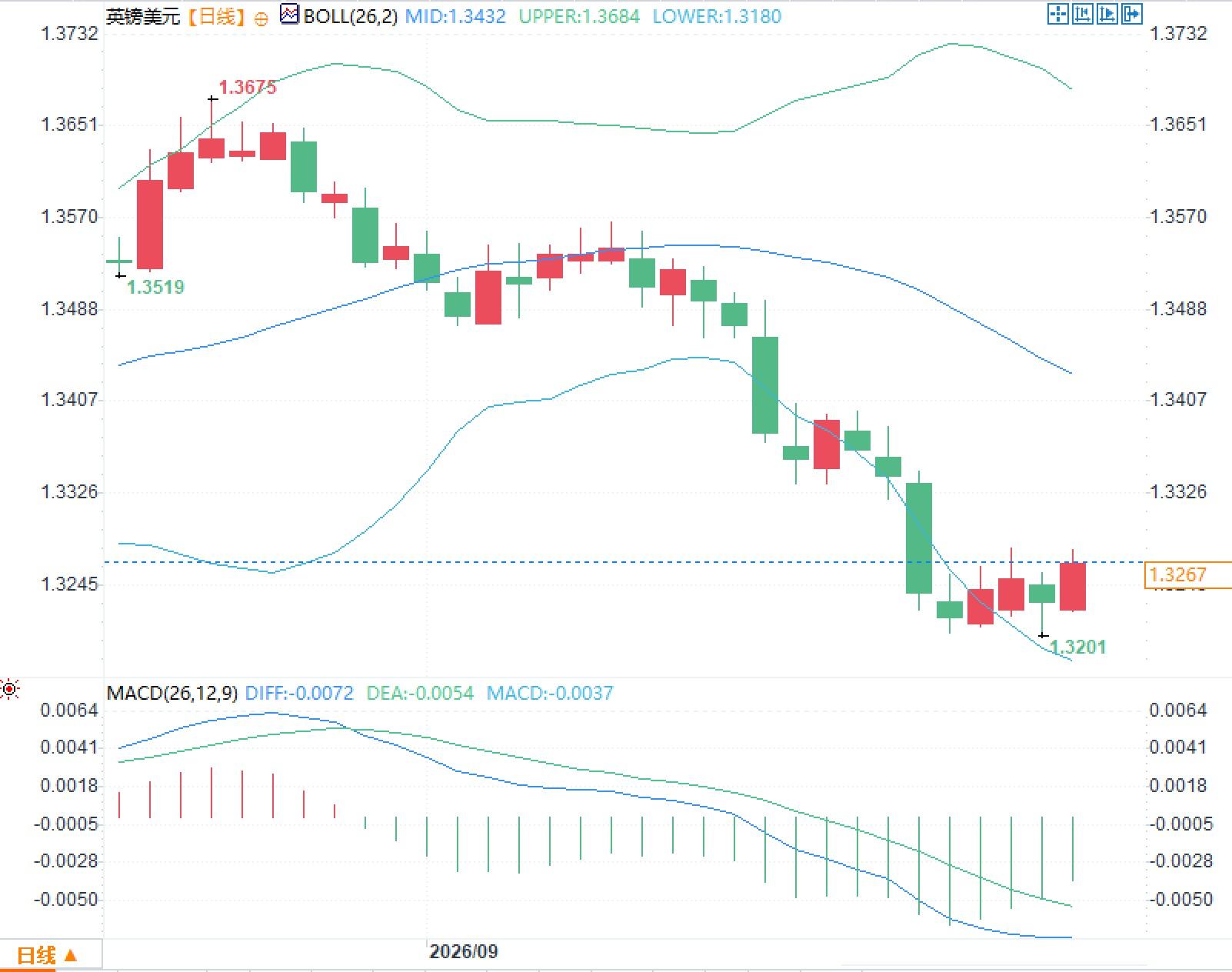
After retreating from its relative highs in September, the GBP/USD daily chart shows the price trading near the lower Bollinger Band, with the middle band trending downwards and the band initially widening before narrowing. The MACD is below the zero line, with both the DIFF and DEA values negative, and the histogram remaining green. On the gilt side, the 10-year yield has recently fluctuated between 5.37% and 5.41%, with the short end anchored by bank interest rates, while the long end reflects more of the term premium and expectations for fiscal financing. The UK budget in late October will provide a public financing path, which, along with price data, constitutes a more significant pricing variable than the final GDP figure. A more useful observation framework is weighted: growth revisions validate demand resilience, the inflation path determines the policy response function, and the energy term structure determines the near-term price slope. When these three pieces of information are out of sync, the exchange rate and gilt-edged bonds exhibit impulses rather than trend shifts. The final figures depict the UK's first half of 2026 as two consecutive quarters of positive growth, but bring policy discussions back to the original range of "moderate activity, upward revision of near-term prices, and weak evidence of a second-round effect."
- Risk Warning and Disclaimer
- The market involves risk, and trading may not be suitable for all investors. This article is for reference only and does not constitute personal investment advice, nor does it take into account certain users’ specific investment objectives, financial situation, or other needs. Any investment decisions made based on this information are at your own risk.