Expectations of further interest rate hikes by the Federal Reserve are rising, pushing the dollar index to around 101.40 and on track for its biggest monthly gain in 14 months.
2026-09-30 15:06:21
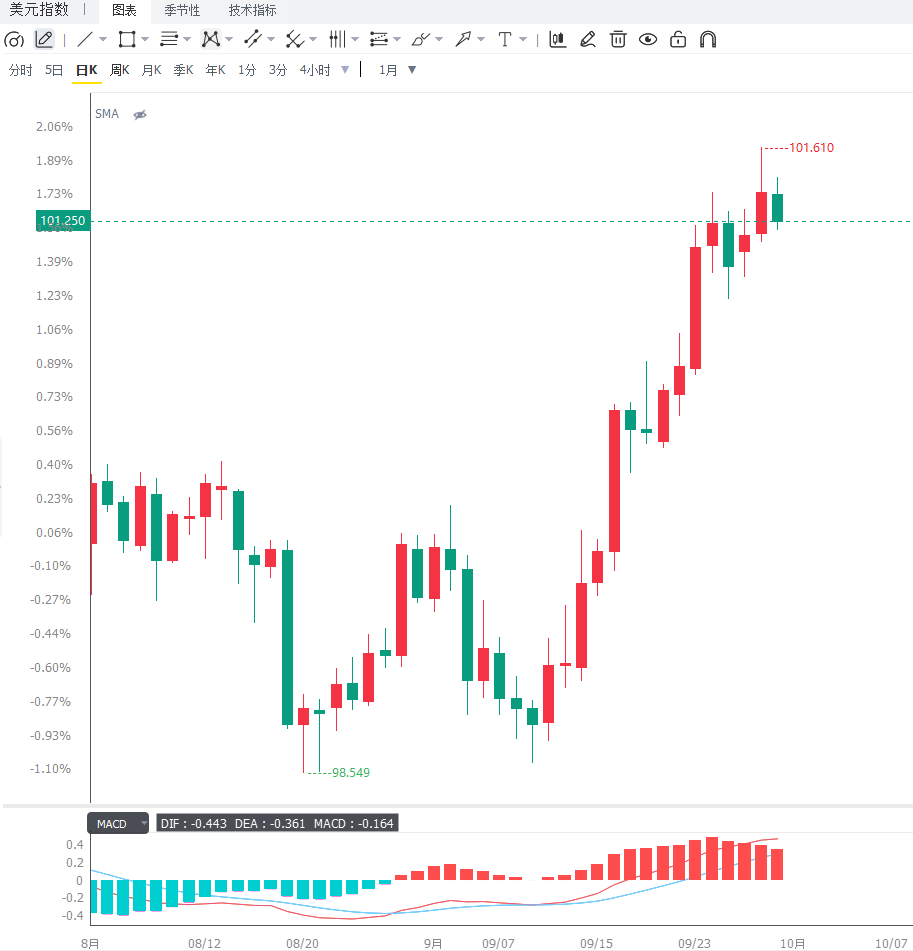
On Wednesday morning in Europe, the US dollar index (DXY) traded around 101.40, continuing its recent strong performance. As market expectations for further interest rate hikes by the Federal Reserve intensify, the dollar gains further support from its interest rate advantage, and the index is on track for its biggest monthly gain in 14 months. Meanwhile, persistently high US Treasury yields further enhance the attractiveness of dollar-denominated assets.  Recent policy statements from Federal Reserve officials have significantly strengthened market focus on further interest rate hikes. Chicago Fed President Goolsby stated that persistently high inflation above the Fed's target is a cause for concern and may require further monetary policy action. Fed Governor Barr pointed out that further rate hikes may still be needed to reduce inflationary pressures. New York Fed President John Williams similarly stated that another rate hike this year could help curb inflation, but he emphasized that there is no immediate urgency to take action after the Fed's rate hike this month. These statements collectively constitute an important fundamental backdrop to the recent strengthening of the US dollar. Market focus has gradually shifted from "whether the Fed will continue to raise rates" to "how much further policy tightening is needed," and changes in interest rate expectations are being transmitted to the dollar market through US Treasury yields. According to the CME FedWatch tool, current market pricing shows a 47.1% probability of a Fed rate hike in October and a 92.5% probability in December. This means that investors' expectations for further policy tightening in December are significantly higher than in October, and the dollar can still find support in the short term from higher policy rate expectations. However, the continued rise of the US dollar also means that the market has already priced in some of the positive factors. Whether future economic data can continue to support expectations of interest rate hikes will determine whether the current upward trend of the dollar can continue. Wednesday's US ADP employment data and Personal Consumption Expenditures Price Index (PCE) will be important catalysts for the short-term market. If the employment data is strong and PCE inflation is higher than expected, the market may further increase its pricing of a Fed rate hike, and the dollar index and US Treasury yields may continue to be supported. Conversely, if both employment and inflation data cool down, profit-taking accumulated from the recent large gains in the dollar may push the index into a technical correction. Another key data that truly determines the market direction is the US September non-farm payrolls report to be released on Friday. The market currently expects the US to add about 90,000 non-farm jobs in September, with the unemployment rate remaining at 4.1%. If actual job growth is significantly higher than expected, the risk of the Fed further tightening policy may rise again. OCBC analysis believes that this week's US employment report is one of the most important risk events for the market. The four-week average of initial jobless claims has remained relatively stable recently, indicating that the labor market has not deteriorated significantly, making the risk of an upward surprise in the non-farm payrolls data worth noting. If employment data significantly exceeds expectations, US Treasury yields may remain high, further supporting the dollar. Inflation remains a core issue for the Federal Reserve's policy. Recent remarks by Barr indicate that the Fed remains vigilant about the risk of renewed inflation, while believing that economic growth and the labor market still possess a certain degree of resilience. Improved economic growth, a stable job market, and expectations of medium-term productivity improvements driven by artificial intelligence have provided some support for the US economy, but the insufficient pace of inflation decline still limits the Fed's room for policy easing. The core drivers of the dollar have now formed a transmission chain of "inflation risk—Fed rate hike expectations—US Treasury yields—dollar." As long as this chain does not reverse significantly, the dollar index may remain strong in the short term. However, technical indicators show that the dollar's rise has entered overbought territory. The daily Relative Strength Index (RSI) of the dollar index has risen to 71.57, entering overbought territory, meaning that upward momentum remains strong, but short-term volatility risks are also increasing. If subsequent economic data fails to further strengthen rate hike expectations, the dollar may experience some profit-taking. From a market sentiment perspective, the US dollar is currently in a phase where both fundamentals and technicals are relatively strong, but there has been some divergence between the two: the fundamentals continue to be supported by expectations of interest rate hikes, while technical indicators suggest that the short-term gains have been quite substantial. Therefore, investors need to pay close attention to whether US data can provide new fundamental momentum for further dollar appreciation. From a daily chart perspective, the US dollar index maintains a clear bullish structure, with the price trading above the 100-day simple moving average and the middle Bollinger Band, currently in the upper half of the recent trading range. The RSI (14) rose to 71.57, entering the overbought zone, indicating that the bullish momentum remains strong, but the risk of chasing the rally in the short term has also increased. The first support level to watch is around the upper Bollinger Band at 101.95. If the index can effectively break through and hold this position, the strong structure is expected to continue. The initial support level is around the 100-day moving average at 100.10, and the middle Bollinger Band at 100.05 forms the second support level, with the two forming a relatively important short-term defensive zone. If support near 100.00 is breached, the correction could extend further, potentially seeking support near the lower Bollinger Band at 98.20. On the 4-hour chart, the US dollar index remains in an upward channel, with short-term moving averages trending upwards and the price consistently trading above major moving averages, indicating a continued bullish short-term trend. However, after continuous gains, momentum is concentrating at higher levels. If the 101.95 level cannot be effectively broken, short-term consolidation or even a technical pullback is possible. If the pullback holds above the 100.10-100.05 area, the bullish structure is likely to remain intact; however, a decisive break below this area warrants caution as the upward trend may enter a more pronounced correction phase.
  Editor's Summary: The US dollar index is currently supported by both expectations of further tightening by the Federal Reserve and high US Treasury yields. Fed officials' focus on inflation risks has further strengthened market pricing in subsequent interest rate hikes. ADP, PCE, and Friday's non-farm payroll data will be key to determining the dollar's next move. If US employment and inflation data continue to show resilience, expectations of a Fed rate hike may intensify further, and the dollar index is likely to continue testing resistance near 101.95. If the data is significantly weaker than expected, market bets on further rate hikes may cool, and the dollar will face profit-taking pressure at higher levels. Current technical indicators have entered overbought territory; therefore, while the fundamentals remain strong, the risk of increased short-term volatility in the dollar needs to be monitored.
Recent policy statements from Federal Reserve officials have significantly strengthened market focus on further interest rate hikes. Chicago Fed President Goolsby stated that persistently high inflation above the Fed's target is a cause for concern and may require further monetary policy action. Fed Governor Barr pointed out that further rate hikes may still be needed to reduce inflationary pressures. New York Fed President John Williams similarly stated that another rate hike this year could help curb inflation, but he emphasized that there is no immediate urgency to take action after the Fed's rate hike this month. These statements collectively constitute an important fundamental backdrop to the recent strengthening of the US dollar. Market focus has gradually shifted from "whether the Fed will continue to raise rates" to "how much further policy tightening is needed," and changes in interest rate expectations are being transmitted to the dollar market through US Treasury yields. According to the CME FedWatch tool, current market pricing shows a 47.1% probability of a Fed rate hike in October and a 92.5% probability in December. This means that investors' expectations for further policy tightening in December are significantly higher than in October, and the dollar can still find support in the short term from higher policy rate expectations. However, the continued rise of the US dollar also means that the market has already priced in some of the positive factors. Whether future economic data can continue to support expectations of interest rate hikes will determine whether the current upward trend of the dollar can continue. Wednesday's US ADP employment data and Personal Consumption Expenditures Price Index (PCE) will be important catalysts for the short-term market. If the employment data is strong and PCE inflation is higher than expected, the market may further increase its pricing of a Fed rate hike, and the dollar index and US Treasury yields may continue to be supported. Conversely, if both employment and inflation data cool down, profit-taking accumulated from the recent large gains in the dollar may push the index into a technical correction. Another key data that truly determines the market direction is the US September non-farm payrolls report to be released on Friday. The market currently expects the US to add about 90,000 non-farm jobs in September, with the unemployment rate remaining at 4.1%. If actual job growth is significantly higher than expected, the risk of the Fed further tightening policy may rise again. OCBC analysis believes that this week's US employment report is one of the most important risk events for the market. The four-week average of initial jobless claims has remained relatively stable recently, indicating that the labor market has not deteriorated significantly, making the risk of an upward surprise in the non-farm payrolls data worth noting. If employment data significantly exceeds expectations, US Treasury yields may remain high, further supporting the dollar. Inflation remains a core issue for the Federal Reserve's policy. Recent remarks by Barr indicate that the Fed remains vigilant about the risk of renewed inflation, while believing that economic growth and the labor market still possess a certain degree of resilience. Improved economic growth, a stable job market, and expectations of medium-term productivity improvements driven by artificial intelligence have provided some support for the US economy, but the insufficient pace of inflation decline still limits the Fed's room for policy easing. The core drivers of the dollar have now formed a transmission chain of "inflation risk—Fed rate hike expectations—US Treasury yields—dollar." As long as this chain does not reverse significantly, the dollar index may remain strong in the short term. However, technical indicators show that the dollar's rise has entered overbought territory. The daily Relative Strength Index (RSI) of the dollar index has risen to 71.57, entering overbought territory, meaning that upward momentum remains strong, but short-term volatility risks are also increasing. If subsequent economic data fails to further strengthen rate hike expectations, the dollar may experience some profit-taking. From a market sentiment perspective, the US dollar is currently in a phase where both fundamentals and technicals are relatively strong, but there has been some divergence between the two: the fundamentals continue to be supported by expectations of interest rate hikes, while technical indicators suggest that the short-term gains have been quite substantial. Therefore, investors need to pay close attention to whether US data can provide new fundamental momentum for further dollar appreciation. From a daily chart perspective, the US dollar index maintains a clear bullish structure, with the price trading above the 100-day simple moving average and the middle Bollinger Band, currently in the upper half of the recent trading range. The RSI (14) rose to 71.57, entering the overbought zone, indicating that the bullish momentum remains strong, but the risk of chasing the rally in the short term has also increased. The first support level to watch is around the upper Bollinger Band at 101.95. If the index can effectively break through and hold this position, the strong structure is expected to continue. The initial support level is around the 100-day moving average at 100.10, and the middle Bollinger Band at 100.05 forms the second support level, with the two forming a relatively important short-term defensive zone. If support near 100.00 is breached, the correction could extend further, potentially seeking support near the lower Bollinger Band at 98.20. On the 4-hour chart, the US dollar index remains in an upward channel, with short-term moving averages trending upwards and the price consistently trading above major moving averages, indicating a continued bullish short-term trend. However, after continuous gains, momentum is concentrating at higher levels. If the 101.95 level cannot be effectively broken, short-term consolidation or even a technical pullback is possible. If the pullback holds above the 100.10-100.05 area, the bullish structure is likely to remain intact; however, a decisive break below this area warrants caution as the upward trend may enter a more pronounced correction phase. Editor's Summary: The US dollar index is currently supported by both expectations of further tightening by the Federal Reserve and high US Treasury yields. Fed officials' focus on inflation risks has further strengthened market pricing in subsequent interest rate hikes. ADP, PCE, and Friday's non-farm payroll data will be key to determining the dollar's next move. If US employment and inflation data continue to show resilience, expectations of a Fed rate hike may intensify further, and the dollar index is likely to continue testing resistance near 101.95. If the data is significantly weaker than expected, market bets on further rate hikes may cool, and the dollar will face profit-taking pressure at higher levels. Current technical indicators have entered overbought territory; therefore, while the fundamentals remain strong, the risk of increased short-term volatility in the dollar needs to be monitored.
- Risk Warning and Disclaimer
- The market involves risk, and trading may not be suitable for all investors. This article is for reference only and does not constitute personal investment advice, nor does it take into account certain users’ specific investment objectives, financial situation, or other needs. Any investment decisions made based on this information are at your own risk.