Oil price declines coupled with rising expectations of a Federal Reserve rate hike have propelled the USD/CAD pair to its eighth consecutive day of gains, potentially leading to further upward movement.
2026-09-30 15:10:16
The USD/CAD pair continued its upward trend during Wednesday's Asian trading session, rising for the eighth consecutive trading day and hovering around 1.4200, maintaining a two-month high. The Canadian dollar has been under pressure recently, influenced by falling international oil prices and slowing Canadian economic growth, while the US dollar has been supported by expectations of further tightening monetary policy from the Federal Reserve.  The crude oil market has recently shown clear signs of cooling. Crude oil exports from the Middle East have gradually recovered to near-normal levels, with the 10-day average export volume rebounding to approximately 17.5 million barrels per day, equivalent to about 98% of the previous benchmark level. Meanwhile, Saudi Arabia has partially resumed operation of its East-West crude oil pipeline, with its transport capacity currently restored to about half, and some tanker traffic continues in the Strait of Hormuz. This supply recovery has reduced market concerns about crude oil shortages and pushed oil prices down from previous highs. The US government also plans to release up to 40 million barrels of crude oil from its strategic petroleum reserves to alleviate domestic fuel cost pressures. Industry data shows that US crude oil inventories increased by about 1 million barrels last week, further strengthening market expectations of improved crude oil supply. Since the Canadian economy is highly susceptible to energy price fluctuations, a decline in oil prices typically weakens the performance of the commodity-linked Canadian dollar. The recent oil price correction, coupled with a stronger US dollar, has been a significant driver of the continued rise in USD/CAD. The Canadian domestic economy is also showing signs of slowing growth. Economists believe that the recovery momentum of the Canadian economy weakened in the third quarter. Preliminary data from Statistics Canada projects August GDP growth of approximately 0.2% month-over-month. While economic activity remains expanding, the pace of growth has slowed compared to previous months. This slowdown means the Bank of Canada needs to balance economic activity and inflation in its monetary policy. If economic data continues to cool, the market may lower its expectations for further tightening of Canadian policy, putting additional pressure on the Canadian dollar. Therefore, the current Canadian economic fundamentals are unlikely to offset the negative impact of falling oil prices. Meanwhile, interest rate expectations in the US continue to strengthen support for the US dollar. The market currently expects a near 68% probability of a Fed rate hike in October and approximately 95% in December. This means that the yield advantage of dollar-denominated assets remains significant, supporting demand for the dollar. The US September non-farm payroll report will be a crucial catalyst for the next phase. The market currently expects approximately 90,000 new non-farm jobs in September, with the unemployment rate remaining around 4.1%. If the actual employment data remains resilient, the market may further strengthen expectations that the Fed will maintain a restrictive monetary policy, and the dollar is likely to continue its strength; if the employment data is significantly weaker than expected, the recent dollar rally may experience a temporary correction. From a market sentiment perspective, USD/CAD has risen for eight consecutive trading days, indicating a relatively clear bullish trend. However, this continuous rise also means that short-term profit-taking is gradually accumulating. Whether the exchange rate can break through 1.4200 and further open up upward space will depend on oil price trends, US dollar interest rate expectations, and changes in Canadian economic data. It is crucial to pay close attention to whether international oil prices continue to fall. If Middle Eastern oil supplies continue to recover and the release of US strategic reserves further increases market supply, oil prices may continue to be under pressure, thus putting pressure on the Canadian dollar. Conversely, if geopolitical tensions deteriorate again and lead to energy supply disruptions, a rebound in oil prices could provide some support for the Canadian dollar and limit further upside for USD/CAD. From a daily chart perspective, USD/CAD has risen for eight consecutive trading days, with the price hovering around 1.4200, approaching a two-month high, and the overall trend remains bullish. 1.4200 is a key psychological level. If the exchange rate breaks through and holds above this level, further upside targets are 1.4250 and 1.4300. If the bulls encounter resistance near 1.4200, a short-term technical pullback is possible. On the downside, the first support level to watch is 1.4150, followed by 1.4100 and 1.4050. Due to the significant previous gains, profit-taking at higher levels should be considered on the daily chart. Looking at the 4-hour chart, USD/CAD remains in a clear upward structure, with the price consistently trading above short-term moving averages. However, the momentum may be cooling after the recent surge. If the price can stabilize above 1.4200, the 4-hour upward structure is expected to continue, potentially extending towards the 1.4250-1.4300 area. If the breakout fails and the price falls below 1.4150, a short-term consolidation at higher levels is possible, with a further test of the 1.4100 area. Overall, with oil prices remaining weak and the US dollar remaining strong, the exchange rate is expected to maintain a bullish trend in the short term, but a technical correction after continuous gains should be anticipated.
 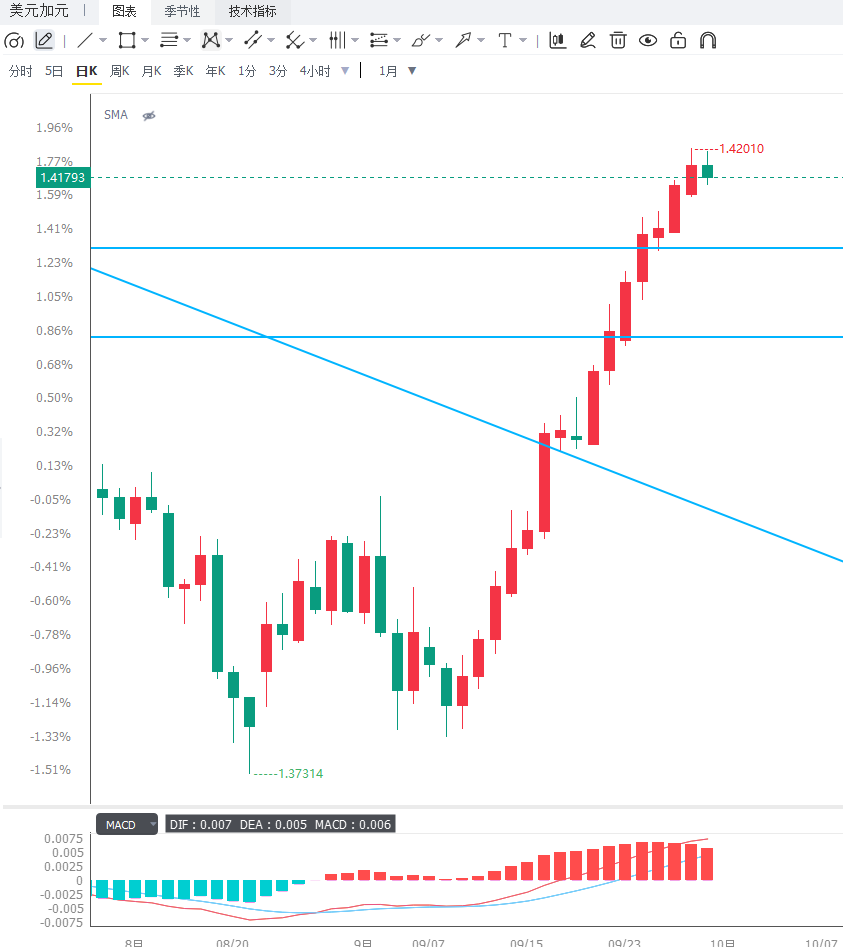 The current rise in USD/CAD is driven by a stronger US dollar, lower oil prices, and a slowdown in Canadian economic growth. The gradual recovery of energy supplies in the Middle East and the US plan to release strategic petroleum reserves further reduce the risk premium for crude oil supply, putting additional pressure on the Canadian dollar due to weaker commodity prices. In the short term, US non-farm payroll data will be a key catalyst for the direction of the US dollar and USD/CAD. If US employment remains resilient, expectations of a Fed rate hike may continue to support the US dollar, and USD/CAD may test higher levels further; if employment data weakens significantly, the US dollar may experience a phase of correction, and the exchange rate will face the risk of a high-level correction. Technically, 1.4200 is the current key breakout level, while 1.4150 to 1.4050 constitute the main support area below.
The crude oil market has recently shown clear signs of cooling. Crude oil exports from the Middle East have gradually recovered to near-normal levels, with the 10-day average export volume rebounding to approximately 17.5 million barrels per day, equivalent to about 98% of the previous benchmark level. Meanwhile, Saudi Arabia has partially resumed operation of its East-West crude oil pipeline, with its transport capacity currently restored to about half, and some tanker traffic continues in the Strait of Hormuz. This supply recovery has reduced market concerns about crude oil shortages and pushed oil prices down from previous highs. The US government also plans to release up to 40 million barrels of crude oil from its strategic petroleum reserves to alleviate domestic fuel cost pressures. Industry data shows that US crude oil inventories increased by about 1 million barrels last week, further strengthening market expectations of improved crude oil supply. Since the Canadian economy is highly susceptible to energy price fluctuations, a decline in oil prices typically weakens the performance of the commodity-linked Canadian dollar. The recent oil price correction, coupled with a stronger US dollar, has been a significant driver of the continued rise in USD/CAD. The Canadian domestic economy is also showing signs of slowing growth. Economists believe that the recovery momentum of the Canadian economy weakened in the third quarter. Preliminary data from Statistics Canada projects August GDP growth of approximately 0.2% month-over-month. While economic activity remains expanding, the pace of growth has slowed compared to previous months. This slowdown means the Bank of Canada needs to balance economic activity and inflation in its monetary policy. If economic data continues to cool, the market may lower its expectations for further tightening of Canadian policy, putting additional pressure on the Canadian dollar. Therefore, the current Canadian economic fundamentals are unlikely to offset the negative impact of falling oil prices. Meanwhile, interest rate expectations in the US continue to strengthen support for the US dollar. The market currently expects a near 68% probability of a Fed rate hike in October and approximately 95% in December. This means that the yield advantage of dollar-denominated assets remains significant, supporting demand for the dollar. The US September non-farm payroll report will be a crucial catalyst for the next phase. The market currently expects approximately 90,000 new non-farm jobs in September, with the unemployment rate remaining around 4.1%. If the actual employment data remains resilient, the market may further strengthen expectations that the Fed will maintain a restrictive monetary policy, and the dollar is likely to continue its strength; if the employment data is significantly weaker than expected, the recent dollar rally may experience a temporary correction. From a market sentiment perspective, USD/CAD has risen for eight consecutive trading days, indicating a relatively clear bullish trend. However, this continuous rise also means that short-term profit-taking is gradually accumulating. Whether the exchange rate can break through 1.4200 and further open up upward space will depend on oil price trends, US dollar interest rate expectations, and changes in Canadian economic data. It is crucial to pay close attention to whether international oil prices continue to fall. If Middle Eastern oil supplies continue to recover and the release of US strategic reserves further increases market supply, oil prices may continue to be under pressure, thus putting pressure on the Canadian dollar. Conversely, if geopolitical tensions deteriorate again and lead to energy supply disruptions, a rebound in oil prices could provide some support for the Canadian dollar and limit further upside for USD/CAD. From a daily chart perspective, USD/CAD has risen for eight consecutive trading days, with the price hovering around 1.4200, approaching a two-month high, and the overall trend remains bullish. 1.4200 is a key psychological level. If the exchange rate breaks through and holds above this level, further upside targets are 1.4250 and 1.4300. If the bulls encounter resistance near 1.4200, a short-term technical pullback is possible. On the downside, the first support level to watch is 1.4150, followed by 1.4100 and 1.4050. Due to the significant previous gains, profit-taking at higher levels should be considered on the daily chart. Looking at the 4-hour chart, USD/CAD remains in a clear upward structure, with the price consistently trading above short-term moving averages. However, the momentum may be cooling after the recent surge. If the price can stabilize above 1.4200, the 4-hour upward structure is expected to continue, potentially extending towards the 1.4250-1.4300 area. If the breakout fails and the price falls below 1.4150, a short-term consolidation at higher levels is possible, with a further test of the 1.4100 area. Overall, with oil prices remaining weak and the US dollar remaining strong, the exchange rate is expected to maintain a bullish trend in the short term, but a technical correction after continuous gains should be anticipated. The current rise in USD/CAD is driven by a stronger US dollar, lower oil prices, and a slowdown in Canadian economic growth. The gradual recovery of energy supplies in the Middle East and the US plan to release strategic petroleum reserves further reduce the risk premium for crude oil supply, putting additional pressure on the Canadian dollar due to weaker commodity prices. In the short term, US non-farm payroll data will be a key catalyst for the direction of the US dollar and USD/CAD. If US employment remains resilient, expectations of a Fed rate hike may continue to support the US dollar, and USD/CAD may test higher levels further; if employment data weakens significantly, the US dollar may experience a phase of correction, and the exchange rate will face the risk of a high-level correction. Technically, 1.4200 is the current key breakout level, while 1.4150 to 1.4050 constitute the main support area below.
- Risk Warning and Disclaimer
- The market involves risk, and trading may not be suitable for all investors. This article is for reference only and does not constitute personal investment advice, nor does it take into account certain users’ specific investment objectives, financial situation, or other needs. Any investment decisions made based on this information are at your own risk.