PCE unexpectedly weakened, but why isn't the market as excited?
2026-09-30 21:02:15
While PCE fell short of expectations across the board, ADP exceeded them, seemingly presenting a contradictory picture of "hot employment but cooling demand." However, this unexpected result wasn't entirely surprising. Previous sub-data showed that the booming stock market had already pushed up inflation through rising service prices in equity assets; and Trump's direct modification of the statistical methodology artificially cooled PCE. The market wasn't oblivious; rather, it understood the changed "yardstick"—therefore, the unexpected weakness in PCE didn't elicit widespread market excitement. 
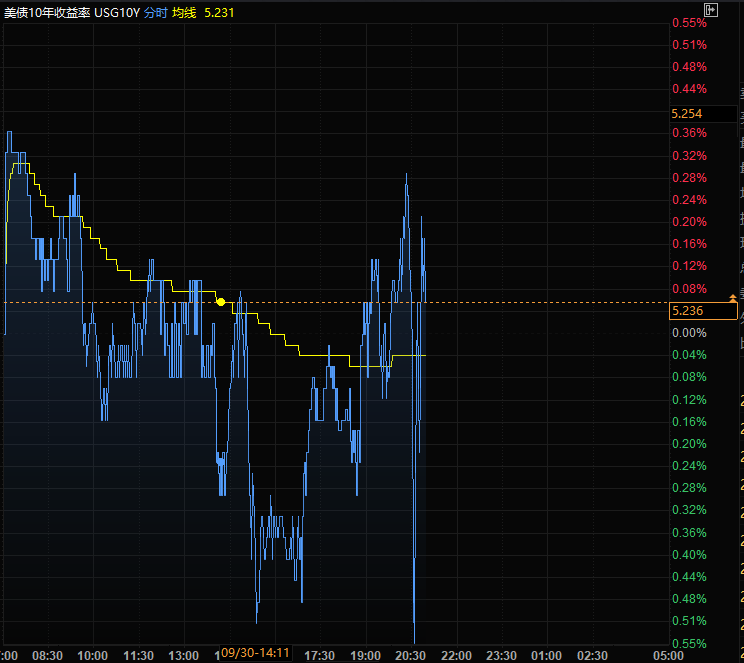 (Trip chart of the 10-year U.S. Treasury yield, source: EasyTrade) At 21:00 Beijing time, the yield on the 10-year U.S. Treasury note is currently at 5.244%.
Data Implementation: An unexpected temperature drop, but bearing the marks of measurement methods.
Overall PCE rose 3.4% year-on-year, and core PCE rose 3.0% year-on-year, both lower than the market expectations of 3.7% and 3.3% respectively, and also lower than the previous values. On a month-on-month basis, overall and core PCE recorded 0.3% and 0.2% respectively, also moderate. Although the latest reading has fallen from 3.7% in July, it has been significantly higher than the Fed's 2% target for more than five consecutive years. Beneath the surface of this apparent improvement lies a hidden agenda—this cooling is not entirely due to a decline in demand, but rather bears a distinct statistical imprint: the Trump administration revised the core measurement methodology, changing portfolio management fees from being measured by financial asset prices to being measured by hours of work and hourly income, systematically weakening the upward pressure of stock market gains on inflation. In other words, this is a cooling that has been smoothed out by a change in measurement methodology, and the market cannot simply interpret it as a dovish turn.Two sides of the data: the "self-mitigation" of inflation and the resilience of employment.
Equally intriguing as the data is the statement from New York Fed President Williams. He unusually provided a relatively precise signal, arguing that some inflationary pressures are subsiding on their own: housing prices, a major household expense, have slowed significantly; while the labor market remains solid, wage increases have not been passed on to consumer prices—providing another reason for "no further rate hikes" based on fundamentals rather than statistical metrics. The employment data paints a more intriguing picture on the other hand. The ADP report showed that private sector employment increased by 90,000 in September, higher than the expected 70,000, and the August figure was also revised upwards. The labor market's resilience against the backdrop of high energy prices and rising interest rates means that the slowdown in inflation is not at the expense of a collapse in employment. When both "softening inflation" and "solid employment" are established simultaneously, the Fed no longer needs to make a painful choice between the two—it gains more room to "hold back."Policy Balance: Communication Dilemmas and the Suspense of October
Williams' precise remarks are important precisely because the Fed's communication environment is no longer what it used to be. Current Chairman Warsh has abandoned the "verbal guidance" used by his predecessors—the kind of pre-meeting hints that shape market expectations. This approach carries the risk that if the market bets on actions officials don't intend to take, the Fed will be forced to choose between "scaring investors" and "delivering an unnecessary rate hike." Williams' remarks helped the central bank avoid this dilemma. The policy balance has subtly shifted, with market pricing for a 25 basis point rate hike on October 28th falling from about 66% on Tuesday morning to around 45%, and expectations for a further 50 basis point hike this year dropping from 55% a week ago to about 35%. With only six days until the midterm elections, a rate hike without urgent justification seems even more awkward. However, the dovish signals are not unanimous—Governor Barr, whose stance is close to Williams', stated that "further adjustments are likely still necessary," and Cook expressed a similar view, although both deliberately avoided mentioning a timetable. By the time of the October policy meeting, officials will have the September jobs report on Friday and the September inflation data to be released two weeks later, at which point the odds will truly be in their favor.Markets and Trading: Patience and Conclusion at 2019 Highs
Returning to the market itself, the lower-than-expected core PCE provided a brief respite for long-term yields, which had been suppressed by high levels for some time. Long-term interest rates have steadily climbed to a 19-year high in recent weeks, with the 10-year Treasury yield rising to 5.25% on Tuesday, significantly higher than the 5% yield when the Fed raised rates on September 16th. If yields remain high, it will further suppress borrowing and spending by businesses and households. In the short term, cooling inflation may provide temporary support for US Treasuries and gold, but directional bets should not be rushed. The statistical factors intertwined with the cooling inflation, the resilience of employment data, and the cautious maneuvering between communication and policy at the highest levels all remind us that we should not linearly extrapolate this weakness into a deep dovish shift. Patience is more valuable than direction; data is more reliable than sentiment. Before Friday's non-farm payrolls data, yields are likely to remain volatile at high levels—a rational trader's approach is not to rush to take sides, but to remain clear-headed amidst ambiguity and act decisively when certainty emerges. (Trip chart of the 10-year U.S. Treasury yield, source: EasyTrade) At 21:00 Beijing time, the yield on the 10-year U.S. Treasury note is currently at 5.244%.
- Risk Warning and Disclaimer
- The market involves risk, and trading may not be suitable for all investors. This article is for reference only and does not constitute personal investment advice, nor does it take into account certain users’ specific investment objectives, financial situation, or other needs. Any investment decisions made based on this information are at your own risk.