Why is Brent crude oil still fluctuating around $100?
2026-10-01 21:28:15
On Thursday, October 1st, a paradox emerged in the international crude oil market that warrants re-examination: Gulf oil transportation capacity has clearly recovered, but Brent crude oil continues to maintain a high risk premium. Brent crude futures are currently trading around $100 per barrel, up approximately 1.9% from the previous settlement price. The market's focus has shifted from simply whether crude oil can be transported to refined product supply, shipping costs, inventory safety margins, and the stability of energy infrastructure. 
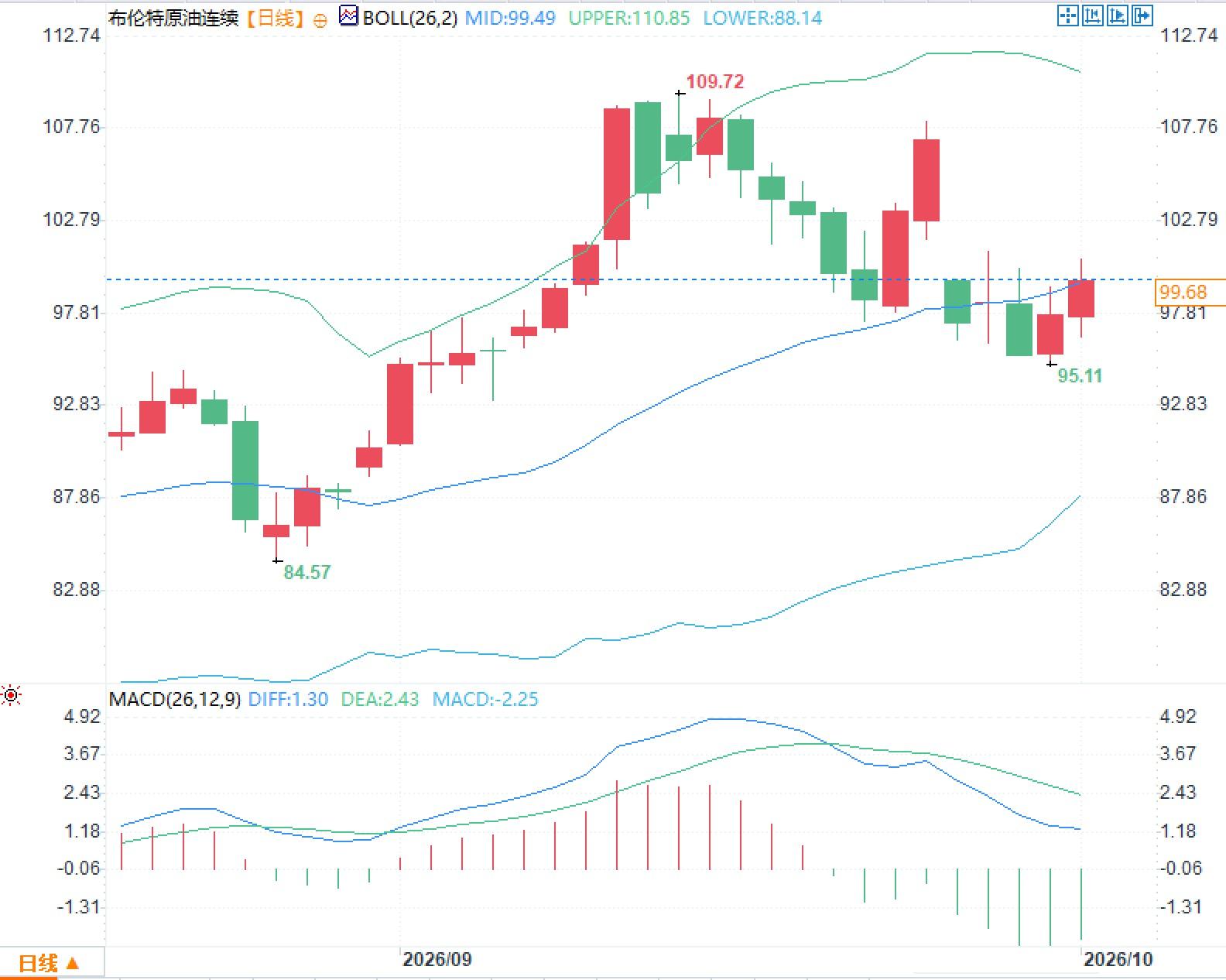 Regarding the MACD, the DIFF is approximately 1.30, the DEA is approximately 2.43, and the histogram value is approximately -2.25. The DIFF being lower than the DEA indicates that the previous upward momentum has significantly weakened, but both indicator lines remain above the zero axis. Considering the fundamentals, the core contradiction reflected by the technical indicators is consistent with the spot market: crude oil transportation is recovering relatively quickly, while the recovery speed of inventory, refining, and refined oil products is relatively lagging.
The recovery of oil production in the Gulf does not equate to a complete return to normal energy supply.
Goldman Sachs estimates that Gulf region oil exports have rebounded to 23.3 million barrels per day in the past week, roughly recovering to the 2025 average, with crude oil exports at approximately 19 million barrels per day. JPMorgan Chase, using a more conservative estimate, estimates crude oil exports at approximately 17.5 million barrels per day, recovering to about 98% of pre-conflict levels, and refined product exports at approximately 3 million barrels per day, for a total export volume of approximately 20.5 million barrels per day, equivalent to 89% of the 2025 level. The difference between the two sets of data mainly stems from statistical methods used for ship tracking, transshipment, and non-public shipping volumes, rather than a fundamental disagreement on the supply recovery trend. Their analysis shows that shipping volumes in the Strait of Hormuz have also recovered to nearly 13 million barrels per day. It is worth noting that the recovery of shipping capacity does not directly equate to the disappearance of risk. Currently, it reflects the increased adaptability of oil companies, shipowners, and port systems to a high-risk environment, including increased ship-to-ship transshipment, changes in loading schedules, and reconfiguration of export routes. In other words, the resilience of the logistics system has improved, but the risk itself is still priced into the price system.The real concern is with refined oil products, not the number of barrels of crude oil.
The most easily overlooked variable in the current oil market is the completely different supply and demand structure emerging between crude oil and refined products. Goldman Sachs estimates that diesel, gasoline, and jet fuel exports will only recover to about 50% of the 2025 average level; JPMorgan Chase estimates it at about 58%. In other words, the fact that crude oil can be loaded onto ships and shipped does not mean that refineries can simultaneously convert it into the diesel, gasoline, and jet fuel that the global market actually needs. The latest inventory data further reinforces this divergence. In the week ending September 25, U.S. commercial crude oil inventories increased by 922,000 barrels to 427.32 million barrels, but gasoline inventories decreased by 1.684 million barrels to 204.362 million barrels, distillate fuel inventories decreased by 2.251 million barrels to 105.18 million barrels, and refinery utilization rates fell to 92.5%. The increase in crude oil inventories while refined product inventories decreased simultaneously indicates that the current constraints are shifting from upstream raw material supply to refining and end-user fuel supply. This is also a key reason why Brent crude oil still carries a risk premium. Oil prices are determined not only by how much crude oil remains underground, but more importantly by how much of that crude oil can be safely transported, refined in a timely manner, and ultimately converted into deliverable refined oil products.Inventory and shipping costs are redefining risk premiums.
Inventory buffers remain thin. A September report from the U.S. Energy Information Administration estimated that global oil inventories have decreased by approximately 400 million barrels since 2026, and projected an average daily decline of about 3 million barrels in the third quarter. Even with a recovery in Gulf exports, the low inventory environment means the market lacks sufficient room to absorb shocks, thus a premium for insurance purposes will remain in spot and near-month prices. The shipping market has also not returned to normal. Recently, charter rates for Very Large Crude Carriers (VLCCs) associated with the Hormuz route approached $1.27 million per day, with secondhand VLCCs aged 5 to 10 years valued at over $150 million, while newbuilds are valued at approximately $135 million. The higher price of secondhand vessels compared to new vessels essentially means the market is paying a time premium for immediately available shipping capacity. Therefore, current Brent crude prices cannot be explained solely by the recovery rate of crude oil exports. A more complete pricing framework should consider crude oil exports, refinery operating rates, refined product inventories, vessel charter rates, and the speed of commercial inventory replenishment. A recovery in any single indicator is insufficient to represent the normalization of the entire energy supply chain.Technical analysis suggests that price and momentum are realigning.
Observing the daily chart, Brent crude oil prices are near the middle Bollinger Band, which is around 99.49, the upper band is around 110.85, and the lower band is around 88.14. After falling back from around 109.72, prices have recently been fluctuating around the middle band area, indicating that short-term prices are finding a new trading range that matches volatility. Regarding the MACD, the DIFF is approximately 1.30, the DEA is approximately 2.43, and the histogram value is approximately -2.25. The DIFF being lower than the DEA indicates that the previous upward momentum has significantly weakened, but both indicator lines remain above the zero axis. Considering the fundamentals, the core contradiction reflected by the technical indicators is consistent with the spot market: crude oil transportation is recovering relatively quickly, while the recovery speed of inventory, refining, and refined oil products is relatively lagging.Frequently Asked Questions
Question 1: Gulf crude oil exports are nearing normal, so why does Brent crude still maintain a high risk premium? Answer: Because crude oil exports are only the first link in the supply chain. Currently, the recovery rate of refined product exports is significantly lower than that of crude oil, global inventory buffers are also lower than before, and shipping insurance, chartering, and immediate shipping costs remain high. Therefore, the market still needs to reserve risk compensation for potential logistical and refining disruptions. Question 2: Why are diesel and gasoline supplies recovering more slowly than crude oil? Answer: The recovery period after refinery units are affected is usually longer than that of oil wells and port shipments. Furthermore, refined product vessels have smaller carrying capacities, a higher risk of cargo combustion, and higher unit transportation risk costs. Therefore, the recovery of crude oil exports cannot be simultaneously translated into a recovery in diesel, gasoline, and jet fuel supplies. Question 3: What is the most important data for judging whether the oil market has truly returned to normal? Answer: It is not enough to only observe Brent crude oil prices or Gulf export volumes; it is also necessary to simultaneously track global commercial inventories, refined product inventories, refinery utilization rates, Hormuz transport volumes, and Very Large Crude Carrier (VLCC) charter rates. Only when these indicators normalize simultaneously will the structural basis of the risk premium change significantly.- Risk Warning and Disclaimer
- The market involves risk, and trading may not be suitable for all investors. This article is for reference only and does not constitute personal investment advice, nor does it take into account certain users’ specific investment objectives, financial situation, or other needs. Any investment decisions made based on this information are at your own risk.