A chart shows that Capesize freight rates rebounded strongly, ending a four-day losing streak for the Baltic Dry Index.
2026-10-01 23:18:15
Latest data shows that the Baltic Dry Index (BDI) was 3140 points on October 1, 2026, up 0.87% month-on-month, marking the largest increase since September 24, 2026. Looking at the short-term charts, the BDI has seen positive growth 6 times, negative growth 5 times, and zero growth 0 times in the last 11 BDI data points. Specifically, the Panamax Freight Index (BPI) was 2379 points, down 0.21% from the previous value; the Capesize Freight Index (BCI) was 5010 points, up 1.66%; and the Supramax Freight Index (BSI) was 1794 points, down 0.17%. For detailed charts of the latest 720-day and 10-year trends of the Baltic Dry Index and its three main sub-indices, please refer to the charts specially created by FX678. 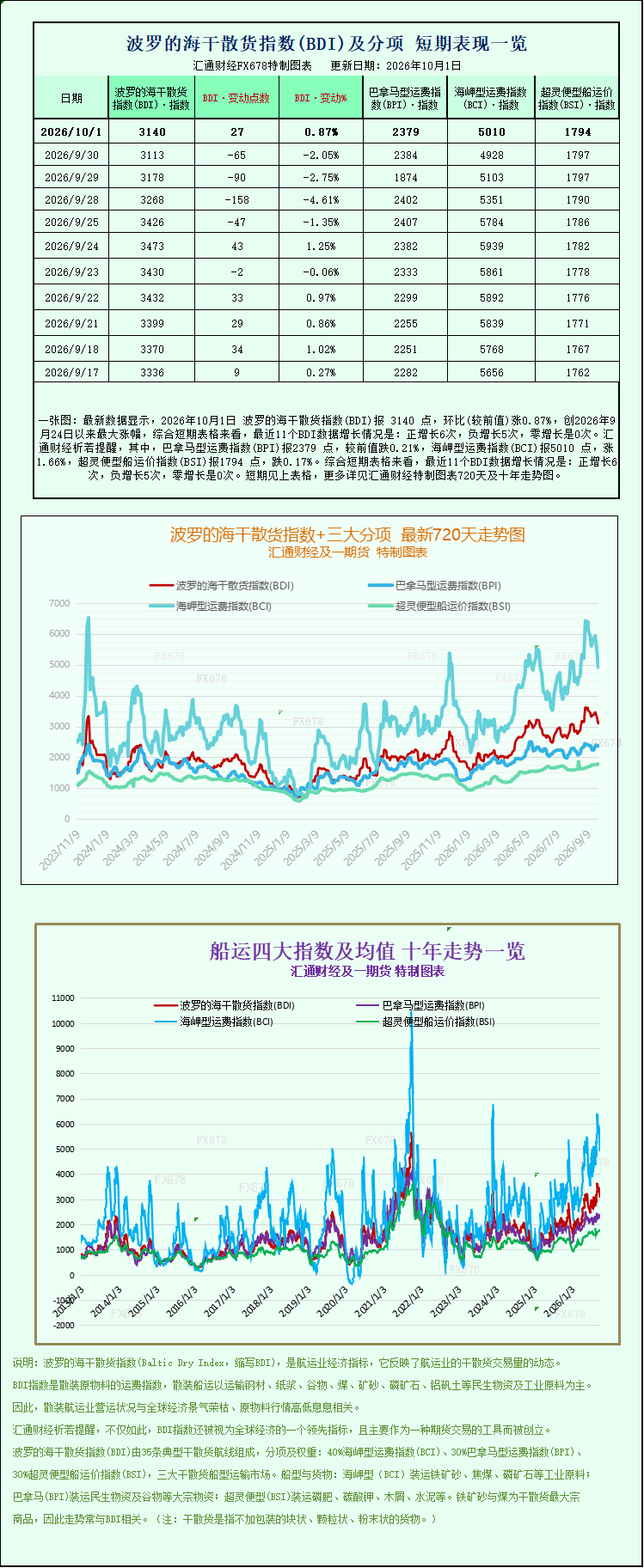 On October 1, 2026, the latest shipping market data showed that the international dry bulk shipping market experienced a phase of recovery. The Baltic Dry Index (BDI), a key indicator, ended its four-day losing streak and rebounded. This index recovery exhibited a clear structural divergence, with freight rates for large Capesize (Good Hope Size) bulk carriers strengthening significantly, completely offsetting the slight weakening pressure from Panamax and Supramax vessels, driving the overall market index recovery and demonstrating the strong resilience of demand for bulk raw materials by sea. Specific trading data showed that as of the close of trading on Thursday, October 1, the Baltic Dry Index, which reflects the freight rate trends of all types of dry bulk vessels, rose 27 points, a daily increase of 0.9%, ultimately closing at 3140 points, ending the previous continuous correction and stabilizing the recent market volatility. Looking at the performance of sub-ship type indices, the market divergence was extremely significant, with large ocean-going bulk carriers becoming the core pillar of this index rebound, while small and medium-sized vessels continued their weak adjustment trend. The Capesize index, a core indicator for very large dry bulk carriers, performed strongly, surging 82 points (1.7%) to close at 5010 points. This marks the first increase in the index in just over a week since September 24th, breaking the previous prolonged slump. In terms of actual operating revenue, 150,000-ton Capesize vessels primarily engaged in the ocean transport of bulk industrial raw materials such as iron ore and coal saw a significant increase in average daily earnings, rising by $741 per day to a current average of $41,932, substantially recovering from previous sluggish profitability. Industry analysts point out that the strong performance of Capesize freight rates is primarily due to the concentrated release of demand during the peak season for global bulk industrial raw material shipping. September and October are traditionally the peak season for global iron ore and thermal coal shipments. Recently, shipments from major iron ore exporting countries such as Brazil and Guinea have continued to rebound, leading to a surge in demand for long-distance freight on the Atlantic route. Meanwhile, the global steel industry accelerated its resumption of production during the traditional peak season, and downstream steel mills' restocking demand was strong, significantly boosting the growth of ocean-going bulk ore shipping orders. Coupled with some overseas miners locking in prices and booking shipping capacity in advance, this further tightened the capacity in the Capesize spot market, driving a rapid rebound in freight rates. In addition, the recent tight supply of effective shipping capacity in the shipping market, with some vessels experiencing reduced turnaround efficiency due to weather and route adjustments, also provided strong support for the rise in freight rates for large vessels. In stark contrast to the strong performance of Capesize vessels, the market for small and medium-tonnage dry bulk carriers continued to be under pressure, with freight rates slightly declining. Specifically, the Panamax index, which mainly transports coal and grain over short and medium distances, fell slightly by 5 points, a decrease of 0.2%, closing at 2379 points. The corresponding average daily earnings for 60,000 to 70,000-tonnage Panamax vessels decreased by $51, with the latest average daily earnings at $21,407. The Supramax index for small and medium-sized vessels also continued its weakness, falling 3 points, or 0.2%, to close at 1794. The sluggish freight rates for small and medium-sized vessels are mainly due to a relatively loose supply and demand situation in specific market segments. Compared to Capesize vessels, which focus on long-distance bulk ore transportation, Panamax and Supramax vessels primarily handle grain and small-to-medium-sized coal shipments. Currently, global grain seaborne demand has entered a period of relative stability, with grain exports from Southeast Asia and the Americas slowing down. At the same time, the supply of new capacity for small and medium-tonnage dry bulk carriers is relatively abundant, leading to intense market competition and making it difficult to generate upward pressure on prices. The overall market remains weak and volatile, a clear divergence from the strong performance of larger vessels. Looking at recent market trends, this rebound after four consecutive days of decline in the BDI index is not a comprehensive market recovery, but rather a typical structural correction, with the core driving force concentrated in the ocean shipping sector for industrial bulk raw materials. The global dry bulk shipping market is currently at a seasonal transition point, with the peak season effect gradually becoming more apparent. Industrial demand continues to provide stronger support to the shipping market, while demand for consumer goods like food remains relatively stable, leading to a divergence in the performance of large and small vessel types. Industry analysts believe that in the short term, the continued progress of land-based resumption of work and production, coupled with a steady recovery in global demand for steel and thermal power, will likely lead to a sustained release of demand for iron ore and thermal coal ocean shipping. Capesize freight rates are likely to remain high, providing continued support for the Baltic Dry Index (BDI). However, due to weak demand and ample capacity, the rebound in freight rates for medium and small vessel types is limited, and the market divergence may continue. Overall, the dry bulk shipping market in the fourth quarter is expected to maintain a high-level fluctuation and structurally strengthening trend, relying on peak industrial demand.
On October 1, 2026, the latest shipping market data showed that the international dry bulk shipping market experienced a phase of recovery. The Baltic Dry Index (BDI), a key indicator, ended its four-day losing streak and rebounded. This index recovery exhibited a clear structural divergence, with freight rates for large Capesize (Good Hope Size) bulk carriers strengthening significantly, completely offsetting the slight weakening pressure from Panamax and Supramax vessels, driving the overall market index recovery and demonstrating the strong resilience of demand for bulk raw materials by sea. Specific trading data showed that as of the close of trading on Thursday, October 1, the Baltic Dry Index, which reflects the freight rate trends of all types of dry bulk vessels, rose 27 points, a daily increase of 0.9%, ultimately closing at 3140 points, ending the previous continuous correction and stabilizing the recent market volatility. Looking at the performance of sub-ship type indices, the market divergence was extremely significant, with large ocean-going bulk carriers becoming the core pillar of this index rebound, while small and medium-sized vessels continued their weak adjustment trend. The Capesize index, a core indicator for very large dry bulk carriers, performed strongly, surging 82 points (1.7%) to close at 5010 points. This marks the first increase in the index in just over a week since September 24th, breaking the previous prolonged slump. In terms of actual operating revenue, 150,000-ton Capesize vessels primarily engaged in the ocean transport of bulk industrial raw materials such as iron ore and coal saw a significant increase in average daily earnings, rising by $741 per day to a current average of $41,932, substantially recovering from previous sluggish profitability. Industry analysts point out that the strong performance of Capesize freight rates is primarily due to the concentrated release of demand during the peak season for global bulk industrial raw material shipping. September and October are traditionally the peak season for global iron ore and thermal coal shipments. Recently, shipments from major iron ore exporting countries such as Brazil and Guinea have continued to rebound, leading to a surge in demand for long-distance freight on the Atlantic route. Meanwhile, the global steel industry accelerated its resumption of production during the traditional peak season, and downstream steel mills' restocking demand was strong, significantly boosting the growth of ocean-going bulk ore shipping orders. Coupled with some overseas miners locking in prices and booking shipping capacity in advance, this further tightened the capacity in the Capesize spot market, driving a rapid rebound in freight rates. In addition, the recent tight supply of effective shipping capacity in the shipping market, with some vessels experiencing reduced turnaround efficiency due to weather and route adjustments, also provided strong support for the rise in freight rates for large vessels. In stark contrast to the strong performance of Capesize vessels, the market for small and medium-tonnage dry bulk carriers continued to be under pressure, with freight rates slightly declining. Specifically, the Panamax index, which mainly transports coal and grain over short and medium distances, fell slightly by 5 points, a decrease of 0.2%, closing at 2379 points. The corresponding average daily earnings for 60,000 to 70,000-tonnage Panamax vessels decreased by $51, with the latest average daily earnings at $21,407. The Supramax index for small and medium-sized vessels also continued its weakness, falling 3 points, or 0.2%, to close at 1794. The sluggish freight rates for small and medium-sized vessels are mainly due to a relatively loose supply and demand situation in specific market segments. Compared to Capesize vessels, which focus on long-distance bulk ore transportation, Panamax and Supramax vessels primarily handle grain and small-to-medium-sized coal shipments. Currently, global grain seaborne demand has entered a period of relative stability, with grain exports from Southeast Asia and the Americas slowing down. At the same time, the supply of new capacity for small and medium-tonnage dry bulk carriers is relatively abundant, leading to intense market competition and making it difficult to generate upward pressure on prices. The overall market remains weak and volatile, a clear divergence from the strong performance of larger vessels. Looking at recent market trends, this rebound after four consecutive days of decline in the BDI index is not a comprehensive market recovery, but rather a typical structural correction, with the core driving force concentrated in the ocean shipping sector for industrial bulk raw materials. The global dry bulk shipping market is currently at a seasonal transition point, with the peak season effect gradually becoming more apparent. Industrial demand continues to provide stronger support to the shipping market, while demand for consumer goods like food remains relatively stable, leading to a divergence in the performance of large and small vessel types. Industry analysts believe that in the short term, the continued progress of land-based resumption of work and production, coupled with a steady recovery in global demand for steel and thermal power, will likely lead to a sustained release of demand for iron ore and thermal coal ocean shipping. Capesize freight rates are likely to remain high, providing continued support for the Baltic Dry Index (BDI). However, due to weak demand and ample capacity, the rebound in freight rates for medium and small vessel types is limited, and the market divergence may continue. Overall, the dry bulk shipping market in the fourth quarter is expected to maintain a high-level fluctuation and structurally strengthening trend, relying on peak industrial demand.
- Risk Warning and Disclaimer
- The market involves risk, and trading may not be suitable for all investors. This article is for reference only and does not constitute personal investment advice, nor does it take into account certain users’ specific investment objectives, financial situation, or other needs. Any investment decisions made based on this information are at your own risk.