Crude oil trading alert: Geopolitical tensions fuel supply concerns, pushing US crude oil back to around $93.
2026-10-02 09:56:16
On Friday during Asian trading hours, WTI crude oil maintained its strength after two consecutive days of gains in international oil prices, trading around $93 per barrel , having touched $93.5 at one point, its highest level since the start of the week's rebound. The Pentagon is considering sending a third aircraft carrier strike group and approximately 10,000 sailors and Marines to the Middle East. This military deployment, coupled with statements from the US regarding potential increased military action after the midterm elections, has reignited geopolitical risk premiums, which had previously moderated. This has led to significant market volatility: traders are simultaneously digesting the positive news of the continued recovery of Middle Eastern oil shipments while reassessing the potential impact of escalating conflict on the supply side.  Institutional views on oil prices are leaning towards cautiously bullish. ANZ analysts Brian Martin and Daniel Hines point out that after six months of destocking, global inventories are low, and the oil market is highly sensitive to any further price spikes . Investors are increasingly concerned that Iran may respond to its military buildup by attacking US assets and energy infrastructure in the region . In other words, current oil prices are likely to be amplified by any geopolitical conflict, leading to a significant increase in volatility. The latest inventory data provides a complex picture of "loose overall, tight structure." According to data from the US Energy Information Administration (EIA), US commercial crude oil inventories increased by 922,000 barrels in the week ending September 25, compared to market expectations of a decrease of approximately 300,000 barrels and a 2.969 million barrel increase the previous week; Cushing inventories also increased by 553,000 barrels. However, the focus is more on refined oil products: distillate fuel inventories decreased by approximately 2.25 million barrels, about 14% lower than the five-year average , and the tight supply of diesel and heating oil has not been alleviated by the accumulation of crude oil inventories; strategic petroleum reserves have further decreased to approximately 283.8 million barrels . This mismatch between "abundant crude oil and scarce fuel" is the core issue causing the current tightness in the refined oil market. On the policy front, the US is addressing the fuel shortage on multiple fronts. Market research indicates that the White House has requested the EU to release approximately 120 million barrels of emergency diesel reserves; otherwise, the US may impose a diesel export ban to stabilize high domestic diesel prices. US Treasury Secretary Scott Bessant has also publicly urged European partners to immediately fulfill their commitments and increase supply, stating that the US should not bear the burden of the global diesel shortage alone. In response, Societe Generale analyst Kit Juckes cautioned that the transmission chain in the refined oil market is far more complex than imagined: crude oil needs to be processed by refineries into various products such as gasoline, naphtha, paraffin, and diesel before being transported to end customers via pipelines or ships. Therefore , if an export ban is implemented, the more likely short-term result is diesel piling up in storage tanks, rather than a significant drop in diesel prices for non-US consumers , and some regions may even face supply mismatches. He further raised macroeconomic concerns: the Eurozone's September growth forecast has been revised upward to 1.3%, but if bond yields and oil prices continue to remain high, will the next update see a downward revision ? The continued rise in energy costs is eroding the optimistic assessment of growth resilience in various economies. From a global perspective, the high oil prices are transmitting outward along the chain of "energy prices → inflation expectations → central bank policy": the US dollar is supported by safe-haven demand and interest rate expectations, and major central banks are becoming more cautious in pricing their interest rate hike paths; economies that import energy are facing pressure from deteriorating terms of trade, and the process of inflation decline may be delayed. Market sentiment is generally dominated by geopolitical concerns, with data taking a backseat. Investors are currently focused on four key areas: the next move in the US-Iran situation, OPEC+ production policy statements over the weekend, the EU's response to diesel release requests, and Friday's US employment data's guidance on the demand outlook —any marginal change in any of these could trigger a rapid repricing of oil prices. From a technical perspective, WTI maintains a structurally bullish pattern on the daily chart: prices are trading above the 100-day moving average and are consistently supported by the lower Bollinger Band, maintaining a complete short-term trend structure; the RSI indicator is in the neutral zone of 51.81 , indicating that this rebound is more of a continuation of consolidation than a depletion of momentum, leaving room for further upward movement. On the resistance side, the first resistance level is at $93.70, near the Bollinger Band middle line/20-day moving average. A successful break above this level would target the upper Bollinger Band at $100.80 . On the support side, $91.80 is close to the current price and serves as the first short-term support. Stronger support lies at the lower Bollinger Band at $86.65 and the 100-day moving average around $84.65 . A significant pullback would likely test these levels. Looking at the 4-hour chart, the price is currently in an upward channel, with the price gradually rising. Momentum indicators are in a slightly bullish zone but haven't overextended, suggesting further upside potential. However, if the price fails to break through $93.70 and a bearish divergence signal appears, a short-term pullback to the $91.80 level is possible. Whether this support holds will be crucial – the key level for a breakout or pullback depends on whether geopolitical news continues to provide upward momentum for oil prices.
 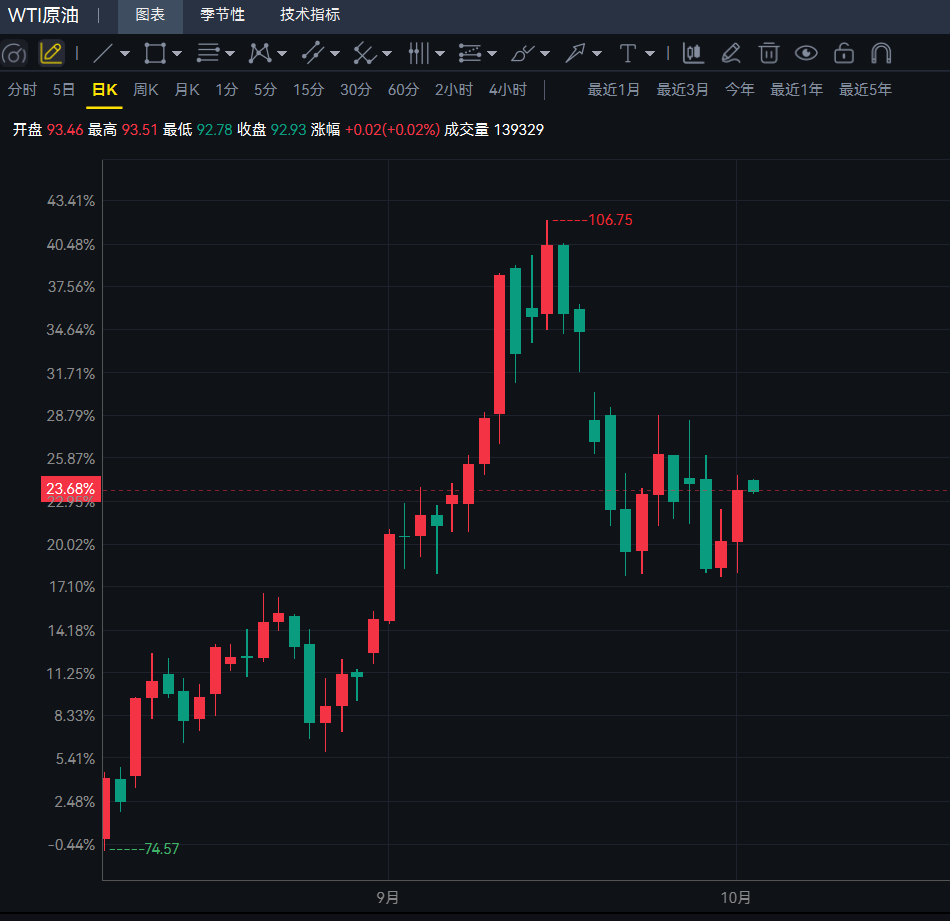 Editor's Summary : Overall, WTI oil prices are driven by both "the return of geopolitical risk premiums" and "structural tightness in refined oil products." The US's deployment of additional carrier strike groups has reignited concerns about supply disruptions, while low US diesel inventories and the EU's reserve release predicament provide fundamental support, making the short-term bullish trend in the oil market relatively clear. However, risks cannot be ignored: US crude oil inventories have been accumulating, demand resilience will be tested by Friday's non-farm payroll data, and if geopolitical tensions ease, the previously rapidly accumulated gains could face downward pressure. Looking ahead, the $93.70 level will determine the short-term direction—a firm hold above this level could lead to a move above $100, while a pullback will require monitoring the support levels at $91.80 and $86.65. On the opportunity side, the widening price spread between diesel and crude oil, and the refined oil price volatility caused by the EU reserve release negotiations, provide structural trading opportunities. On the risk side, the recurring tensions between the US and Iran, unexpected OPEC+ policies, and the negative impact of high oil prices on macroeconomic growth remain significant factors.
Institutional views on oil prices are leaning towards cautiously bullish. ANZ analysts Brian Martin and Daniel Hines point out that after six months of destocking, global inventories are low, and the oil market is highly sensitive to any further price spikes . Investors are increasingly concerned that Iran may respond to its military buildup by attacking US assets and energy infrastructure in the region . In other words, current oil prices are likely to be amplified by any geopolitical conflict, leading to a significant increase in volatility. The latest inventory data provides a complex picture of "loose overall, tight structure." According to data from the US Energy Information Administration (EIA), US commercial crude oil inventories increased by 922,000 barrels in the week ending September 25, compared to market expectations of a decrease of approximately 300,000 barrels and a 2.969 million barrel increase the previous week; Cushing inventories also increased by 553,000 barrels. However, the focus is more on refined oil products: distillate fuel inventories decreased by approximately 2.25 million barrels, about 14% lower than the five-year average , and the tight supply of diesel and heating oil has not been alleviated by the accumulation of crude oil inventories; strategic petroleum reserves have further decreased to approximately 283.8 million barrels . This mismatch between "abundant crude oil and scarce fuel" is the core issue causing the current tightness in the refined oil market. On the policy front, the US is addressing the fuel shortage on multiple fronts. Market research indicates that the White House has requested the EU to release approximately 120 million barrels of emergency diesel reserves; otherwise, the US may impose a diesel export ban to stabilize high domestic diesel prices. US Treasury Secretary Scott Bessant has also publicly urged European partners to immediately fulfill their commitments and increase supply, stating that the US should not bear the burden of the global diesel shortage alone. In response, Societe Generale analyst Kit Juckes cautioned that the transmission chain in the refined oil market is far more complex than imagined: crude oil needs to be processed by refineries into various products such as gasoline, naphtha, paraffin, and diesel before being transported to end customers via pipelines or ships. Therefore , if an export ban is implemented, the more likely short-term result is diesel piling up in storage tanks, rather than a significant drop in diesel prices for non-US consumers , and some regions may even face supply mismatches. He further raised macroeconomic concerns: the Eurozone's September growth forecast has been revised upward to 1.3%, but if bond yields and oil prices continue to remain high, will the next update see a downward revision ? The continued rise in energy costs is eroding the optimistic assessment of growth resilience in various economies. From a global perspective, the high oil prices are transmitting outward along the chain of "energy prices → inflation expectations → central bank policy": the US dollar is supported by safe-haven demand and interest rate expectations, and major central banks are becoming more cautious in pricing their interest rate hike paths; economies that import energy are facing pressure from deteriorating terms of trade, and the process of inflation decline may be delayed. Market sentiment is generally dominated by geopolitical concerns, with data taking a backseat. Investors are currently focused on four key areas: the next move in the US-Iran situation, OPEC+ production policy statements over the weekend, the EU's response to diesel release requests, and Friday's US employment data's guidance on the demand outlook —any marginal change in any of these could trigger a rapid repricing of oil prices. From a technical perspective, WTI maintains a structurally bullish pattern on the daily chart: prices are trading above the 100-day moving average and are consistently supported by the lower Bollinger Band, maintaining a complete short-term trend structure; the RSI indicator is in the neutral zone of 51.81 , indicating that this rebound is more of a continuation of consolidation than a depletion of momentum, leaving room for further upward movement. On the resistance side, the first resistance level is at $93.70, near the Bollinger Band middle line/20-day moving average. A successful break above this level would target the upper Bollinger Band at $100.80 . On the support side, $91.80 is close to the current price and serves as the first short-term support. Stronger support lies at the lower Bollinger Band at $86.65 and the 100-day moving average around $84.65 . A significant pullback would likely test these levels. Looking at the 4-hour chart, the price is currently in an upward channel, with the price gradually rising. Momentum indicators are in a slightly bullish zone but haven't overextended, suggesting further upside potential. However, if the price fails to break through $93.70 and a bearish divergence signal appears, a short-term pullback to the $91.80 level is possible. Whether this support holds will be crucial – the key level for a breakout or pullback depends on whether geopolitical news continues to provide upward momentum for oil prices. Editor's Summary : Overall, WTI oil prices are driven by both "the return of geopolitical risk premiums" and "structural tightness in refined oil products." The US's deployment of additional carrier strike groups has reignited concerns about supply disruptions, while low US diesel inventories and the EU's reserve release predicament provide fundamental support, making the short-term bullish trend in the oil market relatively clear. However, risks cannot be ignored: US crude oil inventories have been accumulating, demand resilience will be tested by Friday's non-farm payroll data, and if geopolitical tensions ease, the previously rapidly accumulated gains could face downward pressure. Looking ahead, the $93.70 level will determine the short-term direction—a firm hold above this level could lead to a move above $100, while a pullback will require monitoring the support levels at $91.80 and $86.65. On the opportunity side, the widening price spread between diesel and crude oil, and the refined oil price volatility caused by the EU reserve release negotiations, provide structural trading opportunities. On the risk side, the recurring tensions between the US and Iran, unexpected OPEC+ policies, and the negative impact of high oil prices on macroeconomic growth remain significant factors.
- Risk Warning and Disclaimer
- The market involves risk, and trading may not be suitable for all investors. This article is for reference only and does not constitute personal investment advice, nor does it take into account certain users’ specific investment objectives, financial situation, or other needs. Any investment decisions made based on this information are at your own risk.